Avionics & Guidance, Navigation, and Control
Modern research, development, and engineering in Avionics and Guidance, Navigation, and Control (GN&C) focuses on creating resilient, adaptable, and highly autonomous flight architectures capable of operating across subsea, atmospheric, and deep-space domains. At the foundational layer, open-architecture avionics and high-performance embedded computing (HPEC) decouple underlying processing hardware from flight-software iterations.
Open-Architecture Avionics & Modular Computing
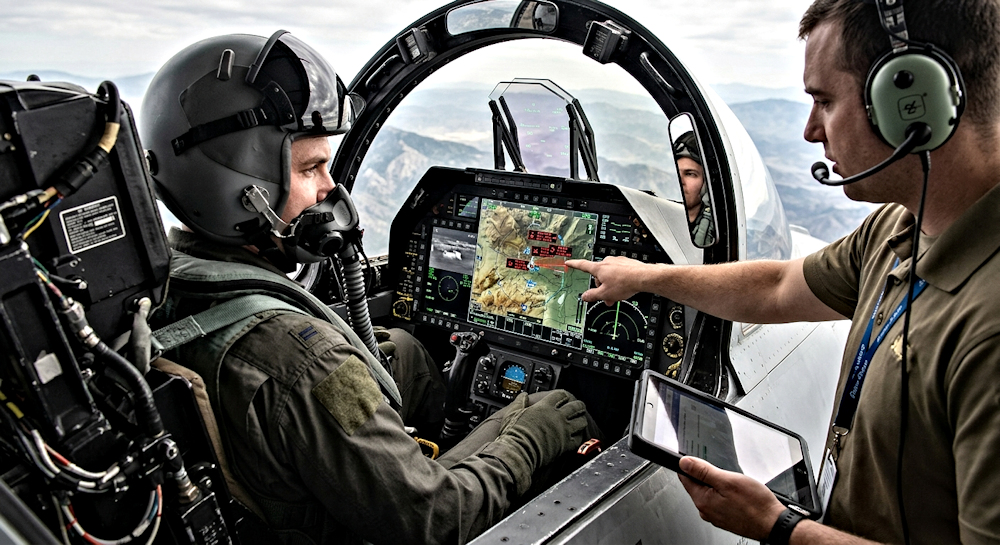
Modern flight architectures rely heavily on open, modular hardware and software frameworks that decouple the underlying processing units from software development cycles. By standardizing these operational interfaces, platforms can deploy over-the-air threat library refreshes, algorithm updates, and system patches without triggering lengthy, full-scale airworthiness re-certification. At the core of this capability are High-Performance Embedded Computing units that ingest and process multi-spectral sensor feeds—fusing active electronically scanned radar, electro-optical and infrared imaging, electronic warfare diagnostics, and secure datalinks into a single, automated situational awareness picture for human operators or onboard mission managers.
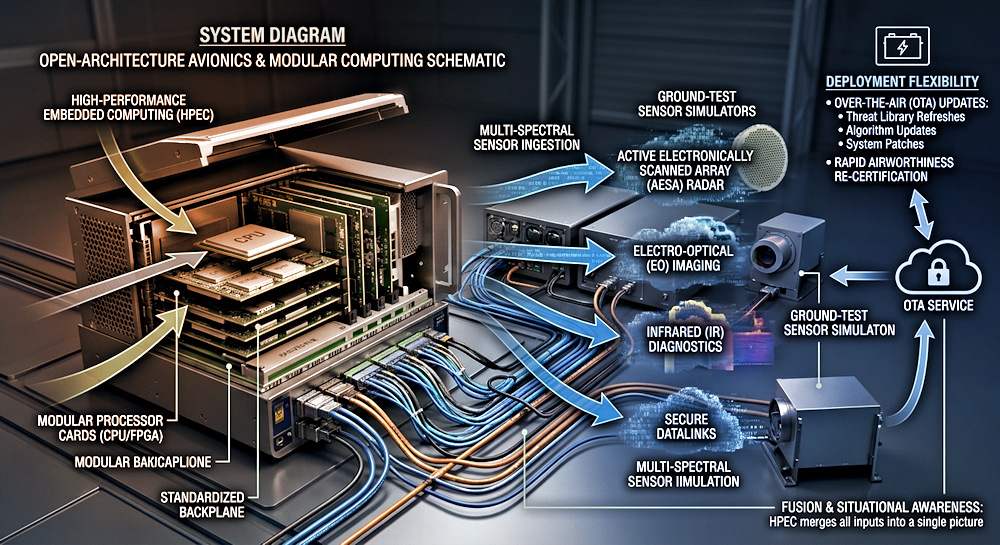
The shift toward Open-Architecture Avionics and Modular Computing represents a fundamental transition in aerospace engineering, moving the industry away from monolithic, single-purpose "stovepipe" systems toward software-defined, hardware-decoupled processing fabrics.
Key Technical Pillars
- Modular Hardware & Interoperable Standards: Systems utilize standardized slot-profile chassis, high-speed backplanes, and universal form factors. Hardware modules—whether for signal processing, image rendering, or encryption—can be swapped out or upgraded mechanically and electrically without re-engineering the surrounding enclosure.
- Decoupled Software & Containerization: By utilizing abstraction layers and standardized Application Programming Interfaces (APIs), mission software is insulated from the physical compute hardware. Embedded software often runs in isolated, flight-certified containers or via microservices, allowing individual algorithms to update independently.
- High-Performance Embedded Computing (HPEC): Modern processing units combine multi-core CPUs, high-throughput GPUs, and reconfigurable Field Programmable Gate Arrays (FPGAs). These units process terabytes of heterogeneous sensor data in real time, executing complex sensor fusion directly at the edge.
Recent Innovations in Open Avionics
- Airworthiness & Delta-Certification: Dynamic memory partitioning and deterministic real-time operating system (RTOS) virtualization enable updates to non-safety-critical software (such as threat libraries or electronic warfare algorithms) without triggering a costly full-scale re-certification of flight-critical control systems.
- High-Speed Optical Backplanes: The integration of high-bandwidth optical interconnects within embedded chassis drastically increases data throughput for multi-spectral sensor feeds while eliminating electromagnetic interference (EMI) and reducing overall wiring weight.
- Advanced Thermal Management: Conduction-cooled, liquid-assisted, and vapor-chamber chassis designs dissipate the extreme thermal loads generated by dense, high-performance GPUs operating in unpressurized or high-temperature compartments.
- Neuromorphic & Edge AI Processing: Low-power neural network accelerators integrated onto modular cards enable real-time target recognition, autonomous sensor management, and signal classification directly on board, reducing reliance on off-board datalinks.
Strategic & Operational Advantages
- Accelerated Field Updates: Traditionally, integrating a new sensor or threat countermeasure required years of flight-testing and systemic re-verification. Open software frameworks allow defense forces to push software tweaks, countermeasure updates, or tactical network protocols over-the-air in days or hours.
- Vendor Agnosticism & Cost Control: By adhering to consensus-driven, open interface specifications, operators avoid proprietary vendor lock-in. Individual sub-components can be competitively sourced, upgraded, or repaired by third parties, significantly lowering long-term lifecycle sustainment costs.
- Multi-Sensor Fusion at the Edge: Raw data streams from Radar, Electro-Optical/Infrared (EO/IR), Signals Intelligence (SIGINT), and Tactical Datalinks are combined directly inside the HPEC unit. Rather than forcing operators to monitor separate screens, open computing platforms merge these inputs into a single cohesive situational picture, drastically reducing cognitive workload.
Resilient Positioning, Navigation, and Timing (Assured PNT)
To operate effectively in contested environments where satellite-based GPS signals are actively jammed, spoofed, or rendered unavailable, advanced navigation architectures depend on multi-sensor fusion. These systems combine high-grade inertial measurement units with alternative positioning streams, including vision-aided odometry, optical flow, terrain contour matching, celestial tracking, magnetic field mapping, and signals-of-opportunity processing. Advanced state estimation algorithms, such as Extended or Unscented Kalman Filters and factor-graph smoothers, continually buffer and process these inputs to bound sensor drift over prolonged outages. On the physical sensor frontier, research into micro-positioning hardware—including chip-scale atomic gyroscopes, optical atomic clocks, cold-atom sensors, and shock-hardened Micro-Electro-Mechanical Systems—provides self-contained, completely un-jammable navigation over long operational durations.
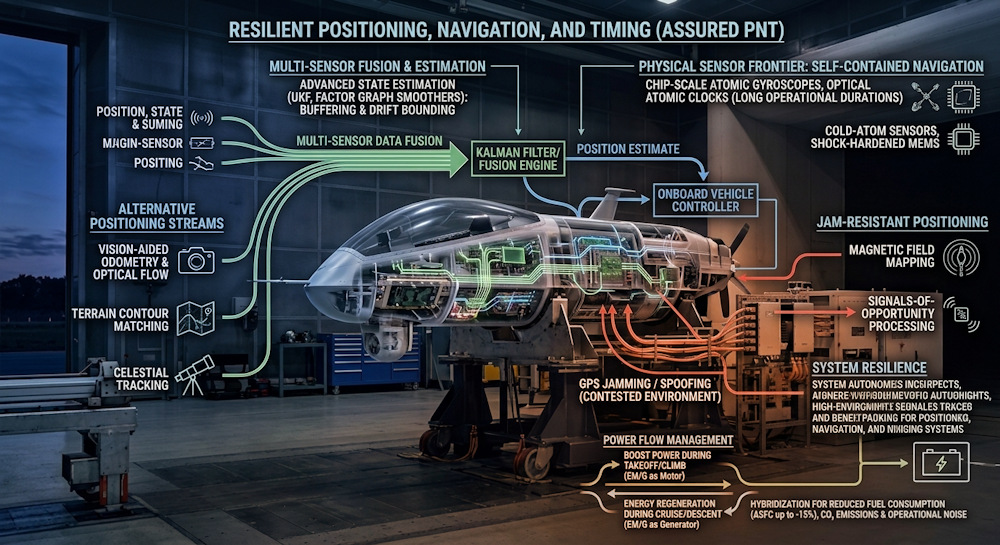
Resilient Positioning, Navigation, and Timing (Assured PNT) represents a fundamental transition from single-source satellite reliance to multi-layered, un-jammable navigation architectures. By integrating high-speed edge computing with advanced physics-based sensors, these architectures ensure continuous operational capability even under heavy electronic warfare, satellite degradation, or complete signal denial.
Next-Generation Sensor Integration
- Signals-of-Opportunity (SoOP) Exploitation: Software-defined receivers passively intercept non-navigational ambient radio frequencies—such as low-Earth-orbit broadband satellites, commercial cellular networks, digital television broadcasts, and high-frequency communications. By measuring phase and Doppler shifts across these diverse signals, platforms resolve accurate 3D positions without transmitting trackable signals.
- AI-Enhanced Magnetic & Gravity Field Navigation: Highly sensitive magnetometer arrays compare ambient localized magnetic anomalies against high-resolution geophysical reference maps. Modern neural networks filter out the platform's own stray electromagnetic noise (from engines and onboard electronics) in real time, transforming Earth's magnetic field into an un-jammable, space-independent global map.
- Optical Flow & Vision-Assisted Terrain Odometry: High-frame-rate infrared and electro-optical cameras continuously track surface features and terrain profiles beneath the platform. Advanced computer vision algorithms compare imagery against onboard satellite maps or ground feature models, bounding inertial drift even over featureless terrain or open water.
- Automated All-Day Celestial Tracking: Compact, wide-field optical sensors automatically identify and track stars, planet edges, and artificial low-orbit objects during both day and night. Integrated star-tracker software continuously cross-references these visual bearings against precise onboard astronomical tables to calculate absolute latitude and longitude.
Quantum & Physics-Frontier Hardware
- Deployable Cold-Atom Interferometers: Ultra-cold atomic vapors—cooled via lasers to near absolute zero—serve as ultra-sensitive quantum accelerometers and gyroscopes. By measuring wave interference patterns in atom clouds, these quantum inertial sensors achieve drift rates orders of magnitude lower than conventional optical gyroscopes, allowing unguided long-range navigation over weeks without external updates.
- Miniaturized Optical Atomic Clocks: Transitioning from microwave-frequency standards to optical-laser transitions has dramatically improved timing stability. Micro-scale optical clocks deliver sub-nanosecond timing holdover over days of satellite disconnection. This extreme precision keeps high-speed datalinks, radar phase-matching, and encrypted communications fully synchronized.
- Shock-Hardened Tactical MEMS: Micro-Electro-Mechanical Systems (MEMS) inertial sensors are now constructed using high-aspect-ratio silicon and piezoelectric architectures. Micro-machined ring resonators and vacuum-packaged inertial cells withstand high-G launch impacts and severe vibrational environments while maintaining low drift rates.
Algorithmic State Estimation & Sensor Fusion
- Factor-Graph Optimization & Smoothing: Moving beyond traditional Kalman filters, modern navigation computers use factor graphs to re-evaluate historical sensor measurements over sliding time windows. This prevents erroneous or spoofed data points from corrupting the overall navigation solution, rapidly restoring truth-state tracking when individual sensors recover.
- Integrity-Aware Zero-Trust Fusion: Advanced state estimators assign dynamic confidence weights to every incoming data stream based on real-time anomaly detection. If a satellite or radio feed begins exhibiting spoofing characteristics, subtle clock jumps, or unnatural Doppler shifts, the fusion engine instantly isolates and drops the compromised stream without disrupting the master navigation output.
AI-Driven Adaptive Control & Autonomous Teaming
The integration of artificial intelligence, machine learning, and safe reinforcement learning into flight control loops enables real-time, adaptive stability management. When an aircraft experiences structural damage, battle stress, or violent aerodynamic shifts, these smart control laws automatically detect the anomaly and reconfigure control surfaces to maintain steady flight. Scaling beyond individual vehicles, autonomous command and control frameworks utilize dynamic pathfinding and statistical search algorithms to manage swarms of uncrewed collaborative assets in communications-degraded environments. To ensure these autonomous systems operate predictably alongside piloted aircraft, safety-critical software envelopes—such as Automatic Ground Collision Avoidance Systems—are hardcoded into the flight logic to enforce strict airworthiness boundaries.
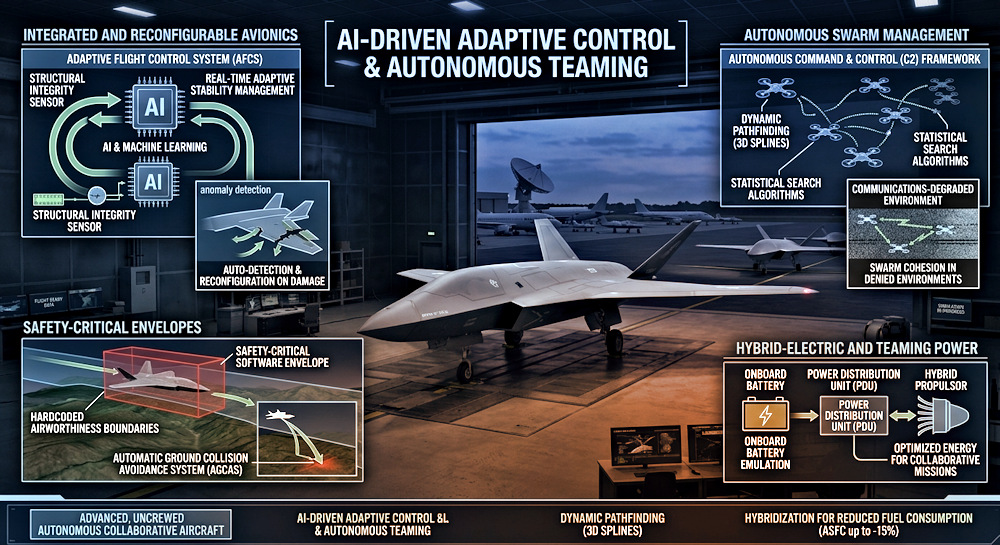
AI-Driven Adaptive Control & Autonomous Teaming marks the operational shift from pre-programmed autopilot systems to intelligent, self-healing, and collaborative flight platforms. By coupling deep reinforcement learning (RL) with real-time state estimation, flight software is transitioning from static deterministic rules to dynamic, context-aware decision engines capable of surviving extreme structural or operational failures.
Next-Generation Adaptive Control Laws
- Online Physics-Informed Neural Adaptation: Rather than relying on static aerodynamic look-up tables, modern control loops continuously run physics-informed neural networks (PINNs) alongside flight dynamics engines. These models estimate physical parameters—such as shifted centers of gravity or missing wing surfaces—and adapt control surface deflection rates within milliseconds to compensate for battle damage.
- Sim-to-Real Differentiable Policy Transfer: Advanced reinforcement learning utilizes differentiable simulation environments to pre-train control policies across millions of extreme failure states. When deployed on physical hardware, these policies perform rapid zero-shot adaptation, handling unexpected wind shear, asymmetric payload drops, or mechanical jammed actuators without requiring offline retraining.
- Reconfigurable Control Allocation: When a primary control surface (such as an aileron) is lost, adaptive control software mathematically redistributes control torque to alternative surfaces—such as asymmetric engine thrust, flaps, or airbrakes—to maintain stable attitude control.
Distributed Autonomous Teaming & Swarming
- Decentralized Task Allocation via Factor Graphs: For multi-agent swarms operating in communications-denied environments, platforms rely on consensus-based market mechanisms and factor graph optimization. Aircraft autonomously bid on targets, intelligence-gathering paths, or decoy assignments without requiring a central command node, ensuring the team functions continuously even if individual units are destroyed.
- Asymmetric Communications-Degraded Routing: Rather than depending on continuous high-bandwidth datalinks, swarmed assets share minimal state vectors (e.g., small localized metadata packets) over ad-hoc directional networks. Dynamic pathfinding algorithms predict peer trajectories across temporary radio blackouts, allowing units to execute complex multi-ship maneuvers autonomously until connection is restored.
- Heterogeneous Manned-Unmanned Teaming (MUM-T): Autonomous "collaborative combat platforms" serve as force multipliers alongside human pilots. The human operator functions as a high-level mission manager—issuing intent-based commands (e.g., "suppress enemy radar in sector B")—while onboard AI autonomously plans low-level routes, manages sensor payloads, and executes tactical maneuvers.
Safety Envelopes & Certification Boundaries
- Deterministic Safety Shields (Simplex Architectures): To bridge the gap between unpredictable neural network outputs and strict airworthiness certification, flight control computers employ run-time assurance (RTA) frameworks. A verified, deterministic mathematical supervisor monitors the AI's commands; if the learning policy outputs a maneuver that exceeds structural limits or approaches terrain, the safety shield instantly overrides the AI and returns the platform to a safe flight envelope.
- Next-Gen Auto-GCAS and Collision Avoidance: Automatic Ground Collision Avoidance Systems (Auto-GCAS) and airborne detect-and-avoid algorithms operate as immutable, hardcoded logic layers. Using predictive trajectory models, these safety nets take control at the absolute limit of safety to pull the aircraft away from terrain or mid-air obstacles, regardless of user inputs or high-level mission goals.
- Formal Verification of Neural Networks: Computer scientists use mathematical verification tools to prove bounded behavior in deep neural networks before flight testing. By verifying that an AI model will never output erratic control commands within defined operational bounds, engineers can satisfy airworthiness authorities without sacrificing machine learning agility.
Airspace Integration & Airborne Collision Avoidance
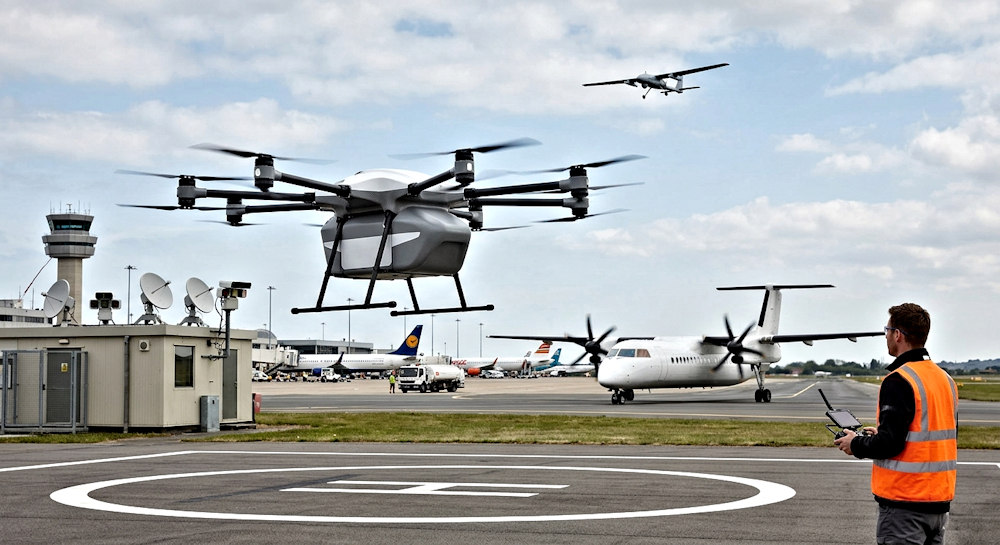
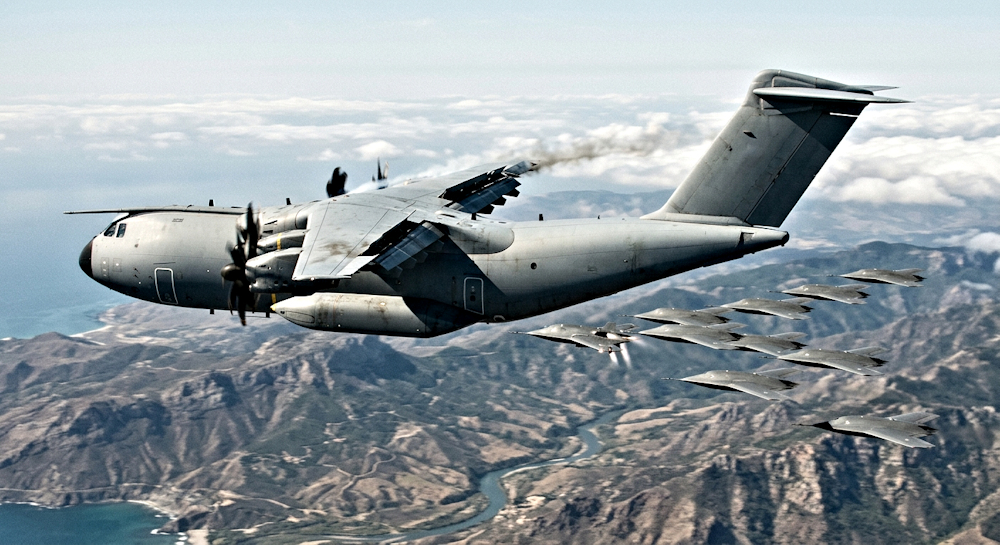
Safely integrating autonomous platforms, uncrewed aircraft systems, and advanced air mobility concepts into shared civil and military airspace requires probabilistic traffic management. Next-generation collision avoidance systems use dynamic programming and Markov decision processes to analyze potential trajectory conflicts in real time, calculating optimal, maneuver-compliant escape paths. By coupling these onboard collision avoidance algorithms with ground-based sense-and-avoid surveillance networks, autonomous platforms can seamlessly navigate complex, highly populated airspaces without relying on human air traffic controllers for separation management.
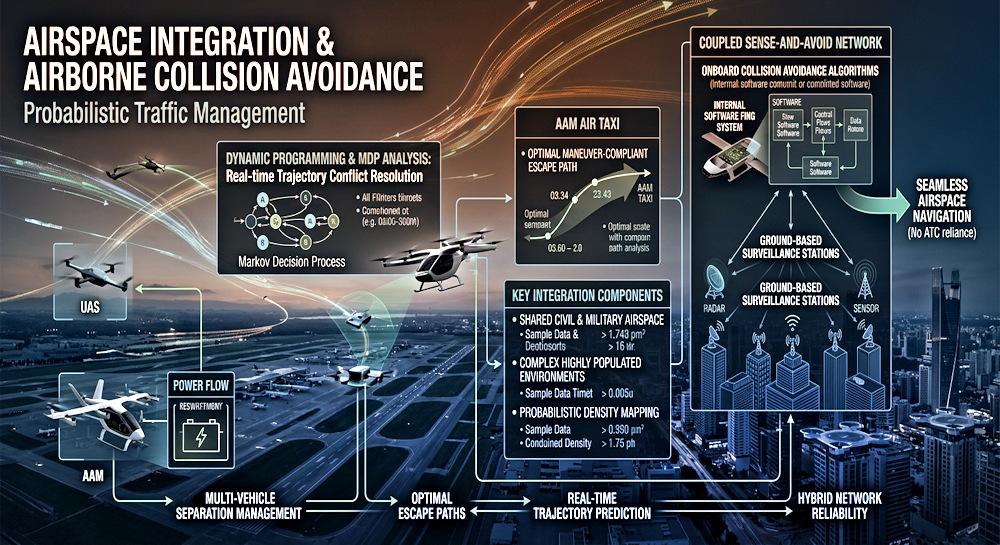
Airspace Integration and Airborne Collision Avoidance mark a massive shift from legacy human-centric Air Traffic Control (ATC) toward fully automated, high-density traffic management architectures. Integrating high volumes of uncrewed aircraft systems (UAS), urban air mobility (AAM) platforms, and traditional piloted aircraft requires transitioning from deterministic separation rules to probabilistic, real-time trajectory optimization.
Algorithmic Avoidance & Decision Theory
- Markov Decision Process (MDP) Logic: Modern collision avoidance engines model the surrounding airspace as a Partially Observable Markov Decision Process (POMDP). Rather than relying on rigid static rules, these systems run pre-computed offline optimizations coupled with real-time state estimates, continuously calculating the mathematical expected value of various escape maneuvers while accounting for intruder trajectory uncertainties.
- Multi-Dimensional Maneuvering: Legacy collision avoidance systems issue advisories strictly along the vertical axis. Next-generation algorithms natively integrate both horizontal and vertical escape vectors, allowing smaller uncrewed platforms with limited climb/descent performance to execute coordinated bank angles, speed changes, or tight turns.
- Neural Network Compression: Because calculating high-dimensional MDP decision tables requires vast offline memory, modern algorithms use compressed deep neural networks (DNNs) to store multi-agent policy tables. Lightweight, onboard edge chips can query these neural networks in microseconds, drastically cutting computing overhead without degrading trajectory safety margins.
Ground-Based & Distributed Surveillance Networks
- Uncrewed Traffic Management (UTM) Ecosystems: Low-altitude airspace management relies on digital UTM networks that act as automated air traffic control. UTM platforms continuously ingest intent data, flight plans, and geofencing boundaries, automatically calculating dynamic route corridors and issuing strategic deconfliction adjustments long before two platforms enter physical proximity.
- Ground-Based Augmentation & Detect-and-Avoid (DAA): Ground-based sensor grids—combining phased-array radar, electro-optical camera clusters, and acoustic tracking nodes—transmit continuous local traffic pictures to airborne units via low-latency datalinks. This allows lightweight uncrewed assets without heavy onboard radar payloads to spot uncooperative (non-transponder) intruders reliably.
- Decentralized Multi-Agent Coordination: In dense low-altitude urban airspaces where ground infrastructure coverage may be shadowed by buildings, autonomous aircraft establish peer-to-peer mesh networks. Platforms cross-share broadcast intent vectors, using distributed consensus algorithms to resolve conflicts locally without needing a central controller.
Trajectory Prediction & Strategic Deconfliction
- 4D Trajectory-Based Operations (TBO): Airspace management is shifting from spatial-only separation to precise 4D trajectory envelopes (latitude, longitude, altitude, and time). Aircraft negotiate tight temporal waypoints down to the second, allowing heavily crowded low-altitude corridors to pack platforms closely together while virtually eliminating mid-air intersection risks.
- Dynamic Geofencing & Contingency Management: When bad weather, microbursts, or system degradations occur, onboard algorithms dynamically calculate temporary "no-go" safety volumes (geofences) around the hazard. Trajectory managers dynamically re-route surrounding autonomous traffic around these pop-up airspaces without human operator intervention.
Interceptor Guidance, Hypersonics & Spaceborne Avionics
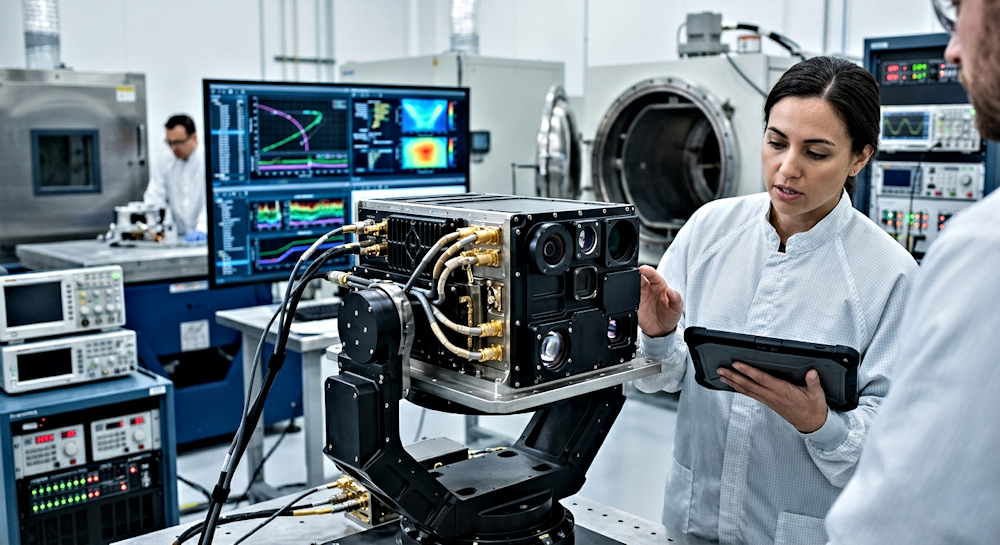
High-consequence flight regimes—such as kinetic interceptors, hypersonic glide vehicles, and long-duration space probes—demand avionics that perform under extreme physical, thermal, and radiological stress. Terminal guidance systems for high-speed interceptors utilize six-degree-of-freedom simulations, real-time seeker fusion, and rapid-response control actuation to counter maneuvering ballistic or hypersonic threats. For deep-space exploration, spaceborne avionics feature radiation-hardened computing architectures with multi-redundant processing buses and self-healing voting logic to isolate hardware faults. Paired with autonomous optical navigation algorithms, these systems execute precise asteroid impacts, planetary atmospheric entries, and autonomous landings without needing real-time commands from Earth.
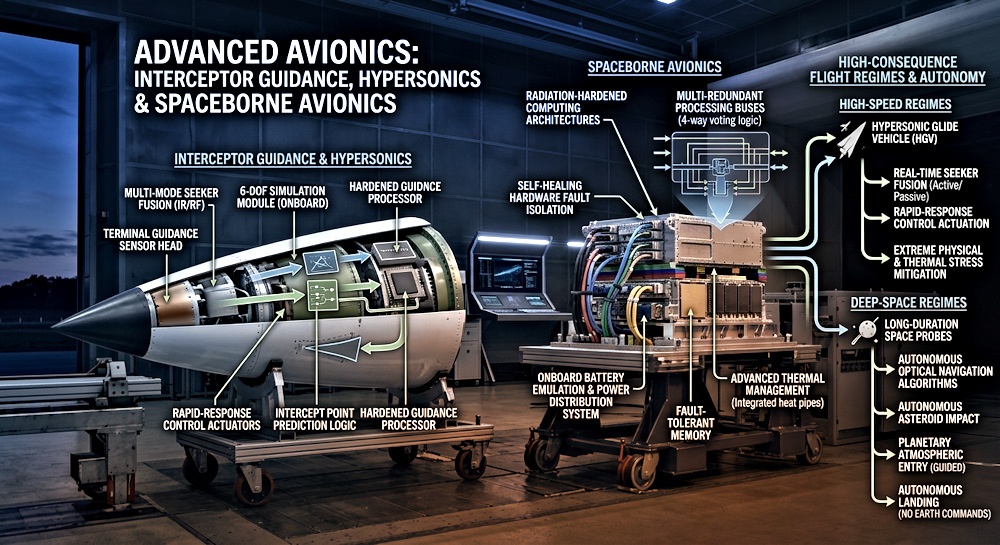
Interceptor Guidance, Hypersonic Flight, and Spaceborne Avionics represent the frontier of extreme-environment processing. Operating in these regimes requires control loops that survive severe kinetic shock, intense thermal plasma, and high radiation levels while making real-time trajectory decisions at extreme velocities.
High-Speed Interceptor Guidance & Reactive Actuation
- Zero-Effort-Miss (ZEM) & Zero-Effort-Velocity (ZEV) Feedback: Modern kinetic interceptors utilize advanced 6-DOF predictive control algorithms. Rather than simply reacting to target movement, the guidance computer continuously projects the future miss distance and calculates optimal thrust or roll maneuvers, minimizing energy consumption during high-G evasive maneuvers.
- Rapid Divert and Attitude Control Systems (DACS): Fast-reacting pulse-rocket thrusters and high-bandwidth electromechanical actuators provide quick response times. Guidance computers cycle control surface deflections and thruster bursts in milliseconds to counter erratic target maneuvers right up to the point of impact.
- Multi-Spectral Seeker Fusion: Terminal interceptors combine dual-mode imaging infrared (IIR) sensors, millimeter-wave (MMW) radar, and optical tracking. Advanced edge processors fuse these feeds in real time, filtering out deployable decoys, ground clutter, and energetic flares to maintain a lock on the target's physical structure.
Hypersonic Flight & Plasma-Penetrating Avionics
- Reinforcement Meta-Learning & Neural Predictor-Correctors: Hypersonic glide vehicles experience non-linear aerodynamic forces, atmospheric shifts, and surface ablation. Real-time reentry guidance algorithms use deep neural networks and online predictor-corrector models to dynamically reshape flight trajectories on the fly, keeping the platform within strict dynamic pressure, structural load, and thermal heating limits.
- Plasma-Sheath-Resistant Communications & Sensing: High Mach speeds ionize surrounding air molecules, forming a dense plasma shield that blocks standard RF signals. Modern avionics overcome this blackout by shifting to higher-frequency optical laser communications, adaptive high-power C-band/X-band beams, and acoustic/magnetic surface sensing to maintain telemetry and tracking.
- Active Thermal-Aware Computing: Extreme skin temperatures transfer heat inward toward processing bays. Avionics chassis feature embedded vapor-chamber heat pipes, Phase-Change Materials (PCM), and high-temperature gallium-nitride (GaN) electronics that maintain clock speeds and system stability without bulky external cooling loops.
Radiation-Hardened Spaceborne Avionics & Autonomous Deep-Space Navigation
- Fault-Tolerant RISC-V & Multi-Core Space Processing: Next-generation spaceflight computing leverages open, radiation-hardened RISC-V processor architectures. Built on Silicon-on-Insulator (SOI) process nodes, these multi-core chips resist Single Event Upsets (SEUs) and total ionizing dose (TID) degradation from cosmic rays.
- Self-Healing Voting Logic & Lockstep Virtualization: Deep-space mission computers employ Triple Modular Redundancy (TMR) at both the gate level and software execution layer. Three independent processor cores compute identical instructions in parallel; if a radiation hit flips a bit in one core, dynamic majority-voting logic instantly corrects the fault without halting the execution pipeline.
- Autonomous Optical Navigation (AutoNav) & Terrain-Relative Landing: For planetary landings or asteroid encounters beyond real-time Earth control, space probes utilize vision-guided state estimation. High-resolution optical cameras match surface features against onboard 3D elevation maps, autonomously adjusting descent thrusters to land within meters of hazardous terrain without human intervention.
Advanced Simulation, HITL Testing & Prototyping
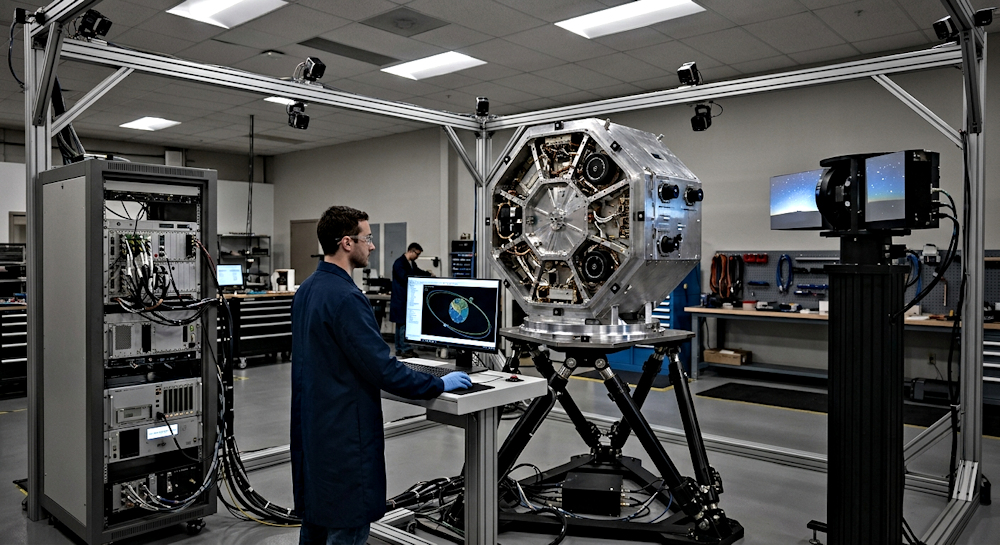
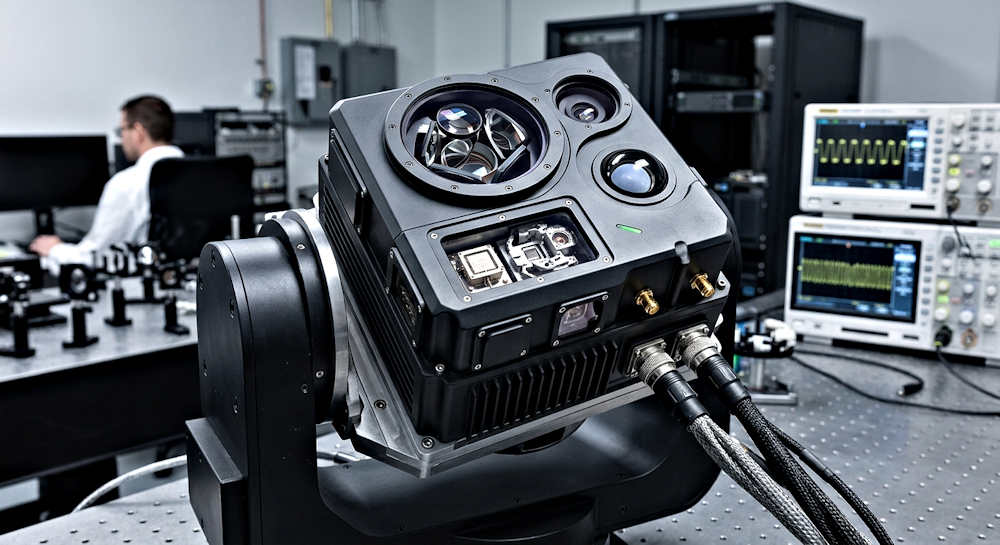
Accelerating the transition of theoretical control algorithms into flight-certified operational systems requires robust modeling, simulation, and hardware validation infrastructure. Specialized prototyping environments integrate radio-frequency and optical sensor emulators, dynamic motion tables, and high-precision optical motion-capture positioning arrays to run Hardware-in-the-Loop test suites. By using model-based software engineering to continuously validate complex physics models against physical flight hardware in controlled environments, development teams can safely identify software edge cases, refine control laws, and verify system safety before executing live-fire flight tests.
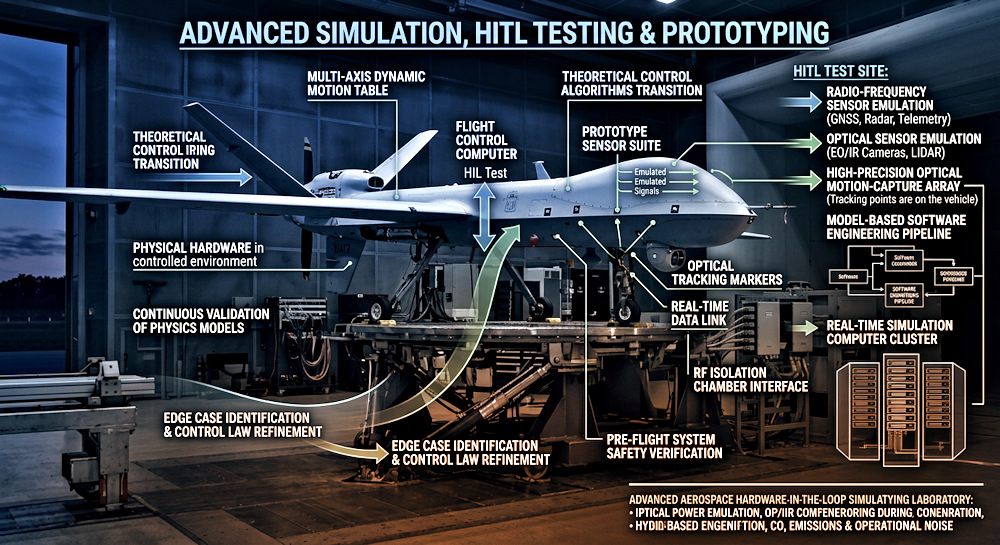
Advanced Simulation, HITL Testing, and Prototyping are the critical bridge between conceptual flight algorithms and flight-certified production hardware. Modern test environments shift validation heavily "to the left," catching edge-case failures in synthetic real-time environments before physical flight tests.
High-Fidelity Environment & Sensor Emulation
- RF and Optical Scene Generation: Advanced scene generators stream real-time, multi-spectral sensor feeds to physical seekers. Optical array emulators project high-frame-rate infrared and electro-optical imagery directly into camera optics, while radio-frequency scene generators project dynamic radar reflections, ground clutter, and deliberate electronic warfare jamming into antenna arrays.
- Dynamic Motion & High-G Simulation: Flight computers and inertial sensors mount on multi-axis dynamic flight motion tables (FMTs). These motion tables continuously simulate complex roll, pitch, yaw, and high-G rotational maneuvers in lockstep with virtual flight dynamics models, stress-testing onboard gyroscopes and fluid accelerometers.
- Optoelectronic Motion-Capture Integration: Sub-millimeter optical positioning systems track indoor scale models and physical actuator rigs in real time. Motion-capture arrays feed ground-truth spatial data back into control computers, enabling precise calibration of visual-inertial odometry and hover stability laws before full-scale deployment.
Digital Twin Convergence & Real-Time HIL Frameworks
- Continuous Digital Twin Synchronization: Rather than relying on static simulation models, developers maintain real-time digital twins of physical flight vehicles. Flight data captured during sub-scale tests continuously tunes the digital twin's physical parameters—such as flexural aeroelasticity and thermal expansion—ensuring the HIL simulator accurately reflects true vehicle dynamics.
- Ultra-Low Latency Real-Time Computing: Modern real-time simulators utilize field-programmable gate arrays (FPGAs) and specialized real-time processors to achieve microsecond loop execution speeds. This low latency prevents synthetic phase delays, allowing closed-loop flight control computers to execute high-bandwidth stabilization maneuvers without experiencing artificial instability.
- Automated Edge-Case Fuzzing: Automated testing engines subject virtual flight environments to thousands of stress cases simultaneously. AI-driven scenario generators automatically alter wind shear profiles, actuator delays, sensor noise, and satellite dropouts to discover hidden software edge cases and control saturation boundaries.
Model-Based Systems Engineering & Safe Deployment
- Automated Code Generation & Model Verification: Software engineers build flight control algorithms inside graphical model-based engineering frameworks. These tools run mathematical proof algorithms to formally verify that the control logic will never command an unsafe state, automatically generating C/C++ flight code directly from verified block diagrams.
- Fault-Injection Testing: HIL testbeds inject physical and electrical faults into flight hardware—such as severing bus communications, dropping power rails, or corrupting memory blocks—to verify that run-time safety shields, fallback modes, and redundant systems trigger seamlessly during severe hardware degradation.