Propulsion Systems
Modern aerospace propulsion research, development, and engineering spans a seamless continuum from high-efficiency atmospheric flight to deep-space transit. By uniting core disciplines in fluid dynamics, thermo-energetics, and advanced materials, leading aerospace institutions are driving major advancements in air-breathing, chemical, electric, and nuclear propulsion architectures.
Atmospheric Subsonic & Sustainable Flight
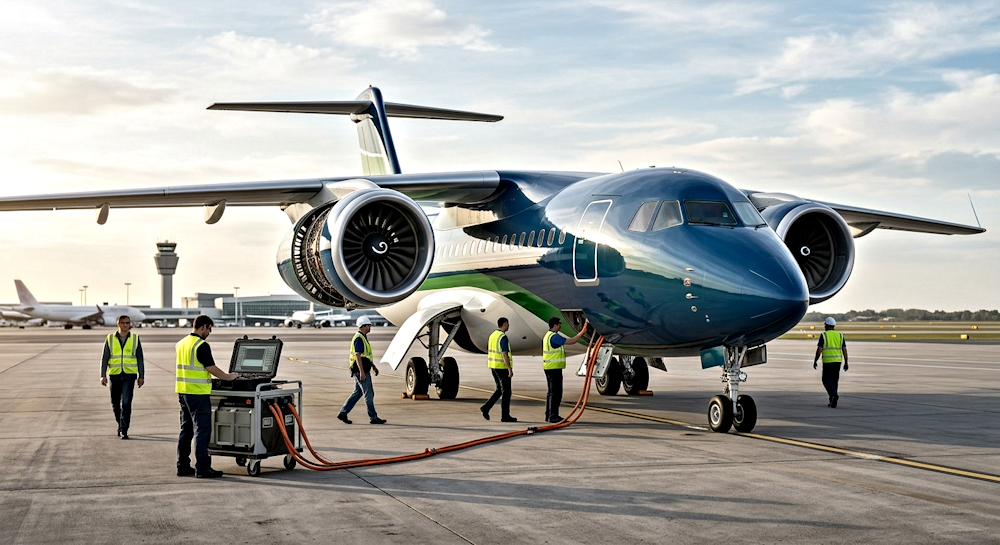
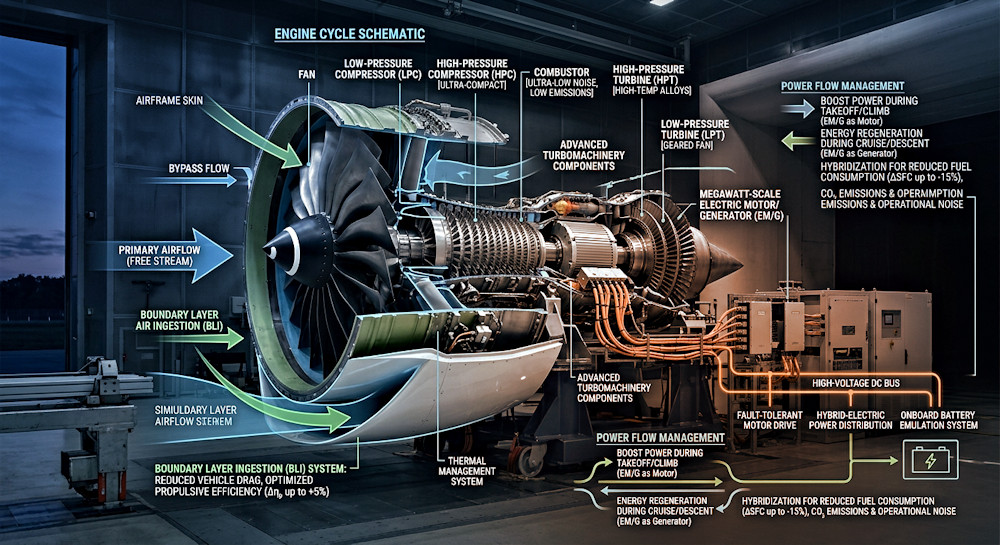
To minimize carbon emissions, fuel consumption, and operational noise in commercial aviation, engineering efforts focus on optimizing air-breathing propulsion cycles and integrating megawatt-scale electric power. Researchers develop advanced turbomachinery—including high-pressure axial compressors, ultra-low-emissions combustors, and durable turbine blading—capable of enduring extreme thermal regimes. Innovative concepts like Boundary Layer Ingestion (BLI) re-engineer airframe integration to swallow slow-moving boundary layer air, significantly reducing vehicle drag. Simultaneously, the transition toward electrified aircraft propulsion leverages high-voltage power distribution, fault-tolerant electric motor drives, and hybrid-electric powertrain emulation to balance energy loads between gas turbines and onboard storage systems.
Next-Generation Airframe Architectures
Traditional "tube-and-wing" designs are reaching their aerodynamic limit. Modern research is leaning heavily into high-aspect-ratio and integrated-body configurations.
- Transonic Truss-Braced Wings (TTBW): By using extra-long, thin wings supported by structural trusses, aircraft can optimize lift while dramatically reducing aerodynamic drag. This configuration allows for higher cruise altitudes and up to a 10%–20% reduction in fuel burn compared to contemporary narrow-body airliners.
- Blended Wing Body (BWB): Merging the fuselage and wings into a single lifting body reduces total weight and aerodynamic drag significantly. BWBs offer dramatically larger internal volume for fuel or cargo while delivering up to 20% to 30% higher fuel efficiency than conventional subsonic airframes.
- Advanced Boundary Layer Ingestion (BLI): Integrating engines into the rear top section of the fuselage allows engines to ingest slower-moving boundary-layer air, reducing the propulsion power needed to push the aircraft forward.
Advanced & Electrified Propulsion Concepts
Turbofan engines are undergoing structural revolutions to extract maximum energy from fuel while accommodating new power sources.
- Ultra-High Bypass Ratio (UHBR) & Open-Fan Architectures: Moving away from traditional engine casings, open-rotor (or propfan) architectures feature exposed, counter-rotating or variable-pitch fan blades. This dramatically increases the bypass ratio (exceeding 15:1 or 20:1), dropping fuel consumption and carbon emissions by 15%–20%.
- Hybrid-Electric Propulsion: Combining traditional jet fuel engines with electric battery packs for high-demand phases (takeoff and climb) allows for smaller, continuously optimized gas turbines running at maximum efficiency during cruise.
- Fully Electric Flight: Restricted primarily to short-range, regional sub-70-passenger routes due to current battery weight energy densities. Key developments include solid-state batteries and high-power density electric motors utilizing advanced cooling systems to minimize thermal weight penalties.
Alternative Fuels & Energy Carriers
Decarbonization relies on replacing conventional fossil-derived jet A-1 fuel with lower- or net-zero-carbon alternatives.
- Sustainable Aviation Fuels (SAF):
- HEFA & Alcohol-to-Jet: Synthesized from waste oils, agricultural residues, and municipal waste.
- Power-to-Liquid (PtL) / e-Fuels: Created by combining green hydrogen (produced via water electrolysis powered by renewables) with captured atmospheric carbon dioxide.
- 100% Drop-In Capability: Modern fuel systems are being modified to run on 100% unblended SAF (up from the historical 50% blend limits).
- Cryogenic Hydrogen Propulsion:
- Direct Hydrogen Combustion: Burning liquid hydrogen LH2 directly in modified gas turbines releases zero CO2, with water vapor being the main byproduct.
- Hydrogen Fuel Cells: Converting LH2 into electricity via onboard fuel cell stacks to drive electric propulsor motors, targeted primarily at regional and mid-range subsonic commercial transport.
Advanced Lightweight Materials & Manufacturing
To offset the added weight of new propulsion systems, batteries, or volumetric hydrogen storage tanks, weight reduction across the airframe is critical.
- Thermoplastic Composites: Unlike traditional thermoset composites, thermoplastics can be welded without rivets or heavy fasteners, are lighter, highly impact-resistant, and recyclable at end-of-life.
- Additive Manufacturing (3D Printing): Enables optimized, biomimetic internal structures (like lattice topologies) that reduce part count and component weight by up to 30%–50% without compromising structural integrity.
- Self-Healing Materials: Smart composite materials capable of sealing micro-cracks automatically, extending airframe lifespans and reducing structural maintenance overhead.
Operational and Digital Optimizations
Hardware advances are complemented by software solutions that optimize how aircraft fly through the atmosphere.
- AI Flight Path Optimization: Machine-learning platforms compute real-time four-dimensional trajectories to continuously avoid contrail-forming atmospheric zones (which account for a major share of non-CO2 global warming effects) and leverage dynamic high-altitude jet streams to cut fuel burn.
- Digital Twin Technology: Creating real-time virtual replicas of engine components and airframes allows predictive maintenance, running engines at maximum thermal efficiency without risking unexpected mechanical failures.
- Formation Flying (Wake Energy Harvesting): Passenger aircraft flying in strategic "V" formations during cruise utilize the updraft generated by the lead aircraft’s wingtip vortices, reducing engine thrust requirements for follower aircraft by 5%–10%.
Hypersonic & Detonation-Based Propulsion
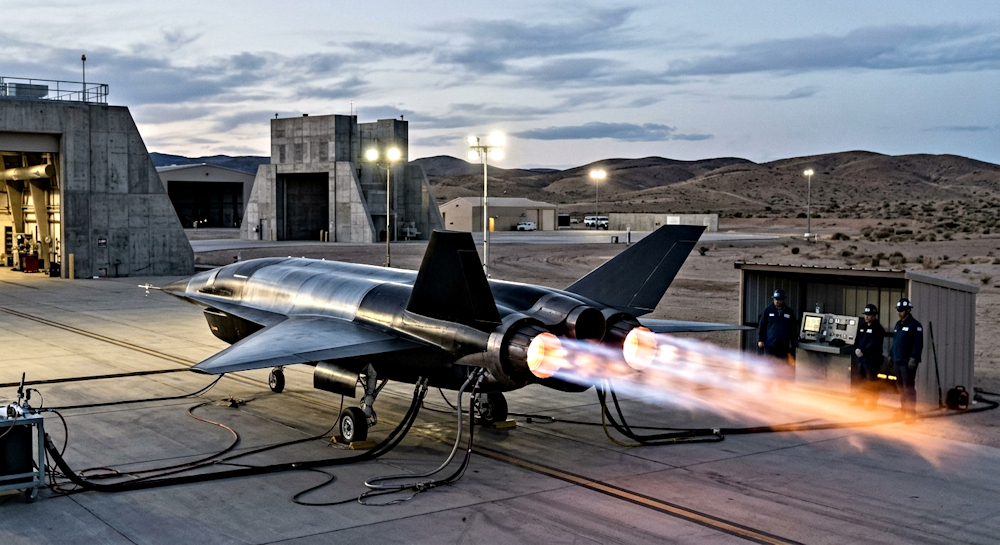
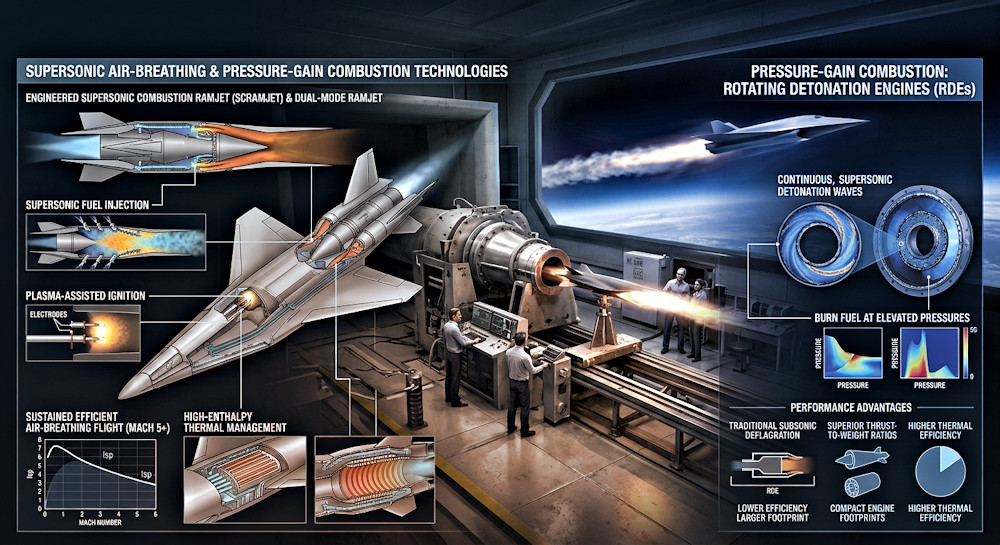
For rapid long-range flight and high-speed atmospheric transit, research emphasizes supersonic air-breathing and pressure-gain combustion technologies. Engineered supersonic combustion ramjets (scramjets) and dual-mode ramjets optimize supersonic fuel injection, plasma-assisted ignition, and high-enthalpy thermal management to sustain efficient air-breathing flight at speeds exceeding Mach 5. In parallel, pressure-gain combustion—exemplified by Rotating Detonation Engines (RDEs)—uses continuous, supersonic detonation waves to burn fuel at elevated pressures. This approach delivers higher thermal efficiency, compact engine footprints, and superior thrust-to-weight ratios compared to traditional subsonic deflagration.
Additive Manufacturing for High-Enthalpy Cooling
Advanced 3D printing enables sub-millimeter regenerative cooling channels inside combustor walls. Complex internal flow geometry allows liquid fuels (such as pre-chilled methane or hydrogen) to absorb extreme aerodynamic heat before being injected, drastically raising thermal endurance and combustion efficiency.
Non-Equilibrium Plasma-Assisted Combustion
Pulsed nanosecond electric discharges generate free radicals and local ionized plasma fields within the airflow. This speeds up chemical reaction kinetics, enabling stable ignition in milliseconds without relying solely ondrag-inducing physical flameholders.
Rotating Detonation Ramjets (RDRs)
Integrating RDE annular chambers into air-breathing scramjet ducting allows detonation waves to operate under incoming supersonic ram airflow. This eliminates traditional compressors while providing continuous pressure gain across a smaller total engine length.
Cascaded Injectors & Cavity Dynamics
Multi-stage wall injection combined with optimized rear-wall expansion cavities creates controlled recirculation zones. This maximizes fuel penetration and mixing efficiency across broad operational envelopes without causing flow blockage or engine unstart.
Combined-Cycle Mode Integration
Dual-mode architectures combine low-speed turbine or rocket operation with high-speed ramjet/scramjet combustion using dynamic variable-geometry inlets. Automated shockwave positioning maintains continuous engine "start" state from subsonic acceleration through hypersonic speeds above Mach 5.
Heavy Launch & In-Space Chemical Systems
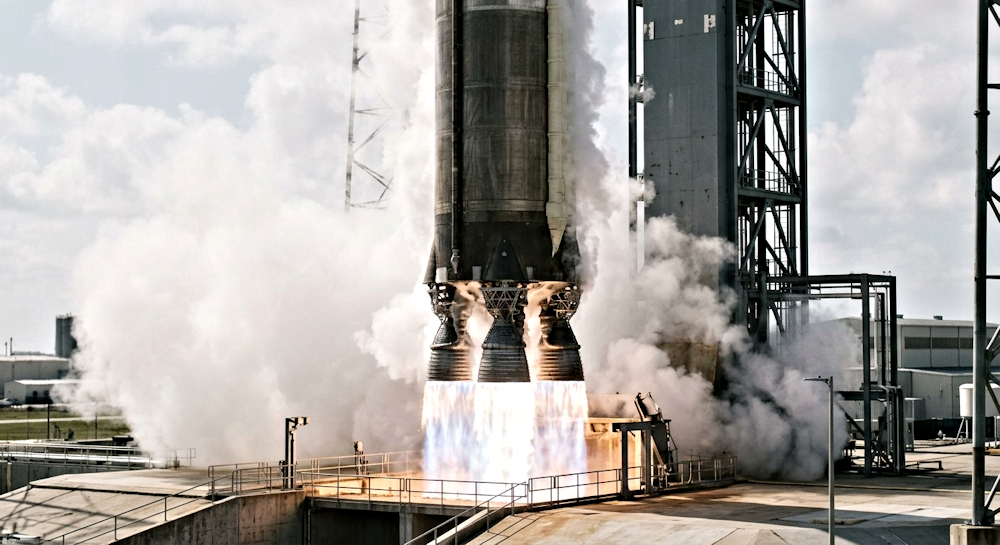
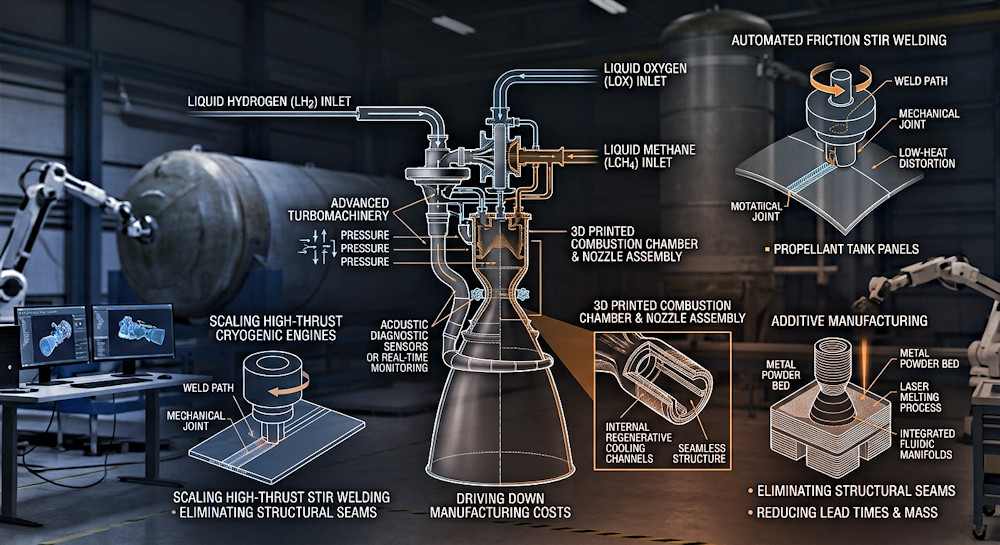
Laying the foundation for Earth-to-orbit transportation and deep-space missions requires scaling heavy-lift liquid and solid propulsion systems while driving down manufacturing costs. Engineering teams continuously refine high-thrust cryogenic engines using liquid hydrogen, liquid oxygen, and methane, pairing them with advanced turbomachinery and acoustic diagnostic tools. To accelerate production, automated friction stir welding and additive manufacturing—such as 3D printing complex combustion chambers and nozzles with internal cooling channels—eliminate structural seams, lower mass, and drastically reduce lead times.
High-Efficiency Cycle & Propellant Shifts
- Full-Flow Staged Combustion (FFSC): Modern heavy-lift engines are shifting from traditional gas-generator or staged combustion cycles to full-flow architectures. By routing all propellants through preburners to drive gas-phase turbopumps, these designs lower turbine operating temperatures, reduce thermal stress, and maximize specific impulse while enabling rapid, low-maintenance reusability.
- Subcooled Liquid Methane (Methalox): Methalox is increasingly replacing traditional RP-1 kerosene. Subcooling propellants closer to their freezing points increases density, allowing more fuel mass in smaller tanks. Methalox burns clean without heavy soot deposition, simplifying engine refurbishment and opening paths for off-world propellant production.
Advanced Manufacturing & Structural Integration
- Generative AI & Computational Engineering: Combustion chambers, injectors, and aerospike nozzles are now designed autonomously via machine-learning algorithms that optimize fluid dynamics, thermal dissipation, and stress vectors faster than humanly possible.
- Large-Scale Additive & Hybrid Fabrication: Laser Powder Bed Fusion (LPBF) and Directed Energy Deposition (DED) enable single-piece printings of large combustion chambers and nozzles complete with internal, complex regenerative cooling micro-channels. Combining high-entropy metallic alloys, proprietary superalloys, and ceramic matrix composites (CMCs) reduces structural mass by up to 25% while enduring temperatures exceeding 1,400°C.
- Welding Innovations: Automated Solid-State Friction Stir Welding (FSW) joins specialized alloys (such as Aluminum-Lithium) without melting the base material, preserving original metal properties, drastically decreasing defect rates, and eliminating structural seams across massive propellant tanks.
In-Space Cryogenic Fluid Management (CFM)
- Zero Boil-Off (ZBO) Cooling: Deep-space chemical propulsion requires holding cryogenic liquid hydrogen, methane, and oxygen for months or years without evaporation loss. Advanced pulse-tube cryocoolers paired with multi-layer vacuum insulation (MLI) re-liquefy boiling gases, making long-term orbital depots and interplanetary transit viable.
- Microgravity Propellant Management Devices (PMDs): Modern in-space tanks utilize passive surface tension devices—such as specialized metallic vanes, sponges, and screens—to pull bubble-free liquid propellants directly to engine inlets during zero-gravity coast phases without requiring heavy settling burns.
Real-Time Diagnostics & Autonomous Health Monitoring
- Acoustic & High-Frequency Health Monitoring: High-rate sensor arrays, high-frequency pressure transducers, and acoustic emission sensors process engine vibrations in real time. Embedded AI edge-compute units detect combustion instabilities, bearing wear, or localized hot spots milliseconds before catastrophic failure, triggering precise micro-throttling to preserve the engine.
Electric, Plasma & Bio-Inspired Propulsion
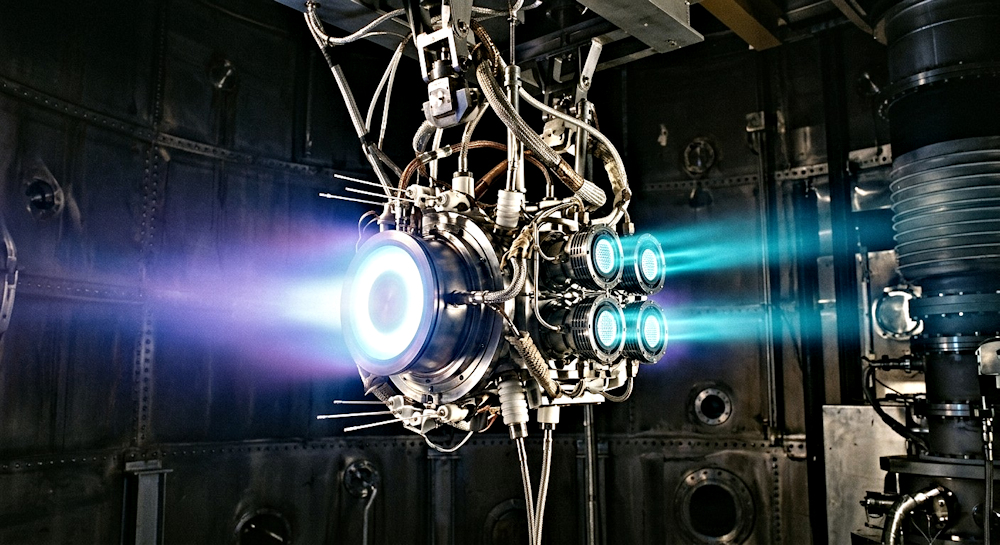
For long-duration space missions, payload transit, and precise satellite maneuvering, high-efficiency non-chemical propulsion provides exceptional specific impulse. Engineers design high-power gridded ion thrusters, Hall thrusters, and magnetoplasmadynamic devices that accelerate ionized propellants via electromagnetic fields to reach extreme exhaust velocities. For micro-satellites and precision formation flying, miniaturized electric micro-thrusters provide precise impulse bits. Beyond traditional engineering, bio-inspired propulsion studies uncover the unsteady fluid dynamics and vortex mechanics of biological movement to inform adaptive propulsors and micro-aerial vehicle designs.
Gridded Ion Thrusters
Use electrostatic fields to accelerate ionized propellant (such as xenon) through series of charged grids, achieving exceptionally high exhaust velocities for long-duration deep-space travel.
Hall Thrusters
Utilize a magnetic field to trap electrons, creating an electrostatic field that accelerates ions in a cross-field plasma, delivering higher thrust-to-power ratios suitable for orbit raising and station-keeping.
Magnetoplasmadynamic (MPD) Thrusters
Employ the Lorentz force generated by high-current electric arcs and magnetic fields to accelerate plasma, capable of processing multi-megawatt power levels for heavy payload transit.
Electric Micro-Thrusters
Downscaled propulsion systems designed for micro-satellites and CubeSats, offering extremely tiny, controlled impulse bits required for ultra-precise formation flying and fine attitude adjustments.
Bio-Inspired Propulsors
Adapt fluid dynamics from biological movement (such as fish swimming or insect flight) by harnessing unsteady aerodynamic forces and vortex shedding to design flexible, adaptive micro-aerial vehicles.
Cryogenic Fluid Management & Space Nuclear Systems
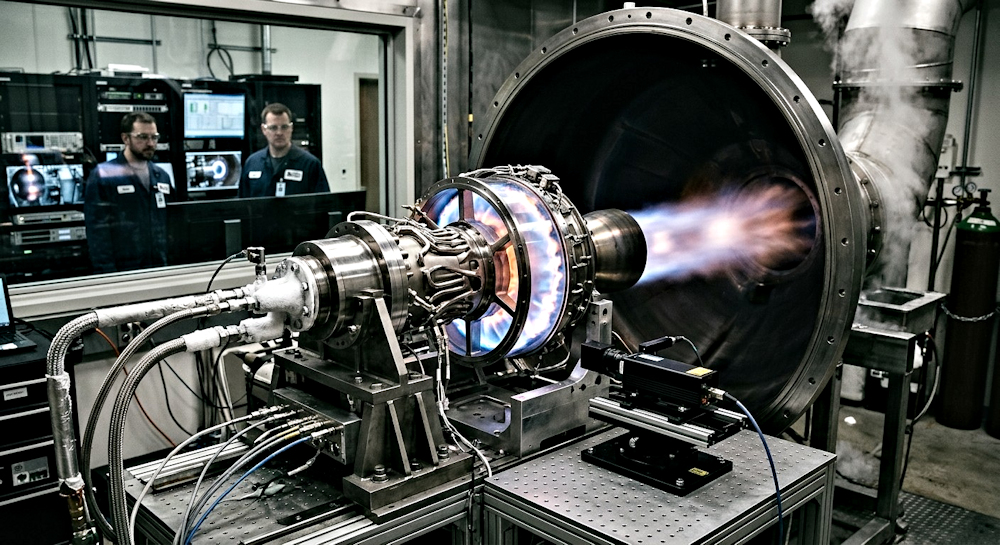
Deep-space exploration relies on preserving volatile fuels and scaling high-energy transit cycles. Advanced Cryogenic Fluid Management (CFM) addresses the challenges of long-duration spaceflight through zero-boil-off storage, automated propellant transfer, and mass gauging in microgravity. To drastically shorten interplanetary travel times, space nuclear propulsion research advances both Nuclear Thermal Propulsion (NTP) and Nuclear Electric Propulsion (NEP). By routing propellant through a high-temperature nuclear reactor core, these systems achieve double the specific impulse of traditional chemical rockets, significantly mitigating deep-space radiation exposure for crewed trajectories.
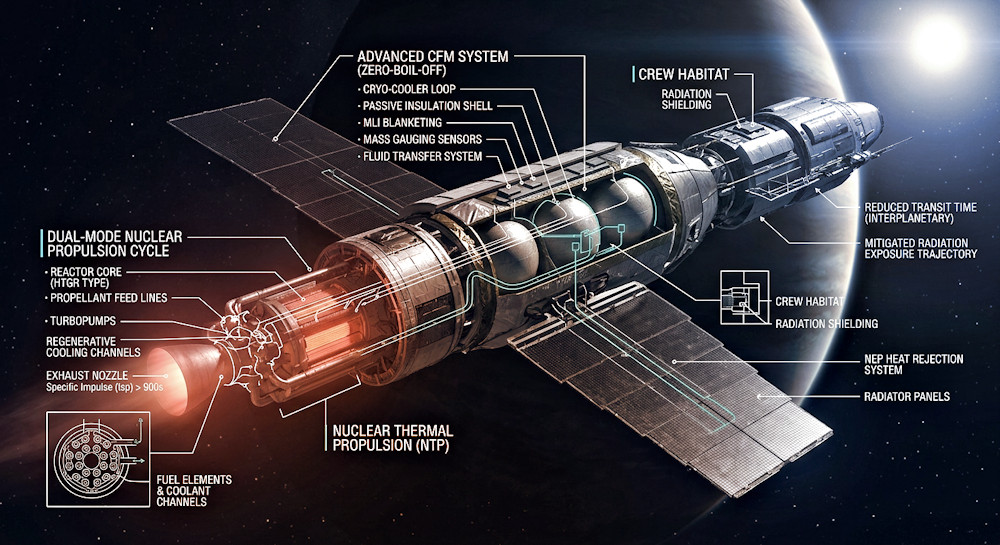
Advanced Cryogenic Fluid Management (CFM)
Storing volatile cryogenic fuels—such as liquid hydrogen LH2, liquid oxygen LOX, and liquid methane LCH4—in deep space requires balancing precise thermal management with microgravity fluid dynamic handling.
- Zero-Boil-Off (ZBO) Thermal Control
- Active Cryocoolers: High-capacity pulse tube and reverse Turbo-Brayton cryocoolers reduce fluid temperatures to near absolute zero, actively suppressing heat ingress and completely preventing propellant boil-off over multi-year operational timescales.
- Advanced Insulation Systems: Multi-Layer Insulation (MLI) is integrated with integrated active cooling loops (load-bearing insulation) to eliminate thermal bridges between outer hull structural supports and internal propellant tanks.
- Microgravity Fluid Handling & Transfer
- Capillary Vane Separators: Microgravity eliminates natural thermal convection and gravity-driven liquid positioning. Engineers utilize surface-tension-driven capillary vanes and porous mesh bubble traps to route liquid phase fuel directly to engine inlets while preventing gas entrainment.
- Automated Docking & Fluid Transfer: Autonomous, closed-loop fluid coupling systems allow remote propellant depot-to-craft transfer. Active pressure management systems handle rapid mass exchange without triggering explosive flash-evaporation or structural acoustic vibration.
- Gauging & Diagnostics
- Radio Frequency Mass Gauging (RFMG): Traditional liquid level sensors fail without gravity. RFMG injects low-power radio waves into tank cavities, using dielectric field response to accurately calculate total remaining fuel volume regardless of fluid slosh or dispersion patterns.
Space Nuclear Systems
Nuclear architectures replace chemical reaction kinetics with extreme thermal or electrical power densities, enabling fast interplanetary transit corridors that minimize astronaut radiation exposure.
- Nuclear Thermal Propulsion (NTP)
- High-Temperature Core Architecture: NTP systems utilize High-Assay Low-Enriched Uranium (HALEU) housed within ceramic-metallic (cermet) or composite matrix fuel elements. These fuel elements sustain reactor core temperatures above 2,500K.
- Working Fluid Dynamics: Liquid hydrogen propellant is pumped through the core, expanding instantly into high-velocity gas exhausted through a convergent-divergent nozzle. This yields a specific impulse (I-sp) double that of liquid chemical engines (~900s vs. 450s) while preserving high thrust capability.
- Nuclear Electric Propulsion (NEP)
- Power Conversion Loops: NEP isolates the reactor core from direct thrust generation. Closed-loop Brayton or thermionic conversion systems turn reactor thermal output into hundreds of kilowatts (or megawatts) of electrical power.
- High-Power Electric Thrusters: Electric power feeds advanced Hall-effect thrusters or Magnetoplasmadynamic (MPD) engines. By accelerating noble gas propellants (e.g., xenon, krypton) via electromagnetic fields, NEP achieves extreme fuel efficiency with an I-sp exceeding 3,000s.
- Thermal Management & High-Temperature Radiators
- Removing waste heat in a vacuum relies entirely on thermal radiation. Modern nuclear architectures utilize ultra-lightweight carbon-composite heat pipes and deployable liquid metal radiative panels designed to dump megawatt-scale thermal loads efficiently without imposing severe mass penalties on the launch vehicle.
Extreme-Environment Materials & Diagnostic Infrastructure
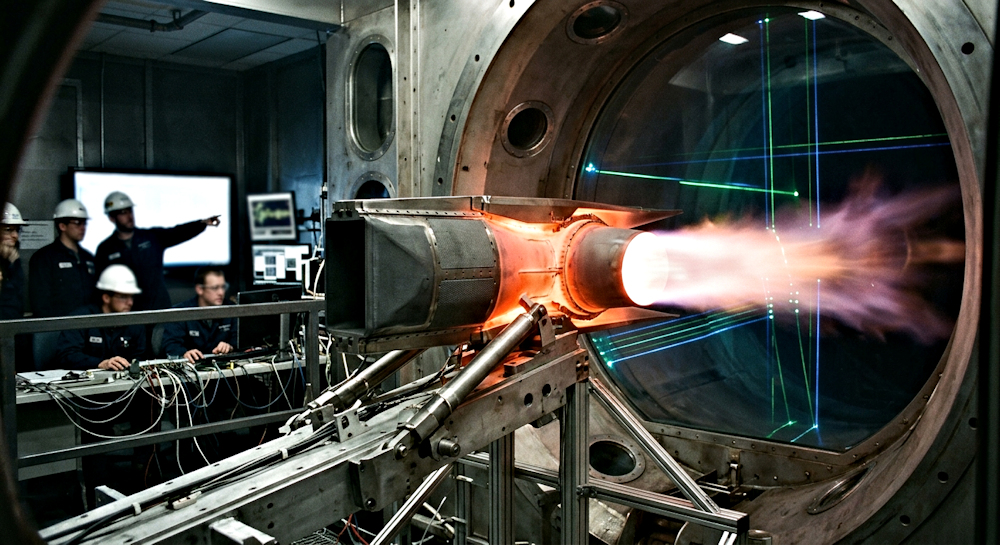
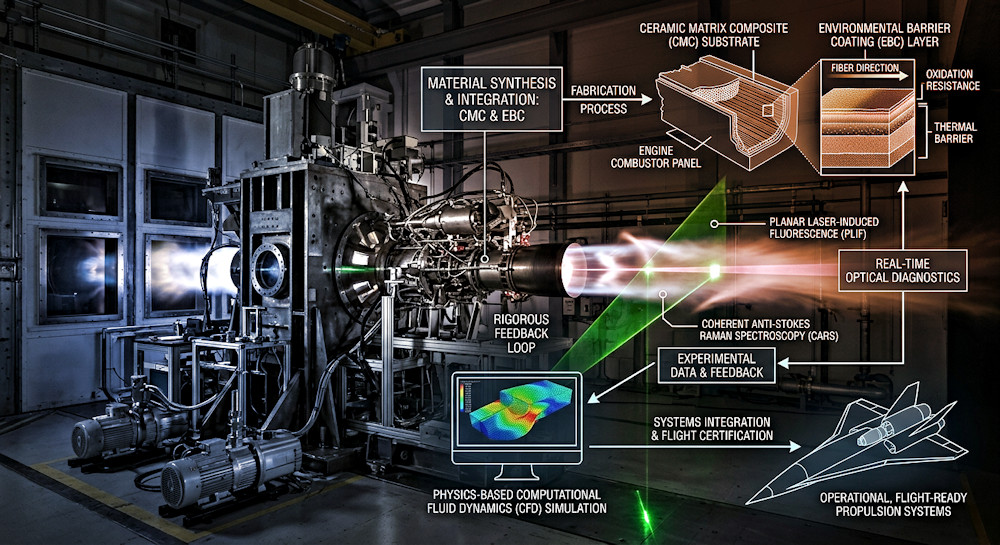
These breakthroughs are enabled by cross-cutting advancements in materials science, computational physics, and ground-testing infrastructure. Synthesizing high-temperature Ceramic Matrix Composites (CMCs) and environmental barrier coatings allows engine components to withstand elevated temperatures with minimal cooling. Researchers couple physics-based computational fluid dynamics (CFD) with real-time optical diagnostics in specialized shock tunnels, high-altitude vacuum chambers, and wind tunnels. This rigorous feedback loop transforms fundamental shock-wave mechanics and high-enthalpy chemistry into operational, flight-ready propulsion systems.
Next-Generation Thermal Protection Materials
- Ultra-High-Temperature Ceramics (UHTCs): Refractory transition metal diborides, nitrides, and carbides (e.g., hafnium diboride and zirconium diboride) are replacing conventional alloys. These materials maintain structural integrity at temperatures exceeding 2000-degrees C (3600-degrees F).
- Multi-Matrix CMCs: Silicon-carbide reinforced with silicon-carbide (SiC/SiC) and carbon-reinforced carbon (C/C) composites now integrate self-healing matrices. When micro-cracks form under mechanical stress, internal phase additions react with ambient oxygen to fill the voids before structural failure occurs.
- High-Entropy Coatings (HECs): Multi-element, single-phase entropy-stabilized oxides are replacing traditional thermal barriers. These offer lower thermal conductivity, higher phase stability at extreme temperatures, and superior resistance to molten dust or sand deposits.
- Mullite & Rare-Earth Silicate Environmental Barriers: Advanced multi-layer Environmental Barrier Coatings (EBCs) use higher-melting-point bond coats paired with rare-earth disilicates (e.g., ytterbium or scandium disilicates) to resist high-temperature water vapor degradation.
Advanced Diagnostic Testing Facilities
- Expansion Shock Tunnels: Facilities utilize high-pressure detonation tubes to accelerate test gas to high velocities, generating true hypersonic enthalpy conditions without burning off volatile test samples before measurement.
- High-Enthalpy Arc-Heated Facilities: Arc-jet facilities utilize electrical discharges to superheat gas to plasma states, simulating long-duration reentry atmospheres to test thermal shield erosion over extended periods.
- Low-Density Altitude Chambers: Vacuum chambers recreate low ambient pressures combined with extreme thermal profiles to evaluate rocket plume expansion, continuous heating, and radiation effects in upper-atmosphere or exo-atmospheric space environments.
Real-Time Non-Intrusive Optical Diagnostics
- Planar Laser-Induced Fluorescence (PLIF): Maps specific chemical species concentration (such as nitric oxide or hydroxyl radicals) dynamically across boundary layers to track combustion reactions and high-enthalpy gas dissociation.
- Femtosecond Coherent Anti-Stokes Raman Spectroscopy (CARS): Uses ultra-short laser pulses to measure temperature fields and gas species density at kilohertz-to-megahertz frame rates, capturing rapid turbulent fluctuations.
- Background-Oriented Schlieren (BOS): Uses high-speed cameras and digital image processing to visualize shock-wave geometries, density gradients, and boundary layer transitions without inserting physical probes into the flow.