Rotorcraft
Modern research, development, and engineering in rotorcraft focuses on creating versatile, high-speed, and environmentally compatible vertical flight architectures capable of operating across urban, expeditionary, and contested environments. At the foundational layer, advanced aeromechanics, active control systems, and electrified propulsion architectures decouple traditional rotorcraft limitations from mission requirements, enabling the development of compound configurations, autonomous operations, and ultra-quiet flight profiles. These advanced rotorcraft systems integrate optimized rotor aerodynamics, fly-by-wire control laws, and health-aware drive trains to deliver vertical lift capabilities with enhanced speed envelopes, reduced logistical footprints, and expanded operational envelopes across commercial transport, and emergency services.
Advanced Rotor Systems & Aeromechanics
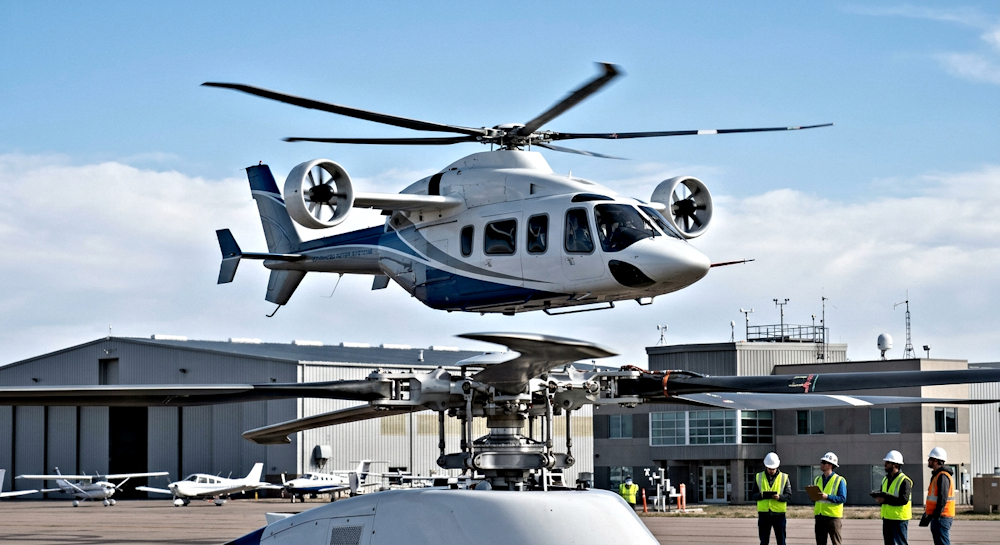
Modern rotorcraft development centers on optimizing rotor aerodynamics, aeroelastic stability, and dynamic loading characteristics to expand flight envelopes beyond conventional helicopter limitations. Advanced rotor systems incorporate variable geometry blades, active trailing-edge surfaces, and optimized blade tip shapes to delay stall onset, reduce vibration, and improve hover efficiency. At the core of these capabilities are sophisticated computational fluid dynamics models, wind tunnel validation programs, and full-scale flight test campaigns that characterize rotor wake interactions, dynamic stall phenomena, and vibratory load transmission under extreme operational conditions.
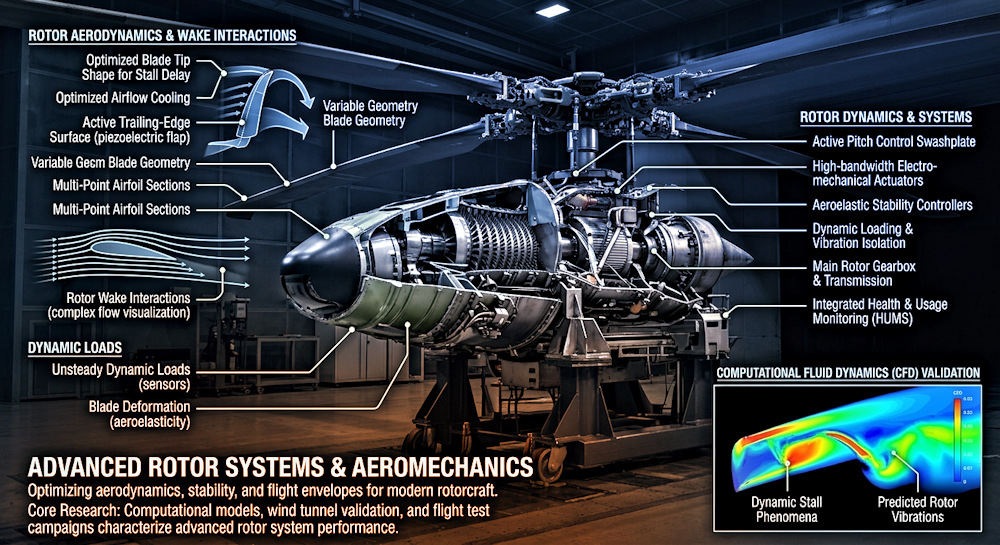
The evolution of Advanced Rotor Systems represents a fundamental transition from passive, mechanically rigid rotors toward adaptive, aerodynamically optimized lifting systems that actively manage airflow separation, blade-vortex interactions, and structural loads across the full range of forward speeds and maneuvering attitudes.
Key Technical Pillars
Variable Geometry and Morphing Rotors
- Blade twist actuation and trailing-edge flaps enable real-time adjustment of rotor aerodynamic characteristics
- Morphing blade sections adapt camber and thickness distributions to optimize performance across hover, cruise, and high-speed flight regimes
- Individual blade control systems modulate pitch angles on a per-revolution basis to cancel vibratory loads and enhance maneuver response
Advanced Blade Planform and Airfoil Design
- Swept, tapered, and anhedral blade tip configurations reduce compressibility effects and blade-vortex interaction noise
- Specialized airfoil families optimized for rotorcraft applications provide high lift-to-drag ratios, moment stability, and stall delay characteristics
- Non-linear twist distributions and advanced aerodynamic fairings minimize induced drag and power requirements across the speed spectrum
Coaxial and Multi-Rotor Configurations
- Counter-rotating coaxial rotor systems eliminate anti-torque requirements and improve hover efficiency through wake contraction
- Tandem, side-by-side, and quad-rotor configurations distribute lifting surfaces to optimize disk loading and ground footprint
- Inter-rotor aerodynamic coupling and wake interaction management enable compact configurations with high payload fractions
Recent Innovations
Active Flow Control Implementation
- Synthetic jet actuators and plasma actuation delay boundary layer separation during high-thrust maneuvers and high-speed flight
- Micro-vortex generators and passive flow control devices improve rotor performance in degraded visual environments and brownout conditions
Advanced Aeroelastic Modeling
- Coupled computational fluid dynamics and structural dynamics simulations predict flutter boundaries, limit cycle oscillations, and dynamic instabilities
- Reduced-order modeling techniques enable real-time aeroelastic load prediction for active control system implementation
Optimum Speed Rotor Technology
- Variable-speed rotor systems adjust rotational velocity to maintain optimal tip Mach numbers across varying forward speeds
- Dual-speed gearboxes and continuously variable transmissions enable efficient power transmission across wide speed ranges
Strategic & Operational Advantages
- Expanded Flight Envelope: Advanced rotor systems enable speeds exceeding traditional helicopter limitations while maintaining vertical lift capability
- Reduced Vibration Signatures: Active blade control and optimized aerodynamics reduce cabin vibration, decreasing crew fatigue and structural fatigue damage
- Enhanced Maneuverability: Individual blade control and variable geometry enable rapid attitude changes and precise position holding in turbulent conditions
- Improved Efficiency: Optimized blade aerodynamics and speed-adaptive rotors reduce fuel consumption and extend operational range
High-Speed Compound Rotorcraft Configurations
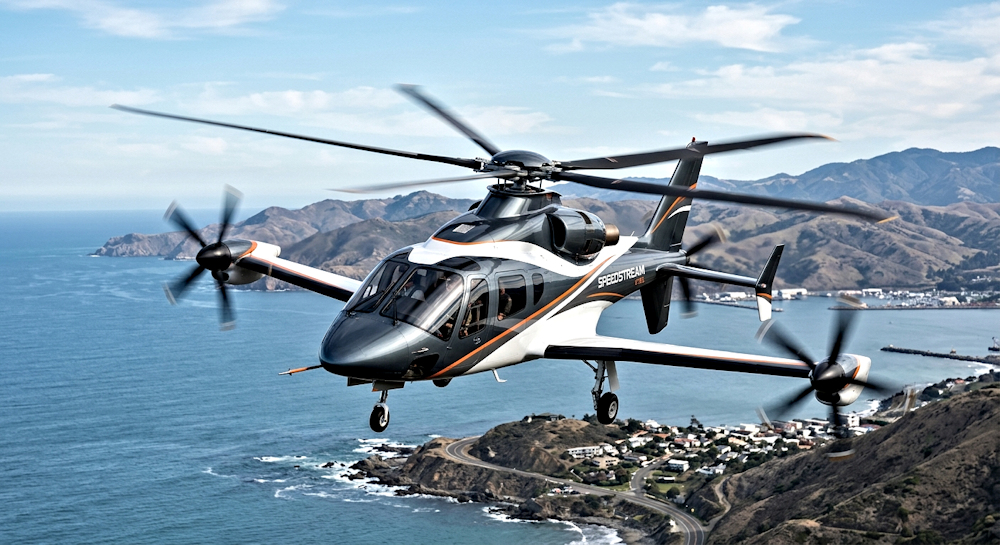
The pursuit of rotorcraft cruise speeds comparable to fixed-wing aircraft has driven development of compound configurations that supplement main rotors with auxiliary thrust and lift systems. Compound rotorcraft integrate wings for offloading rotor lift at speed, propellers or turbojets for auxiliary propulsion, and aerodynamic control surfaces to reduce rotor loading during cruise flight. These hybrid architectures decouple hover efficiency from cruise speed limitations, enabling rotorcraft to achieve speeds exceeding 250 knots while retaining vertical takeoff and landing capability.
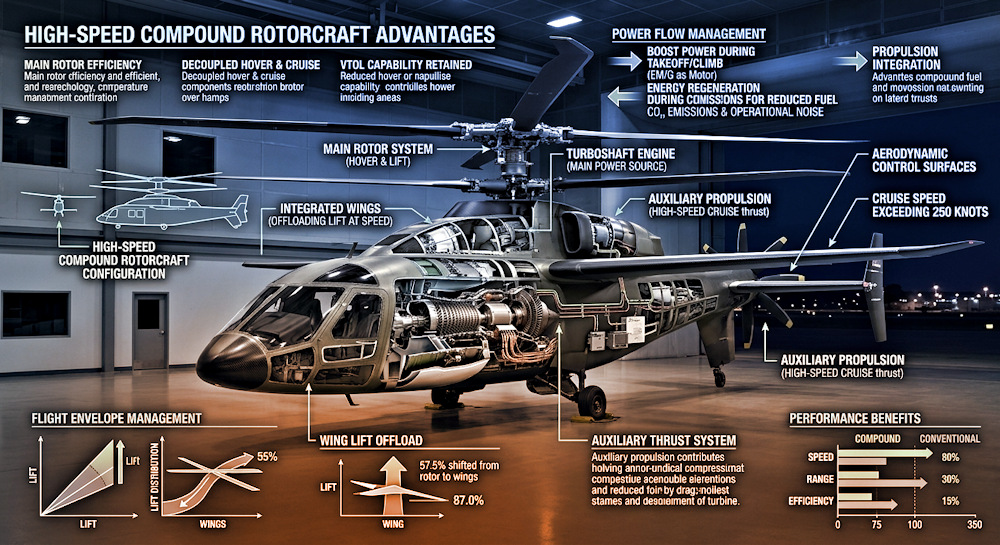
High-Speed Compound Rotorcraft represent the convergence of helicopter vertical lift with fixed-wing cruise efficiency, creating versatile platforms capable of rapid transit, extended range operations, and agile maneuvering across the full flight envelope.
Key Technical Pillars
Lift-Offset Coaxial Rotors
- Rigid coaxial rotor systems with aerodynamic lift offset transfer cruise lift loads from rotors to airframe structure
- Reduced rotor loading enables higher cruise speeds without retreating blade stall or compressibility limitations
- Differential collective and cyclic control provides precise torque and attitude management without traditional anti-torque systems
Auxiliary Propulsion Integration
- Pusher propellers, ducted fans, or turbojet engines provide supplemental thrust for high-speed cruise
- Thrust vectoring and tilt mechanisms enable transition between vertical and horizontal flight modes
- Distributed electric propulsion arrays provide redundant thrust sources and enhanced control authority
Wing and Control Surface Aerodynamics
- Fixed or folding wings offload rotor lift at cruise speeds, reducing power requirements and vibration
- Elevons, ruddervators, and flaperons provide aerodynamic control authority independent of rotor systems
- Wingtip mounted rotors or propellers exploit aerodynamic interactions for improved efficiency
Recent Innovations
Integrated Propulsion and Drive Systems
- Common turbine engines power both main rotors and auxiliary propulsion through integrated gearboxes and clutch mechanisms
- Cross-shafting and redundant power paths ensure continued flight capability following single engine or drive system failures
Tiltrotor and Tiltwing Architectures
- Tilting nacelles or complete wing sections transition between vertical lift and cruise flight configurations
- Conversion corridors and automated transition sequences manage complex aerodynamic interactions during mode changes
Advanced Flight Control Mode Blending
- Fly-by-wire systems automatically blend rotor, wing, and control surface authority across the speed envelope
- Control laws manage complex interactions between rotor wake impingement on wings and tail surfaces
Strategic & Operational Advantages
- Rapid Response Capability: High cruise speeds reduce transit time to distant operational areas, enabling rotorcraft to fulfill rapid reaction and medical evacuation missions
- Extended Operational Radius: Improved cruise efficiency extends unrefueled range, expanding the area of influence from forward operating bases
- Multi-Role Versatility: Compound configurations excel at diverse missions from heavy lift to armed reconnaissance to personnel transport
- Survivability Through Speed: High-speed transit through threat zones reduces exposure to ground fire and man-portable air defense systems
Electrified Propulsion & Hybrid Powertrains
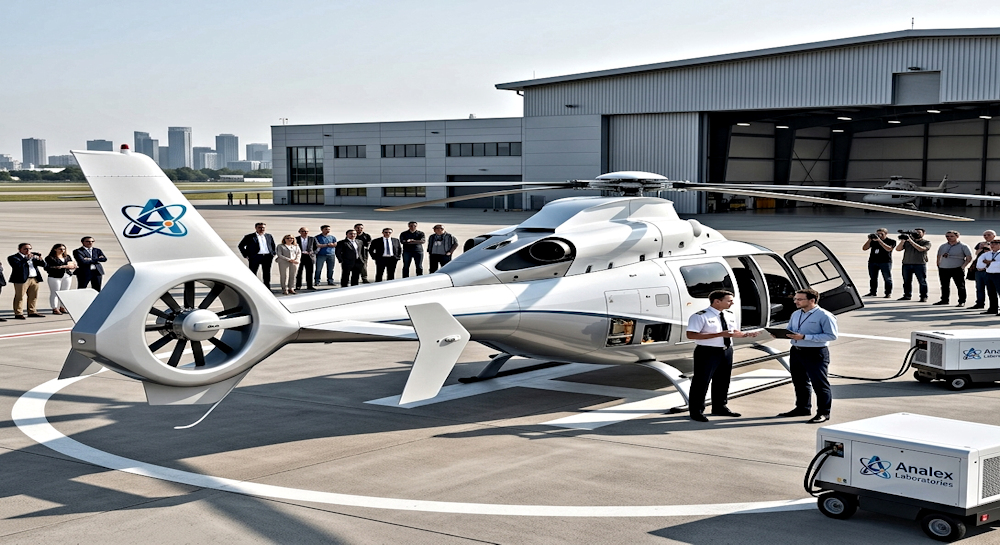
The electrification of rotorcraft propulsion systems represents a transformative shift toward reduced emissions, lower operating costs, and enhanced operational flexibility. Hybrid-electric architectures combine conventional turbine engines with electric motors, batteries, and power management systems to optimize power distribution across flight phases. Fully electric and hydrogen fuel cell systems enable zero-emission vertical flight for urban air mobility, training missions, and short-range logistics operations.
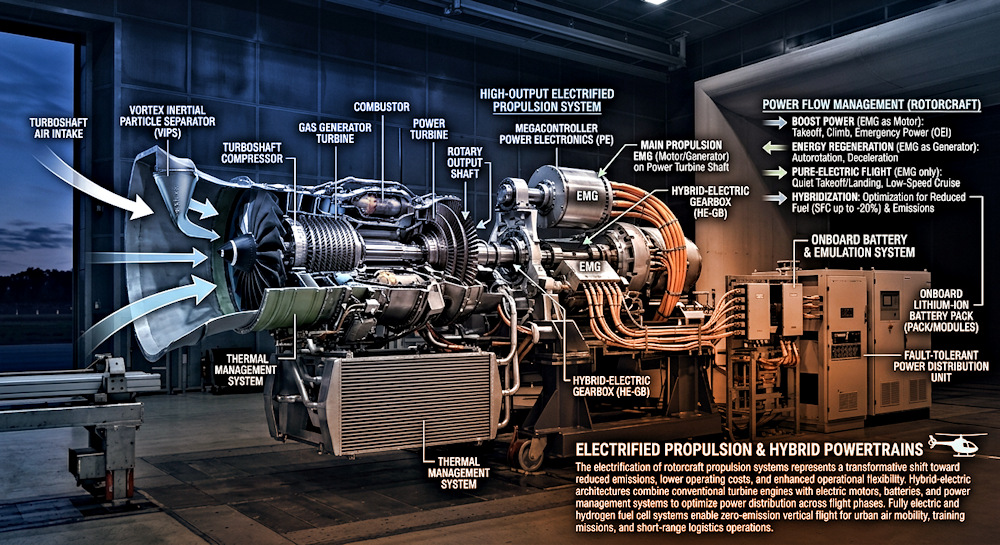
Electrified Propulsion represents the integration of aerospace propulsion with automotive and grid-scale energy technologies, creating distributed power architectures that enable novel rotorcraft configurations previously impossible with mechanical drive systems.
Key Technical Pillars
Distributed Electric Propulsion (DEP)
- Multiple small electric motors and propulsors replace single large engines and mechanical drive trains
- Individual motor control enables precise thrust vectoring, torque balancing, and redundancy management
- Wing-borne or fuselage-mounted propulsors provide vertical lift, cruise thrust, or boundary layer control
Hybrid-Electric Architectures
- Series hybrid systems use turbine engines as generators, decoupling engine speed from rotor speed for optimal efficiency
- Parallel hybrid configurations combine mechanical and electric power paths for peak power augmentation
- Battery energy storage provides burst power for high-demand maneuvers and emergency landing capability
Energy Storage and Thermal Management
- High-energy-density lithium-ion, solid-state, and lithium-sulfur battery systems provide specific energies approaching aerospace fuel requirements
- Supercapacitor and hybrid storage systems manage high-rate charge and discharge cycles
- Liquid cooling and phase-change materials maintain battery temperatures within safe operating limits
Recent Innovations
Turbogenerator Optimization
- Auxiliary power unit-derived turbogenerators optimized for continuous operation at peak efficiency points
- Waste heat recovery and recuperated cycles improve thermal efficiency of combustion-based power generation
Hydrogen Fuel Cell Integration
- Proton exchange membrane fuel cells convert hydrogen fuel to electric power with water as the only byproduct
- Cryogenic hydrogen storage and metal hydride storage systems provide energy densities exceeding battery alternatives
Wireless Power Transfer and Inductive Charging
- Ground-based inductive charging pads enable rapid turnaround without physical cable connections
- In-flight power beaming and inductive coupling extend endurance for persistent operations
Strategic & Operational Advantages
- Reduced Acoustic Signature: Electric propulsion eliminates combustion noise and enables low-tip-speed rotor operation for community-compatible noise levels
- Lower Operating Costs: Reduced fuel consumption, simplified maintenance, and fewer moving parts decrease direct operating costs
- Environmental Compliance: Zero-emission and low-emission propulsion systems meet increasingly stringent environmental regulations and carbon reduction mandates
- Operational Flexibility: Distributed propulsion enables novel configurations such as vectored thrust, tilt-wing designs, and redundancy-optimized layouts
Active Control & Autonomous Operations
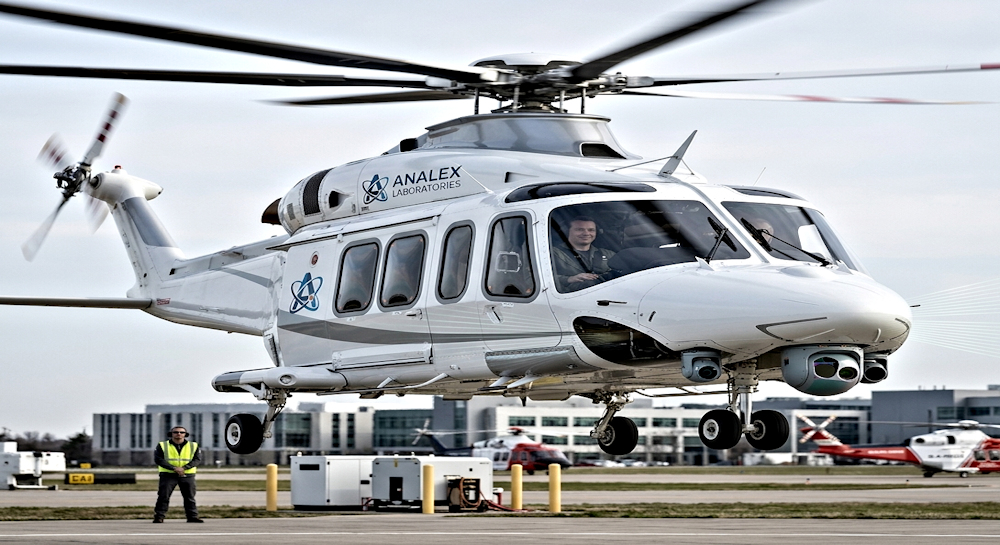
Modern rotorcraft incorporate active control systems that enhance stability, reduce pilot workload, and enable operations in degraded visual environments. Fly-by-wire flight control systems replace mechanical linkages with electronic signaling, enabling advanced control laws, envelope protection, and stability augmentation. Autonomous and semi-autonomous capabilities allow rotorcraft to execute missions with reduced or eliminated pilot intervention, from automated hover and landing to full waypoint navigation and obstacle avoidance.
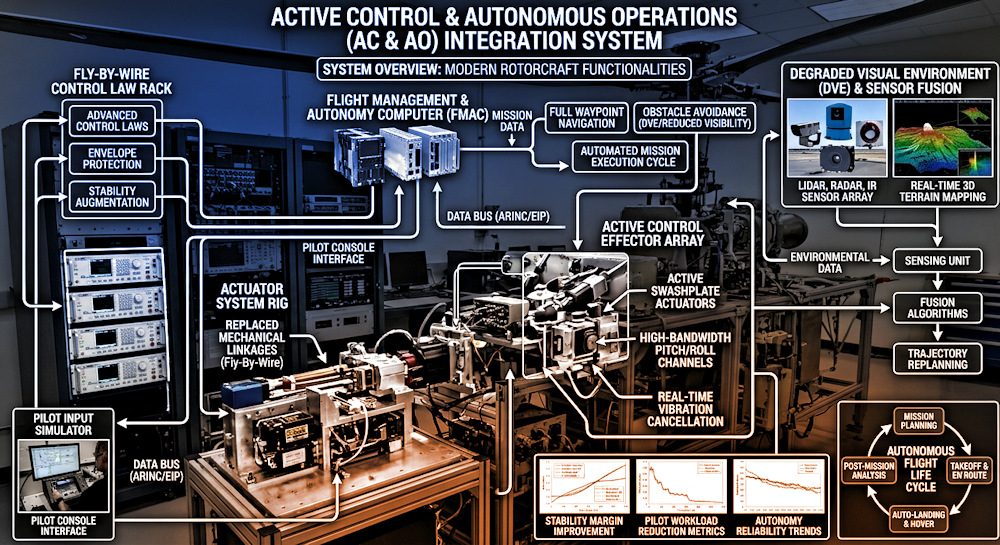
Active Control and Autonomous Operations represent the transition from mechanically limited, pilot-intensive rotorcraft toward intelligent, self-stabilizing platforms capable of operating safely in zero-visibility conditions, complex terrain, and communications-denied environments.
Key Technical Pillars
Fly-by-Wire Flight Control Systems
- Electronic signaling replaces mechanical pushrods, cables, and hydraulics for reduced weight and maintenance
- Control laws provide rate command, attitude hold, and velocity hold modes across the flight envelope
- Envelope protection prevents entry into dangerous flight regimes regardless of pilot inputs
Active Vibration and Noise Control
- Higher harmonic control systems modulate blade pitch at multiples of rotor frequency to cancel transmitted vibrations
- Active trailing-edge surfaces and on-blade actuators reduce blade-vortex interaction noise and vibration
- Tuned mass dampers and active cabin isolation systems attenuate residual vibration transmission
Autonomous Flight Management
- Automated hover hold, position hold, and velocity hold modes reduce pilot workload during low-altitude operations
- Terrain following and obstacle avoidance systems navigate complex environments using radar, lidar, and optical sensors
- Automated landing systems execute precision approaches to unprepared landing zones and moving platforms
Recent Innovations
Degraded Visual Environment (DVE) Mitigation
- Sensor fusion combining radar, lidar, and infrared imaging creates synthetic vision displays for brownout, whiteout, and night operation
- Doppler radar and optical flow sensors detect ground drift and provide hover stability cues when visual references are obscured
Single-Pilot and Reduced-Crew Operations
- Advanced avionics and automation enable safe operation by single pilots for missions traditionally requiring two crew members
- Synthetic crew members and decision support systems assist with navigation, communication, and systems management
Swarming and Collaborative Operations
- Multiple rotorcraft coordinate search patterns, cargo transport, and tactical maneuvers through distributed autonomy
- Leader-follower formations and autonomous aerial refueling extend operational capabilities
Strategic & Operational Advantages
- All-Weather Capability: Active control and synthetic vision enable operations in conditions that ground traditional rotorcraft
- Reduced Training Burden: Envelope protection and stability augmentation reduce pilot skill requirements for safe operation
- Mission Effectiveness: Autonomous systems enable continuous operation during crew rest periods or in high-threat environments
- Safety Enhancement: Automated systems reduce accident rates associated with human factors, spatial disorientation, and controlled flight into terrain
Advanced Materials & Structural Optimization
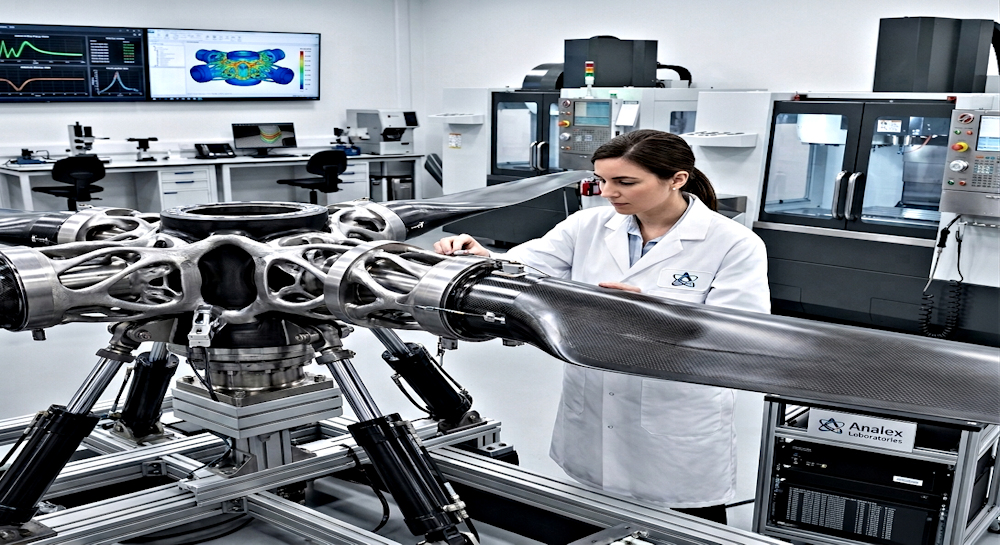
Rotorcraft structures demand materials that provide high strength-to-weight ratios, fatigue resistance, and damage tolerance under cyclic loading conditions. Advanced composite materials, titanium alloys, and hybrid material combinations enable optimized airframes, rotor blades, and drive system components that withstand the unique vibratory and aerodynamic loading environments of rotary-wing flight. Topology optimization and additive manufacturing techniques create efficient structural layouts that minimize weight while maintaining stiffness and strength requirements.
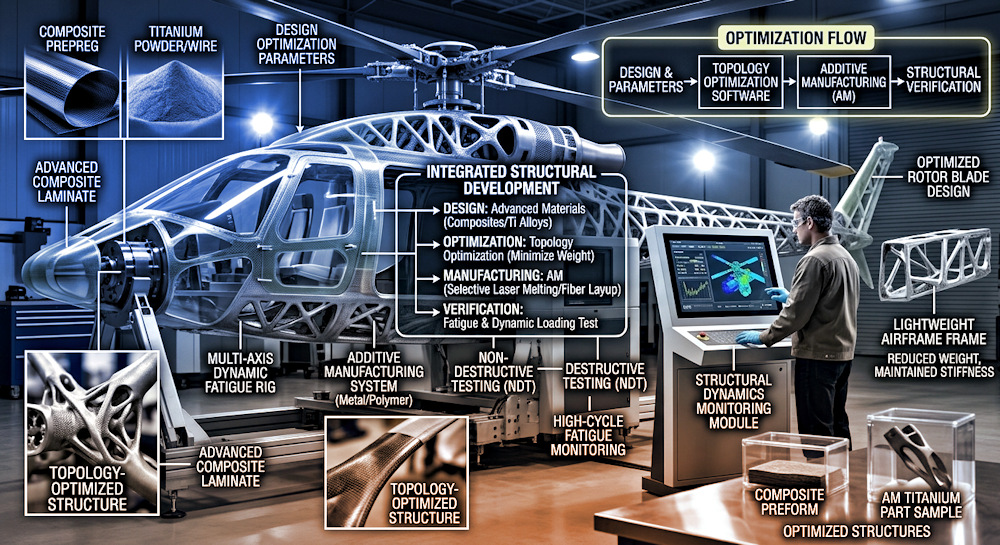
Advanced Materials and Structural Optimization represent the application of materials science and computational mechanics to produce rotorcraft structures that achieve unprecedented weight efficiency, durability, and functional integration.
Key Technical Pillars
Composite Primary Structures
- Carbon fiber reinforced polymer fuselage shells, tail booms, and empennage structures reduce weight and corrosion susceptibility
- Automated fiber placement and tape laying enable large, integrated composite components with optimized laminate schedules
- Sandwich construction with foam or honeycomb cores provides bending stiffness with minimal weight penalty
Elastomeric and Flexible Components
- Elastomeric bearings and flexures replace mechanical hinges and bearings in rotor systems, reducing maintenance and improving damping
- Flexible matrix composite driveshafts accommodate misalignment while transmitting high torque loads
- Elastomeric isolators and mounts attenuate vibration transmission to airframe and cabin
Damage Tolerant and Fail-Safe Design
- Multiple load paths and redundant structure ensure continued flight capability following battle damage or fatigue cracking
- Bonded joints and co-cured attachments distribute loads without stress concentrations associated with mechanical fasteners
- Health monitoring systems detect incipient damage before critical failure
Recent Innovations
Thermoplastic Composites
- Welding and fusion bonding of thermoplastic composites enable rapid assembly and repair without lengthy cure cycles
- Recyclable thermoplastic matrices support sustainability and end-of-life material recovery objectives
Shape Memory Alloy and Active Material Integration
- Shape memory alloy actuators provide lightweight, solid-state control surface actuation
- Piezoelectric materials embedded in structures enable active shape control and vibration suppression
Protective Coatings and Surface Treatments
- Erosion-resistant coatings protect leading edges from sand, rain, and particulate damage in desert and maritime environments
- Anti-icing and de-icing coatings reduce power requirements and maintenance compared to traditional bleed air or electrical heating systems
Strategic & Operational Advantages
- Weight Reduction: Advanced materials achieve structural weight fractions 20-30% lower than traditional aluminum construction
- Extended Service Life: Fatigue-resistant materials and damage-tolerant designs extend time-between-overhaul and total service life
- Reduced Maintenance: Corrosion-resistant composites and elastomeric bearings reduce scheduled maintenance requirements and logistics footprint
- Battle Damage Tolerance: Fail-safe structures and redundant load paths maintain flight capability following hostile fire or impact damage
Acoustic Signature Management & Community Noise
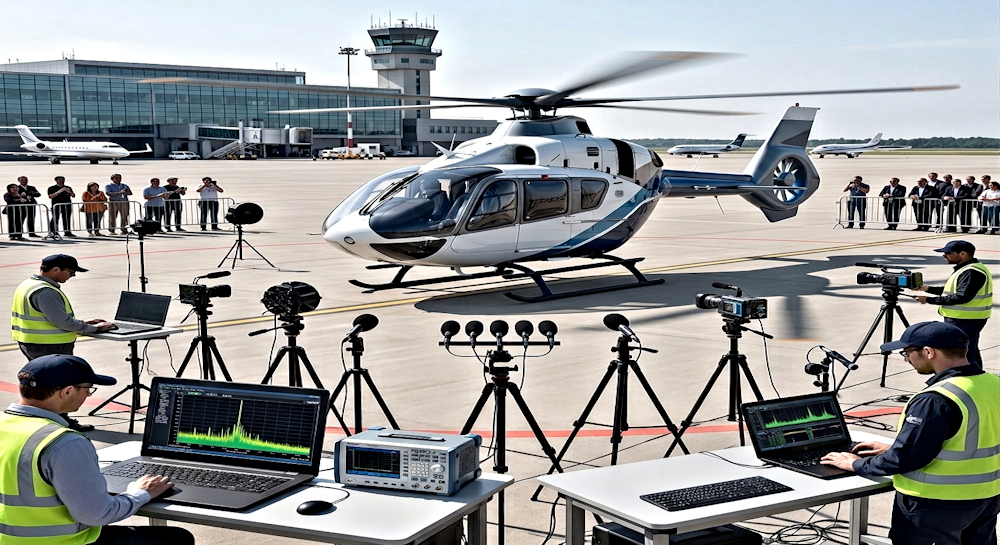
Rotorcraft noise represents a significant limitation on operational flexibility in urban environments and noise-sensitive areas. Advanced acoustic management technologies target the three primary noise sources: rotor blade-vortex interaction, engine and transmission noise, and airframe aerodynamic noise. Through optimized rotor design, active noise control, and operational procedure management, modern rotorcraft achieve noise signatures compatible with urban air mobility operations and community acceptance standards.
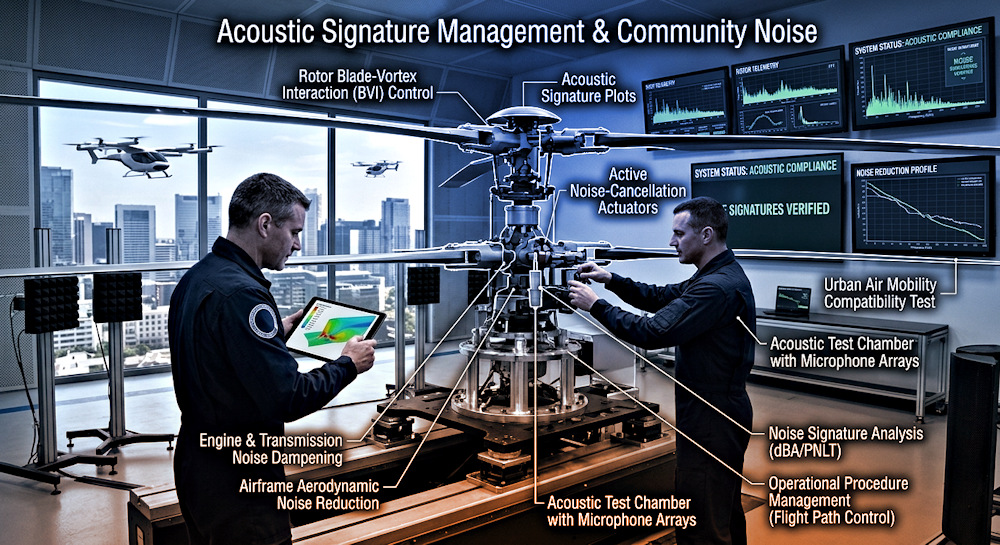
Acoustic Signature Management represents the convergence of aerodynamics, acoustics, and flight operations to minimize the environmental footprint of vertical flight while maintaining safety and performance capabilities.
Key Technical Pillars
Rotor Noise Reduction Design
- Low-noise blade tip shapes and planform optimization reduce blade-vortex interaction and high-speed impulsive noise
- Variable rotor speed and segmented rotor operation enable low-tip-speed operation during noise-sensitive flight phases
- Active trailing-edge devices and on-blade microflaps control vortex formation and interaction timing
Powerplant and Transmission Noise Control
- Advanced inlet and exhaust designs reduce turboshaft engine noise radiation
- Enclosed transmission compartments with acoustic insulation and vibration isolation reduce gear mesh noise
- Electric and hybrid propulsion eliminates combustion noise and enables distributed, low-noise propulsor arrangements
Operational Noise Abatement
- Steep approach and departure profiles minimize noise exposure to populated areas
- Continuous descent autorotation and optimized climb profiles reduce power requirements and noise generation
- Ground track management and routing algorithms avoid noise-sensitive areas while maintaining safety margins
Recent Innovations
Blade Morphing for Noise Control
- Trailing-edge flaps and variable camber adjust blade loading to minimize blade-vortex interaction during descent and approach
- On-blade actuation systems enable real-time adaptation to flight conditions and noise constraints
Acoustic Liner and Barrier Technologies
- Advanced composite acoustic liners in engine compartments absorb broadband noise while maintaining lightweight characteristics
- Active noise cancellation systems generate anti-phase sound fields to cancel cabin and exterior noise
Urban Air Mobility Noise Standards
- Certification metrics addressing sound pressure level, frequency distribution, and annoyance factors specific to urban environments
- Community noise monitoring and flight tracking systems enable adaptive routing based on real-time noise exposure
Strategic & Operational Advantages
- Expanded Operating Areas: Reduced noise signatures enable operations in urban centers, residential areas, and noise-restricted zones
- Public Acceptance: Lower noise levels improve community relations and support regulatory approval for expanded rotorcraft operations
- Covert Operations: Reduced acoustic signatures enhance survivability in military reconnaissance and special operations missions
- Crew Comfort: Reduced cabin noise levels decrease fatigue and improve communication effectiveness during long missions