Automotive Electronics & ECU Architecture
Located in Michigan, Analex Laboratories' 165,000-square-foot McMonagle Automotive Electronics Center specializes in transitioning vehicle electronics from distributed control systems to centralized, software-defined platforms. Its state-of-the-art facility combines advanced prototyping, high-performance computing, and extensive validation environments to support cutting-edge innovations in zonal architectures, high-speed vehicle communications, functional safety, power electronics, and automotive software.
McMonagle Automotive Electronics Center
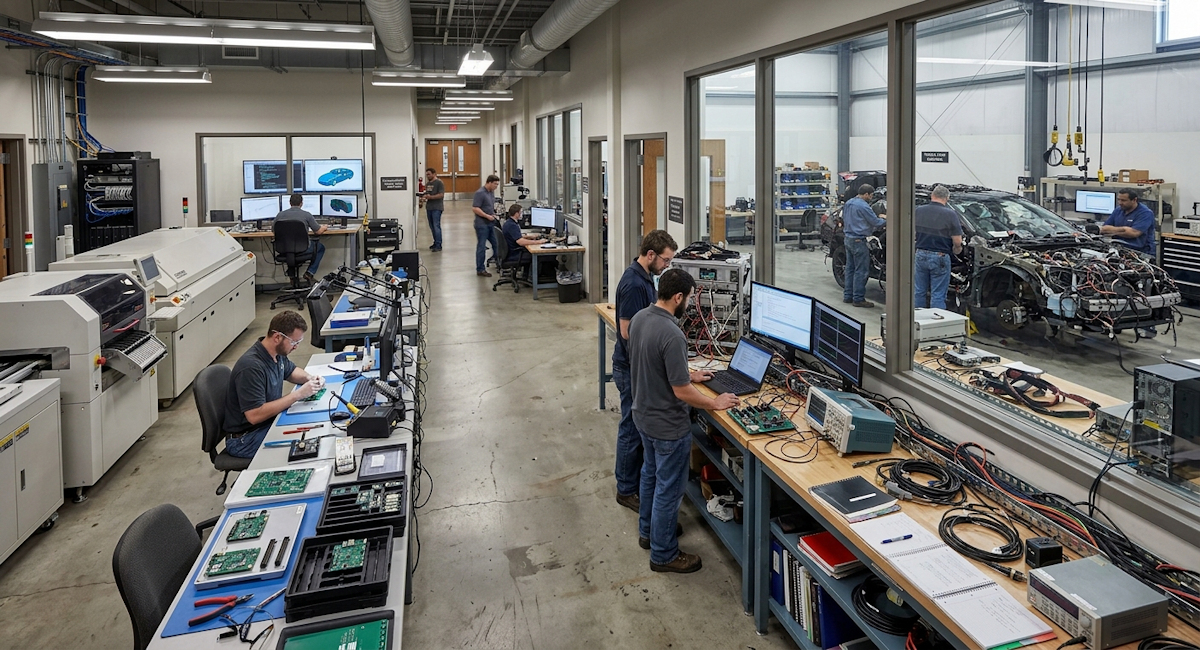
The McMonagle Automotive Electronics Center stands as Analex Laboratories' premier facility for the development of next-generation vehicle electronic systems and electrical architecture, strategically positioned in Michigan to leverage the region's deep automotive engineering expertise and proximity to major industry development centers. McMonagle occupies a purpose-built, 165,000-square-foot complex designed specifically for the unique requirements of modern automotive electronics research, featuring specialized environments for high-performance computing development, electromagnetic compatibility testing, and comprehensive hardware-in-the-loop validation. The facility architecture reflects a deliberate organizational approach that separates sensitive cleanroom environments for semiconductor characterization from high-bay spaces for vehicle-level integration testing, while maintaining seamless connectivity between computational design suites, rapid prototyping laboratories, and extensive validation chambers. Advanced environmental controls throughout the facility maintain precise temperature, humidity, and particulate conditions essential for consistent electronic component evaluation, with specialized infrastructure including extensive electromagnetic shielding, isolated power distribution, and sophisticated grounding systems that ensure accurate measurement of sensitive electronic signals.
McMonagle's core capabilities center on the architectural transformation of vehicle electronics from distributed control systems toward centralized, software-defined platforms that enable unprecedented levels of functionality, upgradability, and integration. The facility maintains extensive computational resources featuring high-performance development workstations, server clusters for software compilation and testing, and specialized emulation platforms that enable virtual prototyping of complex electronic systems prior to physical hardware fabrication. These digital capabilities are complemented by advanced electronics prototyping laboratories equipped with surface-mount assembly systems, automated optical inspection equipment, and precision rework stations that enable rapid fabrication of custom circuit boards, control modules, and power electronic assemblies for evaluation. The prototyping division specializes in producing functional electronic control units utilizing wide bandgap semiconductors, multi-core processing architectures, and high-speed communication interfaces that reflect the industry's rapid evolution toward zonal architectures and centralized high-performance computing platforms.
The testing infrastructure at McMonagle represents a comprehensive approach to electronic system validation, combining extensive hardware-in-the-loop capabilities with electromagnetic compatibility testing, environmental stress screening, and network communication validation. The facility features multiple hardware-in-the-loop test systems that integrate real electronic control units with simulated vehicle environments, enabling comprehensive software validation under precisely controlled fault conditions, load scenarios, and timing constraints that would be dangerous or impractical to replicate on actual vehicles. Electromagnetic compatibility chambers enable characterization of emission profiles and immunity characteristics across the full frequency spectrum, ensuring that electronic systems operate without interference in the electrically noisy automotive environment. Environmental test capabilities include temperature cycling chambers, thermal shock equipment, and highly accelerated life test systems that subject electronic components to extreme thermal and mechanical stresses to identify potential reliability issues prior to production deployment. McMonagle's unique capabilities include network validation systems that verify time-sensitive networking performance, communication protocol conformance, and cybersecurity resilience across complex multi-node electrical architectures.
McMonagle's equipment portfolio encompasses state-of-the-art systems specifically configured for automotive electronics development and validation. High-speed oscilloscopes and logic analyzers capture transient electrical phenomena with exceptional fidelity, enabling detailed analysis of power switching characteristics, signal integrity, and communication timing across high-speed data interfaces. Advanced power analysis equipment characterizes efficiency, thermal performance, and electromagnetic emissions of wide bandgap semiconductor-based converters operating at elevated switching frequencies. The facility maintains specialized safety analysis tools including fault injection systems that simulate hardware failures, software errors, and communication disruptions to verify that electronic systems maintain safe operation under degraded conditions. For software development, McMonagle utilizes comprehensive toolchains for model-based design, automatic code generation, and static analysis that ensure compliance with functional safety standards throughout the development lifecycle. The facility's communication test infrastructure includes network analyzers, protocol conformance testers, and specialized equipment for validating time-sensitive networking performance that enables deterministic data transmission across complex vehicle network topologies.
Cutting-Edge Specialties
- Zonal Architecture and Centralized High-Performance Computing
McMonagle's engineering teams specialize in the development of zonal electrical architectures that fundamentally restructure vehicle electronics by organizing control systems around physical location rather than functional domain, enabling significant reductions in wiring complexity and substantial improvements in computational efficiency. This specialty addresses the transition from distributed electronic control unit networks toward centralized computing platforms where high-performance computers execute sophisticated software-defined vehicle functions while zonal controllers manage local sensors and actuators through simplified communication topologies. Engineers develop advanced gateway systems, zone controllers, and central compute platforms that integrate multi-core processing, hardware accelerators for artificial intelligence inference, and high-speed Ethernet connectivity within automotive-qualified packaging. The facility's prototyping capabilities enable fabrication of complex multi-layer circuit boards with high-density interconnects, advanced thermal management features, and robust electromagnetic compatibility characteristics essential for reliable operation of centralized computing systems in challenging automotive environments.
- Time-Sensitive Networking and High-Speed Vehicle Communication
The facility maintains dedicated expertise in the implementation of time-sensitive networking protocols over automotive Ethernet that enable deterministic communication for safety-critical control functions while supporting high-bandwidth data streams for advanced driver assistance, infotainment, and diagnostic applications. This specialty encompasses the design of network architectures that guarantee bounded latency and jitter for real-time control loops while efficiently transporting high-definition video, lidar point clouds, and software update packages across shared physical infrastructure. Engineers develop sophisticated switch hardware, network interface controllers, and protocol stacks that implement traffic shaping, frame preemption, and redundancy mechanisms essential for achieving the stringent timing requirements of automated driving and chassis control systems. McMonagle's testing infrastructure validates network performance under worst-case traffic conditions, fault scenarios, and electromagnetic interference, ensuring that communication systems maintain deterministic behavior and fail-operational capabilities required for high-integrity automotive applications.
- Functional Safety and Cybersecurity Integration
McMonagle has established specialized capabilities in the concurrent development of functional safety and cybersecurity features that protect automotive electronic systems from both systematic failures and malicious attacks while maintaining compliance with international standards. This specialty addresses the complex challenge of designing electronic architectures that achieve high automotive safety integrity levels for critical functions while implementing robust security mechanisms that prevent unauthorized access, protect cryptographic keys, and ensure secure over-the-air software updates throughout the vehicle lifecycle. Engineers develop hardware security modules, secure boot implementations, and intrusion detection systems that integrate seamlessly with safety-critical software executed on lockstep processor cores with comprehensive diagnostic coverage. The facility's validation capabilities include fault injection testing that verifies safe degradation under hardware failures, penetration testing that identifies cybersecurity vulnerabilities, and comprehensive analysis that demonstrates the independence of safety mechanisms from potential security breaches.
- Wide Bandgap Power Electronics and Efficient Energy Conversion
The facility specializes in the development of power electronic systems utilizing wide bandgap semiconductors including silicon carbide and gallium nitride that enable higher efficiency, faster switching frequencies, and improved thermal performance compared to conventional silicon-based devices. This specialty addresses the critical requirements of electrified powertrains, onboard charging systems, and auxiliary power converters that demand high power density and minimal energy losses to maximize electric vehicle range and performance. Engineers design advanced gate drive circuits, thermal management solutions, and electromagnetic interference filtering that enable reliable operation of wide bandgap devices at elevated switching frequencies and temperatures. McMonagle's characterization equipment validates switching performance, conduction losses, and thermal behavior across wide operating ranges, while hardware-in-the-loop systems evaluate power electronic control algorithms under dynamic load conditions that replicate the demanding requirements of automotive traction applications.
- Software-Defined Vehicle Operating Systems and Middleware
McMonagle maintains specialized expertise in the development of vehicle operating systems and middleware frameworks that abstract hardware complexity and enable efficient software deployment across diverse electronic architectures while supporting deterministic execution for real-time control functions. This specialty encompasses the creation of software platforms that provide standardized interfaces for application development, efficient resource management across heterogeneous computing resources, and robust communication mechanisms that support service-oriented architectures and data-centric publish-subscribe patterns. Engineers develop adaptive software platforms that enable dynamic configuration, over-the-air updates, and continuous functional enhancement throughout the vehicle lifecycle while maintaining strict isolation between safety-critical and convenience functions. The facility's software validation capabilities include extensive simulation environments, hardware-in-the-loop test systems, and static analysis tools that verify correct implementation, timing behavior, and resource utilization of complex software stacks executing on multi-core processing platforms.