Automotive Infotainment & Human-Machine Interface
Located in New York, Analex Laboratories' 160,000-square-foot Fettman Automotive Human-Machine Interface Center is a purpose-built facility for advancing, prototyping, and testing next-generation digital cockpits and in-vehicle interaction systems. Its multidisciplinary engineering teams utilize advanced simulators, computational clusters, and biometric monitoring to develop cutting-edge automotive technologies, including multimodal controls, augmented reality head-up displays, AI voice assistants, non-contact biometric personalization, and software-defined architectures.
Fettman Automotive Human-Machine Interface Center
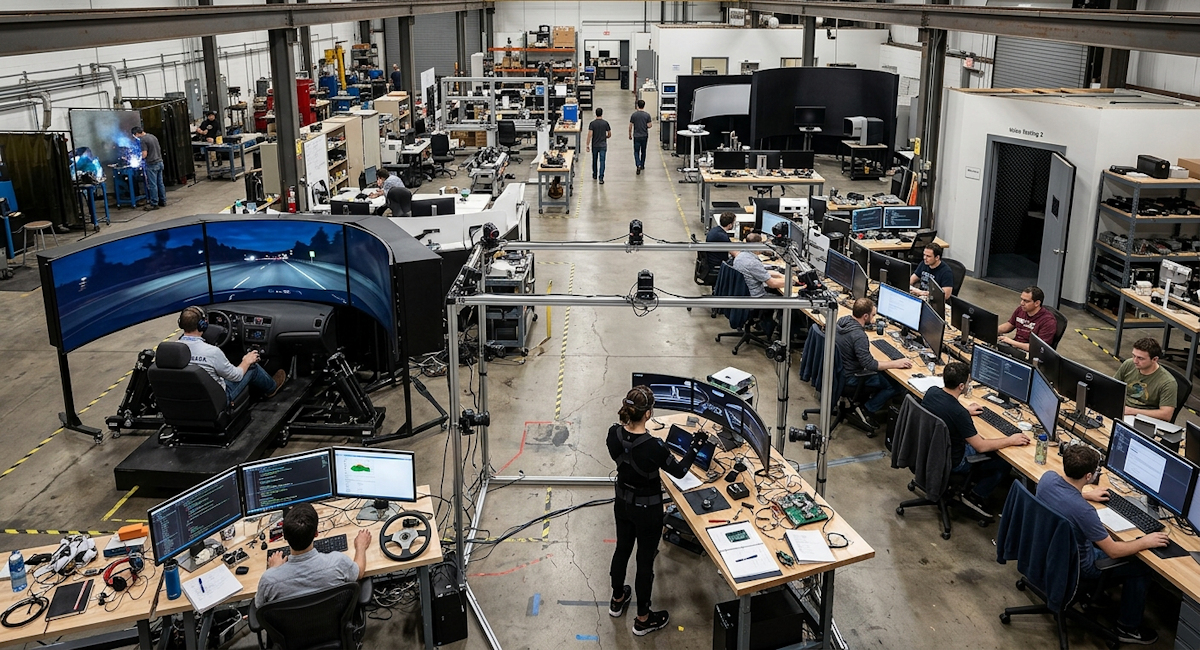
The Fettman Automotive Human-Machine Interface Center serves as Analex Laboratories' premier facility for the advancement of in-vehicle interaction technologies and digital cockpit systems, strategically located in New York to leverage the state's vibrant technology ecosystem, design talent, and proximity to major media and entertainment industries. Fettman encompasses a 160,000-square-foot purpose-built complex specifically designed for HMI research, featuring specialized environments for display technology development, voice and gesture interaction testing, user experience evaluation, and comprehensive digital cockpit integration. The facility architecture reflects a deliberate organizational approach that separates high-fidelity user testing studios from software development laboratories, with integrated spaces for hardware prototyping, perception research, and multi-sensory interaction evaluation. Advanced infrastructure throughout includes acoustically isolated chambers for voice recognition testing, variable lighting environments that simulate diverse driving conditions, and ergonomic evaluation spaces equipped with motion capture systems and physiological monitoring equipment.
Fettman's core capabilities center on the development of intuitive, safe, and engaging interfaces that enable seamless interaction between vehicle occupants and increasingly complex automotive systems including infotainment, navigation, climate control, and advanced driver assistance features. The facility maintains extensive computational resources featuring high-performance graphics processing clusters, artificial intelligence training platforms, and real-time rendering systems capable of generating photorealistic visualizations for augmented reality applications and digital cockpit environments. These computational capabilities are complemented by advanced prototyping laboratories equipped with display integration stations, haptic feedback development tools, and sensor fusion platforms that enable rapid iteration of touchscreens, control surfaces, and non-contact interaction modalities. The prototyping division specializes in creating functional HMI systems including curved and flexible display assemblies, directional audio systems, and multi-modal input devices that integrate voice, gesture, and tactile feedback within cohesive interaction architectures.
The testing infrastructure at Fettman represents a comprehensive approach to human-machine interface validation, combining controlled usability studies, distraction assessment, real-world driving simulation, and physiological response measurement. The facility features multiple driving simulator suites equipped with high-fidelity motion platforms, wraparound visual displays, and realistic vehicle controls that immerse test participants in diverse driving scenarios while evaluating interaction effectiveness and cognitive workload. Dedicated usability laboratories include one-way observation rooms, eye-tracking systems, and biometric monitoring equipment that quantify user attention, emotional response, and physiological stress during interface interactions. The facility maintains specialized equipment for evaluating display readability including photometric measurement systems, contrast analyzers, and glare assessment tools that ensure visual interfaces remain legible across diverse ambient lighting conditions. Fettman's unique capabilities include distraction testing protocols that measure the impact of interface designs on driving performance, enabling optimization of interaction flows that minimize glance time and cognitive demand while maintaining functional effectiveness.
Fettman's equipment portfolio encompasses state-of-the-art systems specifically configured for automotive HMI development. High-resolution display characterization systems measure luminance, color accuracy, and response time across diverse display technologies including organic light-emitting diode panels, liquid crystal displays, and projection systems for head-up display applications. Advanced audio testing equipment including anechoic chambers, microphone arrays, and acoustic holography systems enable development of spatial audio cues and voice recognition systems that function reliably in noisy vehicle environments. The facility maintains specialized instrumentation for gesture recognition development including depth cameras, radar sensors, and computer vision systems that track hand position and movement with millimeter precision. For user research, Fettman utilizes comprehensive biometric monitoring including electroencephalography, galvanic skin response, and heart rate variability measurement that provide objective insights into cognitive load, emotional engagement, and stress responses during interface interactions.
Cutting-Edge Specialties
- Multimodal Interaction and Intelligent Interface Orchestration
Fettman's engineering teams specialize in the development of multimodal human-machine interfaces that seamlessly integrate touch, voice, gesture, and gaze-based inputs within cohesive interaction frameworks, enabling natural communication with vehicle systems while minimizing driver distraction and cognitive workload. This specialty addresses the complex challenge of designing intelligent interface managers that interpret user intent across diverse input modalities, resolve ambiguous commands through contextual understanding, and provide appropriate feedback through multiple sensory channels including visual, auditory, and haptic displays. Engineers develop sophisticated fusion algorithms that combine inputs from disparate sensors including capacitive touch arrays, microphones, cameras, and eye-tracking systems to create robust interaction experiences that adapt to user preferences, environmental conditions, and driving scenario demands. The facility's testing capabilities validate multimodal system performance across diverse user populations, lighting conditions, and acoustic environments, ensuring reliable operation and intuitive interaction for the broad spectrum of vehicle occupants.
- Augmented Reality Head-Up Display and Spatial Interface Development
The facility maintains dedicated expertise in the development of augmented reality head-up display systems that project contextual information directly into the driver's forward field of view, creating intuitive overlays that enhance situational awareness without requiring eyes-off-road glances at traditional dashboard displays. This specialty encompasses the design of high-brightness projection systems, precision optical assemblies, and real-time rendering pipelines capable of generating perspective-correct graphics that appear anchored to real-world objects and road features with minimal latency and accurate depth perception. Engineers develop advanced environmental modeling algorithms that fuse vehicle positioning, sensor data, and high-definition map information to generate relevant augmented content including navigation guidance, hazard warnings, and vehicle trajectory predictions that align precisely with the driver's visual perspective. Fettman's optical testing capabilities characterize display luminance, contrast ratio, and image quality across diverse ambient lighting conditions, while human factors studies evaluate the impact of augmented information on driver attention, depth perception, and decision-making performance.
- Artificial Intelligence Voice Assistants and Natural Language Understanding
Fettman has established specialized capabilities in the development of intelligent voice interaction systems that leverage advanced natural language processing, contextual understanding, and emotion recognition to enable conversational interaction with vehicle systems that feels intuitive and responsive. This specialty addresses the integration of large language models, speech recognition engines, and dialogue management systems within automotive-qualified computing platforms that operate reliably without continuous cloud connectivity while maintaining user privacy and data security. Engineers develop acoustic processing algorithms that isolate occupant speech from road noise, wind buffeting, and media audio, enabling accurate recognition across diverse acoustic environments and speaker demographics. The facility's testing infrastructure evaluates voice system performance including recognition accuracy, response latency, and conversational coherence across extensive scenario libraries, while user studies assess naturalness, perceived intelligence, and trust in automated assistants that manage complex vehicle functions through spoken dialogue.
- Biometric Personalization and Wellness-Oriented Cockpit Experiences
The facility specializes in the development of biometric monitoring systems that detect occupant identity, emotional state, and physiological condition through non-contact sensing technologies, enabling automatic personalization of vehicle settings and proactive wellness interventions that enhance comfort and safety. This specialty encompasses the integration of facial recognition, iris scanning, heart rate monitoring, and stress detection technologies that authenticate users, recall individual preferences, and adapt cabin environments including lighting, temperature, seating position, and media content to optimize occupant wellbeing. Engineers develop intelligent systems that recognize signs of driver fatigue, stress, or medical distress through analysis of facial expressions, steering behavior, and physiological signals, triggering appropriate interventions including alerts, environmental adjustments, or automated driving mode activation. Fettman's validation capabilities include biometric accuracy testing across diverse demographics, privacy assessment of data handling practices, and wellness outcome evaluation that demonstrates measurable improvements in occupant comfort and alertness during extended driving periods.
- Software-Defined Digital Cockpit Architectures
Fettman maintains specialized expertise in the development of software-defined cockpit platforms that decouple hardware and software lifecycles, enabling continuous feature enhancement, over-the-air updates, and extensive customization while maintaining functional safety and deterministic performance for critical driving information displays. This specialty addresses the design of scalable computing architectures, high-speed data networks, and virtualization technologies that support multiple independent display domains, seamless content migration between screens, and dynamic reconfiguration of control layouts based on driving mode and user preferences. Engineers develop robust software frameworks that ensure safety-critical information including speed, warnings, and navigation guidance remains visible and accurate even when infotainment systems experience software faults or require updates. The facility's testing capabilities validate system responsiveness, graphics performance, and failure mode behavior across extensive use case scenarios, ensuring digital cockpit platforms deliver engaging user experiences while maintaining the reliability and availability essential for automotive deployment.