Advanced Driver Assistance Systems & Autonomous Driving
Located strategically in Pennsylvania, the Feustel Autonomous Driver Center is Analex Laboratories' premier research facility, equipped with 195,000 square feet of high-performance computing, specialized testing chambers, and controlled proving grounds to support full-spectrum automated driving development. The center's cutting-edge capabilities focus on advancing multi-modal sensor fusion, digital-twin simulations, optimized edge AI processing, V2X communications, and high-definition mapping to ensure robust, real-world autonomous navigation.
Feustel Autonomous Driver Center
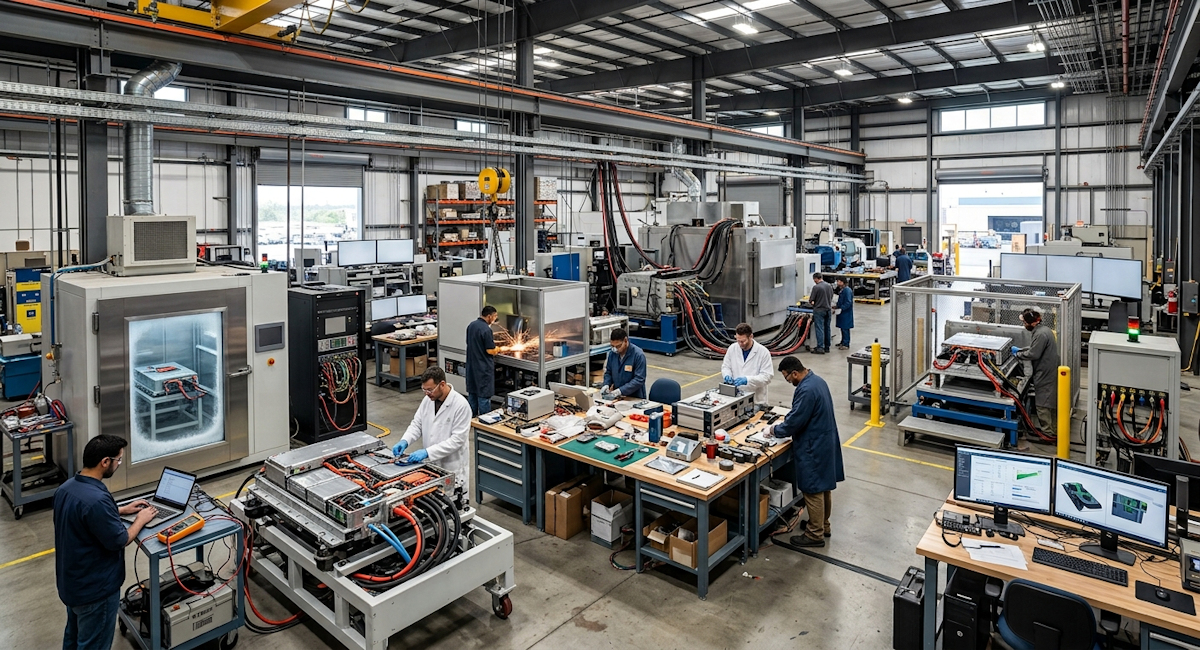
The Feustel Autonomous Driver Center serves as Analex Laboratories' premier research facility dedicated to the advancement of automated driving systems and advanced driver assistance technologies, strategically located in Pennsylvania to leverage the region's robust engineering heritage and proximity to major transportation corridors. Feustel encompasses a 195,000-square-foot integrated complex specifically designed to support the full spectrum of autonomous system development, from sensor hardware prototyping through algorithm validation and vehicle-level integration testing. The facility architecture reflects a sophisticated organizational approach that separates high-bay garage spaces for instrumented vehicle preparation, cleanroom environments for optical sensor calibration, electromagnetic chambers for radio frequency testing, and extensive server farms for artificial intelligence model training and simulation workloads. Advanced climate control systems maintain precise environmental conditions essential for consistent sensor performance evaluation, while redundant power infrastructure and specialized network architecture support the massive data throughput requirements of high-definition mapping, real-time perception processing, and continuous simulation operations.
Feustel's core capabilities center on the development and validation of perception systems, decision-making algorithms, and vehicle control strategies that enable increasingly sophisticated levels of driving automation. The facility maintains extensive computational resources featuring high-performance computing clusters equipped with specialized accelerators for training deep neural networks on massive datasets of annotated driving scenarios, sensor recordings, and simulated environments. These computational capabilities are complemented by advanced prototyping laboratories where engineers develop and refine camera systems, radar modules, lidar units, and ultrasonic sensors, utilizing precision optical benches, anechoic chambers, and environmental simulation equipment to characterize sensor performance across diverse lighting, weather, and temperature conditions. The prototyping division specializes in creating integrated sensor suites that combine multiple modalities through sophisticated fusion algorithms, producing perception systems capable of robust object detection, classification, and tracking under challenging real-world conditions including adverse weather, occlusions, and complex urban environments.
The testing infrastructure at Feustel represents a comprehensive approach to autonomous system validation, combining extensive simulation capabilities with controlled physical test environments and carefully orchestrated on-road evaluation programs. The facility features multiple high-fidelity driving simulators that immerse human test participants in realistic virtual environments while monitoring physiological responses, cognitive workload, and intervention patterns during supervised autonomous operation. Large-scale indoor test halls equipped with configurable infrastructure elements, robotic pedestrian targets, and mobile platform vehicles enable repeatable evaluation of emergency braking, collision avoidance, and complex maneuvering scenarios under precisely controlled conditions. The facility maintains an extensive outdoor proving ground incorporating various road geometries, intersection configurations, and surface conditions that support progressive validation of autonomous functions from basic lane keeping through complex urban navigation. Feustel's unique capabilities include vehicle-in-the-loop systems that integrate physical test vehicles with simulated traffic environments, enabling safe evaluation of edge-case scenarios and fault conditions that would be dangerous or impractical to replicate on public roads.
Feustel's equipment portfolio encompasses state-of-the-art systems specifically configured for autonomous driving research and development. High-resolution camera calibration rigs utilizing multi-target arrays and precision motion platforms ensure accurate geometric and photometric characterization of imaging systems across wide temperature ranges and vibration profiles. Advanced radar test systems featuring programmable target simulators enable evaluation of detection performance, range accuracy, and Doppler processing capabilities without requiring extensive physical test tracks. The facility maintains multiple lidar characterization chambers equipped with calibrated reflectivity targets, controlled atmospheric conditions, and precision positioning systems that quantify range accuracy, point cloud density, and interference rejection capabilities. For system-level validation, Feustel utilizes comprehensive data acquisition platforms capable of synchronously recording high-rate sensor streams, vehicle bus communications, and positioning reference data with sub-millisecond precision, enabling detailed post-test analysis of perception algorithm performance, decision-making timing, and control system responses. The facility's edge computing laboratory provides development platforms for optimizing neural network inference on automotive-grade processing hardware, characterizing latency, thermal performance, and power consumption under realistic workload conditions.
Cutting-Edge Specialties
- Multi-Modal Sensor Fusion and Perception Architecture
Feustel's research teams specialize in the development of advanced sensor fusion systems that integrate data from cameras, radar, lidar, and ultrasonic sensors to create comprehensive environmental understanding exceeding the capabilities of any individual sensing modality. This specialty addresses the critical challenge of achieving robust perception across diverse operating conditions by leveraging complementary sensor strengths while intelligently managing conflicting information and sensor degradation scenarios. Engineers develop sophisticated fusion algorithms utilizing deep learning architectures that operate at multiple abstraction levels, from low-level signal fusion through high-level semantic interpretation, enabling detection and tracking of vulnerable road users, vehicles, infrastructure elements, and dynamic obstacles with high reliability. The facility's testing infrastructure validates perception system performance across extensive scenario libraries incorporating varying lighting conditions, weather phenomena, and geometric configurations, ensuring that fused sensor systems maintain accurate environmental understanding when individual sensors experience reduced performance or temporary occlusion.
- Digital Twin-Based Simulation and Scenario Generation
The facility maintains specialized capabilities in the creation and utilization of digital twin environments that provide high-fidelity virtual representations of real-world locations, enabling comprehensive autonomous system validation without the safety risks and logistical constraints of extensive on-road testing. This specialty encompasses the development of physics-based simulation platforms that accurately model sensor physics, vehicle dynamics, traffic behavior, and environmental conditions to create realistic test scenarios for perception, planning, and control algorithm evaluation. Engineers utilize generative artificial intelligence techniques to automatically create diverse scenario variations including rare edge cases, adversarial conditions, and complex multi-agent interactions that would require impractical amounts of real-world driving to encounter naturally. Feustel's unique capabilities include the integration of real sensor data with simulated environments, enabling software-in-the-loop and hardware-in-the-loop testing that validates system performance using actual production-intent computing hardware and sensor components within virtual scenarios that replicate challenging real-world situations.
- Edge AI Computing and Real-Time Processing Optimization
Feustel has established dedicated expertise in the development of onboard computing architectures capable of executing sophisticated autonomous driving algorithms within strict latency, power consumption, and thermal constraints imposed by automotive deployment environments. This specialty focuses on optimizing neural network inference for specialized accelerators through quantization, pruning, and architecture search techniques that maintain perception accuracy while achieving real-time performance on energy-efficient hardware. Engineers develop custom computational pipelines that balance workload distribution between centralized processing units and distributed edge computing elements, ensuring that safety-critical functions maintain deterministic response times while maximizing the utilization of available computational resources. The facility's edge computing laboratory enables comprehensive characterization of processing system performance including inference latency under thermal stress, power consumption across various workload profiles, and fault tolerance mechanisms that ensure graceful degradation during hardware anomalies or software exceptions.
- V2X Communication and Cooperative Autonomy
The facility specializes in the development of vehicle-to-everything communication systems that enable cooperative perception, intention sharing, and coordinated maneuvering between connected vehicles, infrastructure elements, and vulnerable road users. This specialty addresses the integration of dedicated short-range communication and cellular vehicle-to-everything technologies with onboard autonomous systems, creating architectures that leverage external information sources to extend perception range beyond onboard sensor limitations and improve decision-making through awareness of traffic signal timing, road hazard warnings, and surrounding vehicle intentions. Engineers develop sophisticated security protocols that authenticate communication sources, encrypt sensitive data exchanges, and detect anomalous messages that could indicate cyber attacks or system malfunctions. Feustel's testing infrastructure validates V2X system performance including communication range, message latency, and interoperability across diverse equipment implementations, ensuring that cooperative autonomy functions operate reliably in mixed-traffic environments where connected and non-connected vehicles share roadways.
- High-Definition Mapping and Robust Localization
Feustel maintains specialized capabilities in the creation, maintenance, and utilization of high-definition maps that provide centimeter-level localization accuracy and detailed semantic understanding of road infrastructure essential for safe autonomous navigation. This specialty encompasses the development of mapping systems that capture precise lane geometry, traffic control device locations, road surface characteristics, and dynamic layer information including construction zones and temporary traffic patterns. Engineers create robust localization algorithms that combine high-definition map data with real-time sensor observations including visual features, lidar point clouds, and satellite positioning to maintain accurate vehicle pose estimation in GPS-denied environments such as urban canyons, tunnels, and dense foliage. The facility's research addresses the critical challenge of map freshness and change detection, developing automated systems that identify infrastructure modifications through fleet-based data collection and crowd-sourced observation, ensuring that autonomous systems operate with current, accurate environmental representations that reflect real-world conditions.