Automotive Safety Systems
The Lind Automotive Safety Center, an Analex Laboratories facility in Utah, is a 190,000-square-foot research complex equipped with computational simulation platforms, prototyping laboratories, and advanced crash-testing infrastructure. Its engineering teams specialize in developing integrated active, passive, and post-crash vehicle technologies, including automatic emergency braking, adaptive restraint systems, interior occupant monitoring, and vulnerable road user protection.
Lind Automotive Safety Center
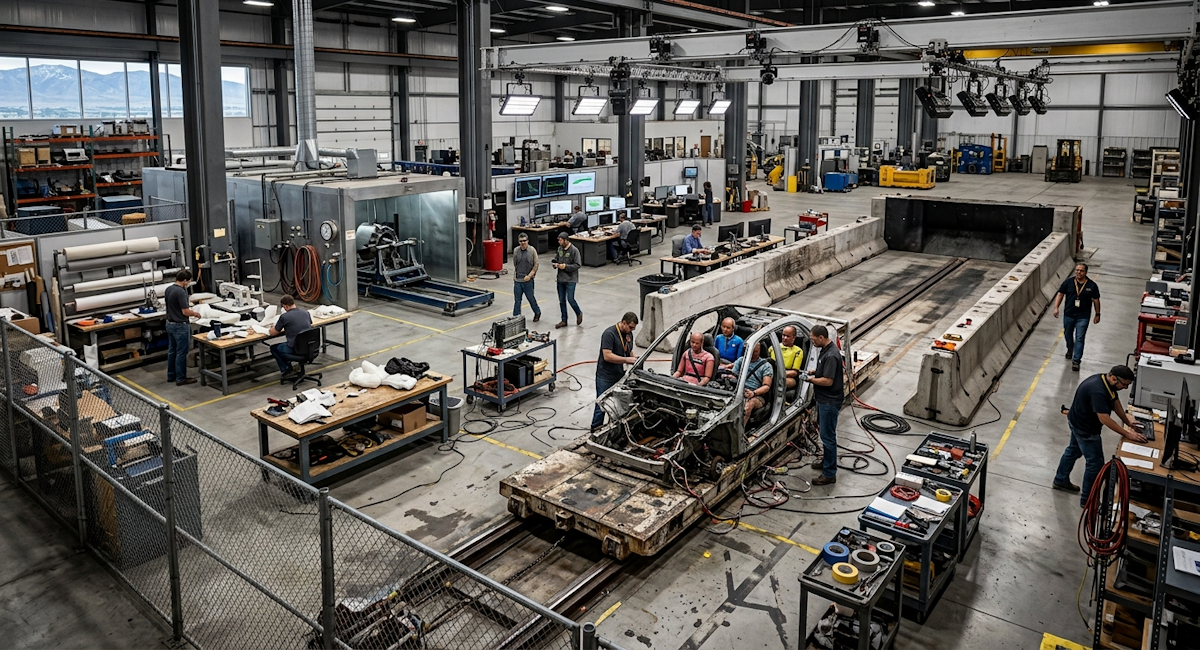
The Lind Automotive Safety Center represents Analex Laboratories' dedicated facility for the advancement of vehicle safety technologies and occupant protection systems, strategically located in Utah to leverage the state's diverse terrain for real-world testing and proximity to major automotive development corridors. Lind encompasses a 190,000-square-foot purpose-built complex specifically designed for safety system research, featuring specialized environments for crash simulation, sensor development, restraint system testing, and comprehensive safety validation. The facility architecture reflects a deliberate organizational approach that separates high-energy impact test areas from precision instrumentation laboratories, with integrated spaces for computational crash analysis, component prototyping, and full-system integration evaluation. Advanced infrastructure throughout includes reinforced concrete barriers capable of withstanding high-speed vehicle impacts, specialized ventilation systems for managing post-test atmospheres, and isolated foundations that prevent vibration transmission between sensitive measurement equipment and high-energy test apparatus.
Lind's core capabilities center on the development of active safety systems that prevent crashes, passive safety systems that protect occupants during collisions, and post-crash technologies that facilitate rescue operations and minimize injury severity. The facility maintains extensive computational resources featuring finite element analysis platforms capable of simulating complex crash scenarios, enabling virtual evaluation of structural behavior, occupant kinematics, and restraint system performance prior to physical testing. These computational capabilities are complemented by advanced prototyping laboratories equipped with precision sewing systems for airbag fabrication, pyrotechnic device assembly stations, and sensor integration facilities that enable rapid development of safety components for evaluation. The prototyping division specializes in creating functional safety systems including advanced airbag modules, seatbelt pretensioners, collision detection sensors, and interior monitoring cameras that reflect the industry's rapid evolution toward integrated active and passive safety architectures.
The testing infrastructure at Lind represents a comprehensive approach to safety system validation, combining component-level evaluation, subsystem testing, and full-vehicle crash assessment under precisely controlled conditions. The facility features multiple impact test systems including sled facilities that subject occupant compartments to controlled deceleration pulses, barrier impact rigs for evaluating structural crashworthiness, and pedestrian protection test equipment that assesses injury potential to vulnerable road users. Indoor test areas equipped with high-speed cameras, motion capture systems, and extensive lighting enable detailed analysis of high-speed events including airbag deployments, seatbelt engagement, and structural deformation. The facility maintains specialized anthropomorphic test devices representing diverse occupant sizes and ages, instrumented with sensors that quantify forces, accelerations, and deflections experienced during crash events. Lind's unique capabilities include hardware-in-the-loop systems that integrate physical restraint components with virtual crash environments, enabling safe evaluation of safety system performance across extensive scenario libraries without the cost and complexity of full-scale crash testing.
Lind's equipment portfolio encompasses state-of-the-art systems specifically configured for automotive safety development. High-speed imaging systems capable of capturing thousands of frames per second enable detailed analysis of transient events including airbag inflation, structural buckling, and occupant motion during crash events. Advanced sensor systems including accelerometers, load cells, and pressure transducers quantify the mechanical environment experienced by vehicle structures and occupants during collisions with exceptional precision. The facility maintains specialized equipment for evaluating sensor performance including radar cross-section measurement systems, camera calibration rigs, and environmental test chambers that validate detection capabilities across diverse lighting, weather, and temperature conditions. For restraint system development, Lind utilizes precision tension testers, inflation gas analysis equipment, and thermal chambers that characterize airbag fabric properties, propellant performance, and system reliability over wide temperature ranges.
Cutting-Edge Specialties
- Automatic Emergency Braking and Collision Avoidance Integration
Lind's engineering teams specialize in the development of automatic emergency braking systems that utilize sensor fusion to detect imminent collisions with vehicles, pedestrians, cyclists, and other obstacles, automatically applying braking force when driver intervention is insufficient to prevent impact. This specialty addresses the integration of radar, camera, and lidar technologies with high-performance computing platforms capable of real-time object detection, trajectory prediction, and threat assessment across diverse driving scenarios and environmental conditions. Engineers develop sophisticated algorithms that balance collision avoidance effectiveness with false positive mitigation, ensuring systems intervene decisively in genuine emergency situations while avoiding unnecessary activations that could create rear-end collision risks. The facility's testing infrastructure validates automatic emergency braking performance across extensive scenario catalogs including varying approach speeds, obstacle types, road surface conditions, and visibility constraints, ensuring systems meet stringent regulatory requirements and consumer safety expectations.
- Advanced Occupant Protection and Adaptive Restraint Systems
The facility maintains dedicated expertise in the development of adaptive restraint systems that customize protection levels based on occupant size, position, and crash severity, utilizing multi-stage airbags, variable-force seatbelt pretensioners, and intelligent deployment algorithms to optimize injury mitigation for diverse occupant demographics. This specialty encompasses the design of occupant classification systems that distinguish between adults, children, and child seats, enabling appropriate airbag suppression or deployment strategies that prevent injuries to vulnerable passengers while ensuring adequate protection for properly positioned adults. Engineers develop advanced airbag architectures including knee bags, center-mounted curtains, and far-side protection systems that address injury mechanisms identified through biomechanical research and real-world crash data analysis. Lind's testing capabilities include sled testing with diverse anthropomorphic test devices, component-level airbag deployment characterization, and full-system integration validation that ensures coordinated restraint responses across varied crash scenarios.
- Interior Monitoring and Child Presence Detection
Lind has established specialized capabilities in the development of interior monitoring systems that detect occupants throughout the vehicle cabin, with particular emphasis on child presence detection technologies that prevent heatstroke tragedies through continuous monitoring of rear seating areas. This specialty addresses the integration of thermal imaging, motion sensing, and radar-based detection technologies capable of identifying human presence regardless of lighting conditions, clothing types, or seating positions while maintaining privacy through appropriate data processing architectures. Engineers develop sophisticated algorithms that distinguish between living occupants and inanimate objects, track occupant position and posture for optimized airbag deployment timing, and detect signs of driver impairment or distraction that may compromise vehicle control. The facility's validation capabilities include environmental testing across extreme temperature ranges, false positive evaluation with diverse object types, and integration testing that ensures reliable operation within complete vehicle electrical architectures.
- Vulnerable Road User Protection and Pedestrian Safety
The facility specializes in the development of systems that protect pedestrians, cyclists, and other vulnerable road users through active collision avoidance technologies and passive impact mitigation features including deployable hoods, exterior airbags, and structural designs that reduce injury severity during unavoidable contacts. This specialty addresses the unique challenges of detecting and responding to vulnerable road users who exhibit unpredictable motion patterns, smaller radar cross-sections, and greater injury susceptibility compared to vehicle occupants. Engineers develop advanced sensor configurations optimized for detecting pedestrians in urban environments, algorithms that predict crossing intentions and trajectory changes, and exterior vehicle designs that minimize head and lower extremity injury potential during impacts. Lind's testing infrastructure includes pedestrian impactors, cyclist surrogates, and active hood deployment systems that validate protection effectiveness across diverse impact scenarios, speeds, and pedestrian postures.
- Post-Crash Safety and Emergency Response Integration
Lind maintains specialized expertise in the development of technologies that enhance occupant survival and facilitate rescue operations following collisions, including automatic collision notification systems, advanced e-call functionality, and vehicle designs that maintain occupant compartment integrity while enabling efficient extrication by emergency responders. This specialty encompasses the integration of multi-axis accelerometers and crash severity algorithms that automatically detect significant impacts, transmit location and injury potential information to emergency services, and unlock doors while disabling high-voltage systems to facilitate safe rescue operations. Engineers develop robust communication systems that maintain connectivity in damaged vehicles, battery backup architectures that ensure emergency system operation following electrical system compromise, and structural designs that prevent door jamming while maintaining crashworthiness. The facility's validation capabilities include full-scale crash testing with emergency response simulation, communication system testing in shielded environments, and durability testing that ensures reliable operation under extreme conditions including vehicle submersion and fire exposure.