Chassis & Vehicle Dynamics Engineering
Located in Ohio, the 175,000-square-foot Resnik Vehicle Dynamics Engineering Center is Analex Laboratories' premier facility for developing and testing advanced automotive chassis systems, featuring purpose-built laboratories, computational simulation platforms, and dynamic test environments. The facility specializes in cutting-edge vehicle engineering, including x-by-wire integration, integrated dynamics control, active suspensions, lightweight multi-material structures, and real-time multibody simulation.
Resnik Vehicle Dynamics Engineering Center
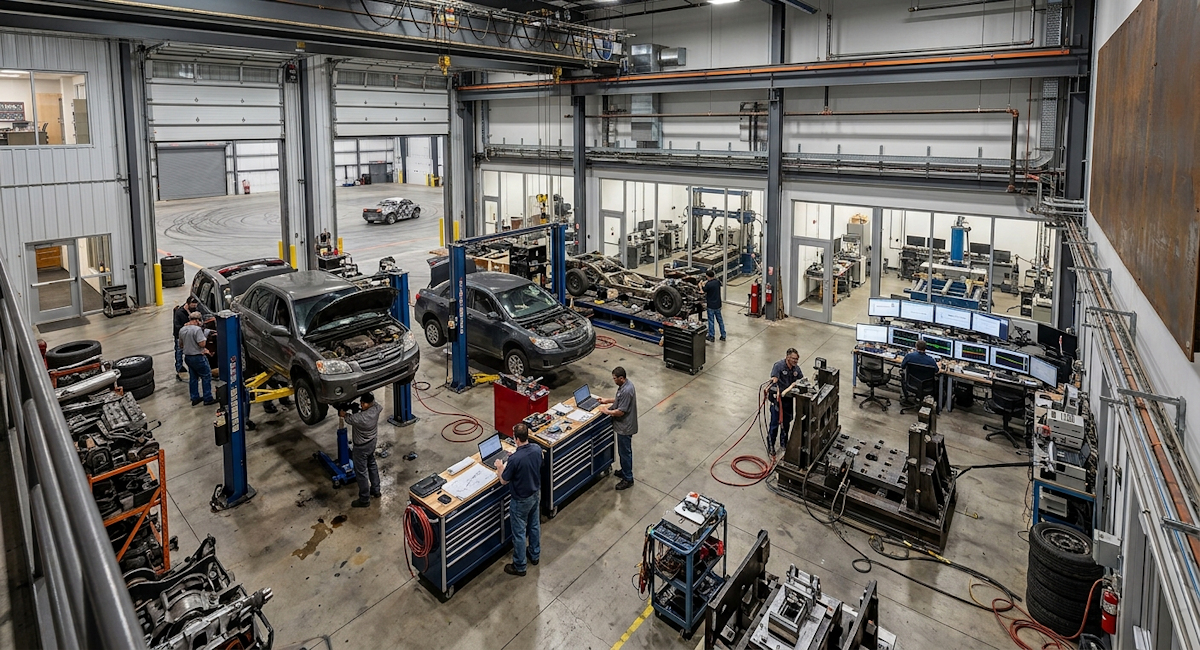
The Resnik Vehicle Dynamics Engineering Center serves as Analex Laboratories' premier facility for the advancement of automotive chassis systems and vehicle dynamics technologies, strategically located in Ohio to leverage the state's deep automotive manufacturing heritage and proximity to major proving grounds and testing facilities. Resnik encompasses a 175,000-square-foot purpose-built complex specifically designed for chassis development, featuring specialized environments for suspension prototyping, steering system evaluation, brake testing, and comprehensive vehicle dynamics validation. The facility architecture reflects a deliberate organizational approach that separates high-bay vehicle preparation areas from precision instrumentation laboratories, with integrated spaces for multibody simulation, hardware-in-the-loop testing, and full-vehicle dynamic evaluation. Advanced infrastructure throughout includes reinforced floor slabs capable of supporting heavy test fixtures, isolated foundations for sensitive measurement equipment, and climate-controlled environments that maintain consistent conditions for repeatable chassis component evaluation across diverse temperature and humidity ranges.
Resnik's core capabilities center on the design, prototyping, and validation of complete chassis systems including suspension architectures, steering mechanisms, brake systems, and integrated vehicle dynamics controls that define modern automotive handling, ride comfort, and safety performance. The facility maintains extensive computational resources featuring multibody dynamics simulation platforms capable of modeling complete vehicle behavior under diverse operating conditions, enabling virtual evaluation of chassis designs prior to physical prototype fabrication. These computational capabilities are complemented by advanced prototyping laboratories equipped with precision machining centers, welding systems, and composite fabrication equipment that enable rapid production of suspension components, steering linkages, and chassis structural elements for evaluation. The prototyping division specializes in creating functional chassis assemblies utilizing advanced materials including high-strength steels, aluminum alloys, and polymer composites that optimize the trade-offs between structural stiffness, mass reduction, and manufacturing feasibility essential for modern vehicle applications.
The testing infrastructure at Resnik represents a comprehensive approach to chassis and vehicle dynamics validation, combining component-level evaluation, subsystem testing, and full-vehicle dynamic assessment under precisely controlled conditions. The facility features multiple dynamic test rigs including suspension parameter measurement machines, steering system evaluators, and brake dynamometers that characterize component performance across wide operating envelopes. A large indoor test hall equipped with a flat-floor driving surface enables controlled evaluation of vehicle handling maneuvers, stability interventions, and ride quality assessment under repeatable conditions independent of weather. The facility maintains specialized equipment for measuring vehicle inertial properties, center of gravity location, and suspension kinematics with exceptional precision. Resnik's unique capabilities include hardware-in-the-loop systems that integrate physical chassis components with virtual vehicle environments, enabling safe evaluation of control strategies, failure modes, and edge-case scenarios that would be dangerous to replicate on public roads or traditional proving grounds.
Resnik's equipment portfolio encompasses state-of-the-art systems specifically configured for chassis and vehicle dynamics engineering. High-frequency motion platforms and hydraulic actuators subject suspension components and complete chassis assemblies to road-induced vibrations, steering inputs, and braking forces that replicate real-world operating conditions with high fidelity. Advanced data acquisition systems synchronously capture vehicle motion parameters, suspension displacements, tire forces, and control system responses at high sampling rates, enabling detailed analysis of transient dynamic behavior. The facility maintains specialized instrumentation including inertial measurement units, optical tracking systems, and strain gauge arrays that quantify chassis deformation, component loading, and vehicle attitude during dynamic maneuvers. For tire and road interaction studies, Resnik utilizes flat-belt tire test machines and portable friction measurement devices that characterize grip characteristics across diverse surface conditions, informing chassis tuning decisions and stability control algorithm development.
Cutting-Edge Specialties
- X-by-Wire Chassis Systems and Mechatronic Integration
Resnik's engineering teams specialize in the development of brake-by-wire, steer-by-wire, and suspension-by-wire systems that replace traditional mechanical linkages with electronic actuation, enabling unprecedented flexibility in vehicle dynamics control and paving the way for software-defined chassis architectures. This specialty addresses the design of fault-tolerant electronic systems capable of delivering precise, responsive control of vehicle motion while maintaining safety through redundant architectures, comprehensive diagnostics, and graceful degradation strategies. Engineers develop advanced actuator technologies, high-integrity control algorithms, and human-machine interfaces that provide intuitive driver feedback while enabling innovative control strategies such as variable steering ratio, predictive brake actuation, and adaptive suspension response. The facility's testing infrastructure validates by-wire system performance including response latency, force feedback quality, and fail-operational behavior under fault conditions, ensuring these critical safety systems meet stringent reliability and availability requirements.
- Integrated Vehicle Dynamics Control and Multi-Actuator Coordination
The facility maintains dedicated expertise in the development of integrated control systems that coordinate multiple chassis actuators including active suspension, torque vectoring, rear-wheel steering, and active aerodynamics to optimize vehicle behavior across diverse driving conditions and driver demands. This specialty encompasses the creation of unified control architectures that dynamically distribute forces and moments across all four tires, maximizing grip utilization while enhancing agility, stability, and comfort through predictive, model-based control strategies. Engineers develop sophisticated estimation algorithms that reconstruct tire-road friction, vehicle states, and driver intent from available sensor measurements, enabling control systems that adapt to changing conditions and anticipate driver inputs. Resnik's simulation and testing capabilities validate integrated control strategies across extensive scenario libraries including emergency maneuvers, split-friction braking, and limit-handling situations, ensuring coordinated actuator responses that maintain vehicle stability while maximizing performance.
- Advanced Suspension Systems and Ride Dynamics Optimization
Resnik has established specialized capabilities in the development of active and semi-active suspension systems that continuously adapt damping, spring rate, and geometry to optimize ride comfort, handling response, and road holding across diverse operating conditions. This specialty addresses the design of hydraulic, electromagnetic, and electromechanical actuation systems capable of delivering precise force control at each wheel, responding to road disturbances and vehicle motions within milliseconds to isolate occupants from harshness while maintaining tire contact with the road surface. Engineers develop control algorithms that balance competing objectives including body motion control, wheel hop suppression, and energy efficiency, utilizing preview information from forward-looking sensors and vehicle-to-infrastructure communication to anticipate road conditions and proactively adjust suspension settings. The facility's prototyping capabilities enable fabrication of custom suspension hardware with optimized kinematics, compliance characteristics, and packaging efficiency for specific vehicle applications.
- Lightweight Chassis Structures and Advanced Materials Integration
The facility specializes in the development of chassis structural systems utilizing advanced materials and manufacturing processes that achieve significant mass reduction while maintaining or improving structural stiffness, crash performance, and durability characteristics. This specialty encompasses the design of multi-material chassis architectures that strategically combine high-strength steels, aluminum alloys, polymer composites, and additive-manufactured elements to optimize strength-to-weight ratios across diverse loading conditions. Engineers utilize topology optimization, generative design, and multi-physics simulation to create efficient structural layouts that maximize performance while minimizing material usage. Resnik's testing capabilities include static and dynamic structural evaluation, fatigue life assessment, and corrosion resistance validation that ensure lightweight chassis designs meet stringent durability and safety requirements over complete vehicle lifecycles.
- Real-Time Multibody Simulation and Virtual Chassis Development
Resnik maintains specialized expertise in the creation and utilization of high-fidelity multibody dynamics models that enable comprehensive virtual evaluation of chassis performance, reducing reliance on physical prototypes while accelerating the development timeline and expanding the design space that can be explored. This specialty encompasses the development of real-time capable simulation models that accurately represent suspension kinematics, tire behavior, and chassis compliance, enabling hardware-in-the-loop testing and driving simulator applications that immerse test drivers in realistic virtual environments. Engineers create parameterized chassis models that can be rapidly adapted to evaluate diverse design alternatives, conduct sensitivity studies, and optimize tuning parameters without the time and expense of fabricating physical hardware. The facility's simulation capabilities support correlation studies that validate virtual models against physical test data, ensuring that simulation predictions accurately represent real-world vehicle behavior and can be relied upon for design decisions and control system calibration.