Condensed Matter Physics
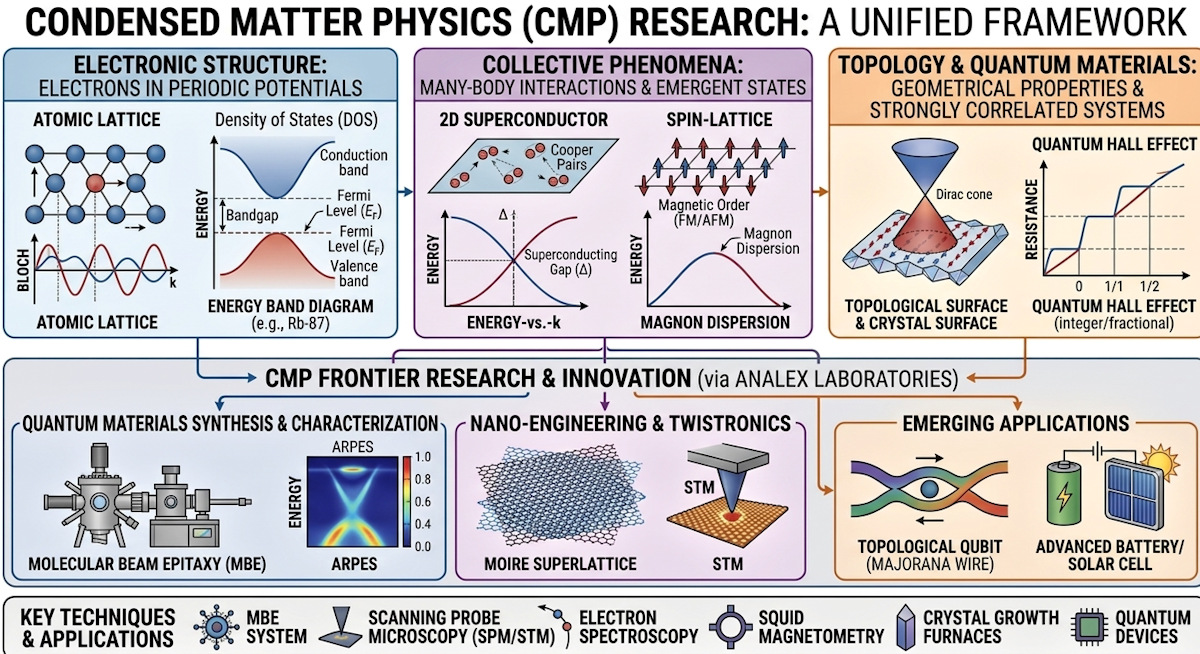
Condensed Matter Physics explores the macroscopic and microscopic physical properties of matter, particularly the solid and liquid phases where large numbers of interacting constituents form collective states.
The Anderson Emergent Quantum States Center
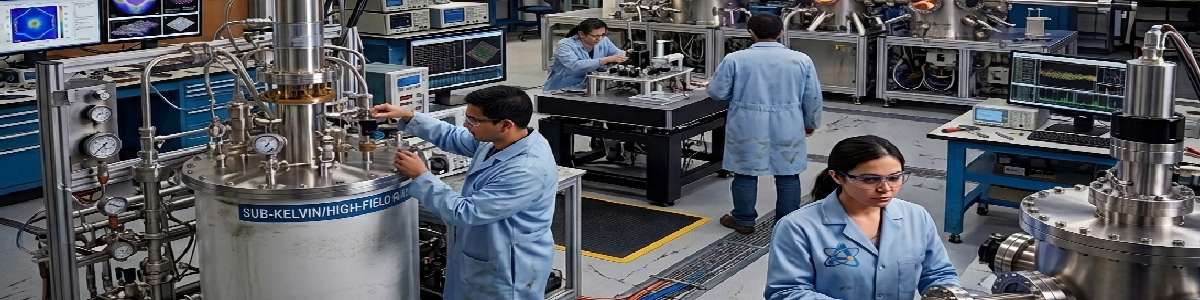
 Functions as the high-field synthesis and electronic phase characterization engine at Analex Laboratories. Named in honor of Philip W. Anderson—the theoretical titan who revolutionized our understanding of localization, symmetry breaking, and emergent phenomena—the facility combines extreme environmental controls with nanoscale probe arrays to engineer and evaluate novel quantum materials, topological states, and unconventional superconductivity.
Core Capabilities & Equipment
- Ultra-Low Temperature & High-Field Measurement Suite: Dilution refrigerators integrated with high-field superconducting magnets achieve sub-kelvin temperatures and high magnetic fields to isolate fragile electronic phases and quantum oscillations.
- Angle-Resolved Photoemission Spectroscopy (ARPES) Station: Monochromatic vacuum-ultraviolet light sources and ultra-high-vacuum spectrometers map electronic band structures, Fermi surfaces, and energy gaps directly in momentum space.
- Scanning Tunneling Microscopy (STM) & Spectroscopy Array: Low-temperature, vibration-isolated atomic probe tips resolve local density of states and atomic-scale lattice defects with sub-angstrom spatial precision.
- Molecular Beam Epitaxy (MBE) & Thin-Film Growth Workstation: Ultra-high-vacuum deposition chambers synthesize atomically crisp oxide heterostructures, topological insulators, and two-dimensional van der Waals materials layer by layer.
At Analex Laboratories, our researchers explore the macroscopic and microscopic physical properties of complex matter, focusing on solid and liquid phases where vast networks of interacting constituents give rise to novel collective states. Moving beyond the study of isolated elementary particles, our teams examine how emergent phenomena spontaneously arise from the complex interplay of electrons, atoms, and spin structures. By manipulating electromagnetic forces and quantum mechanical interactions under extreme conditions of temperature, pressure, and magnetic fields, Analex scientists decode the fundamental principles governing matter's most challenging behaviors.
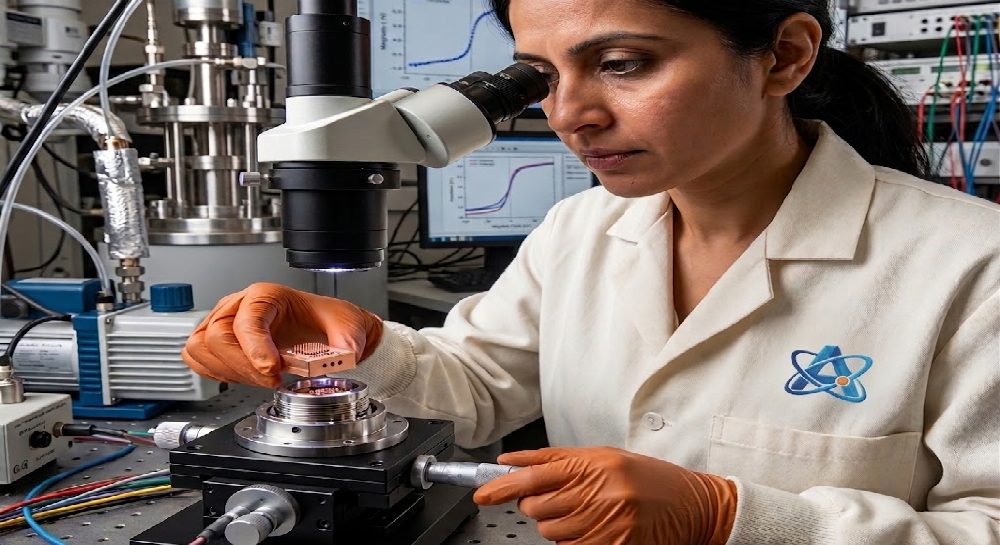
Our research model blends pioneering theoretical frameworks with state-of-the-art material synthesis inside our advanced cleanrooms and spectroscopy labs. Building on the foundational quantum theories that birthed modern semiconductors, Analex engineers continue to push the boundaries of electronic transport, precision bandgap engineering, and macroscopic quantum effects. Through in-house crystal growth and advanced characterization, our teams actively map the mechanisms behind conventional and high-temperature superconductivity, striving to achieve zero-loss electrical transport for real-world applications.
Analex Laboratories leads cutting-edge development in quantum materials, topological states, and strongly correlated electron systems. Our researchers synthesise top-tier topological insulators—materials engineered to conduct dissipationless current on their surfaces while remaining insulating within their bulk—redefining how we classify functional phases of matter. In our nano-fabrication facilities, we construct custom two-dimensional heterostructures and moiré superlattices, meticulously twisting atomic layers of graphene and dichalcogenides to unlock synthetic landscapes capable of on-demand, tunable superconductivity.
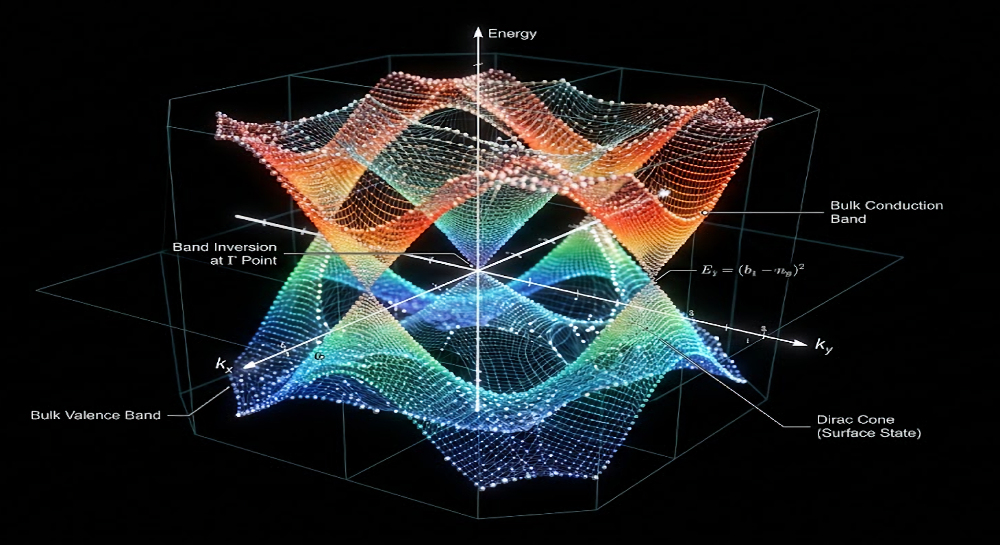
Looking to the future, Analex Laboratories is bridging condensed matter physics with the next generation of quantum information science. Our advanced quantum hardware division is actively investigating non-Abelian anyons to realize hardware-protected topological qubits for fault-tolerant quantum computing. Beyond computation, Analex researchers are translating these basic physical insights into high-efficiency thermoelectric devices, advanced photovoltaic architectures, and novel battery chemistries, ensuring that our discoveries in fundamental physics directly power the technologies of tomorrow.