Building Automation & Energy Efficiency
The Slayton Building Automation Center at Analex Laboratories in Wisconsin is a premier R&D facility specializing in front-end research, prototyping, and testing for intelligent building automation and energy management systems. Through its state-of-the-art laboratories and systematic validation process, the facility accelerates the development of smart, grid-interactive building technologies that reduce energy consumption while optimizing occupant comfort.
Slayton Building Automation Center
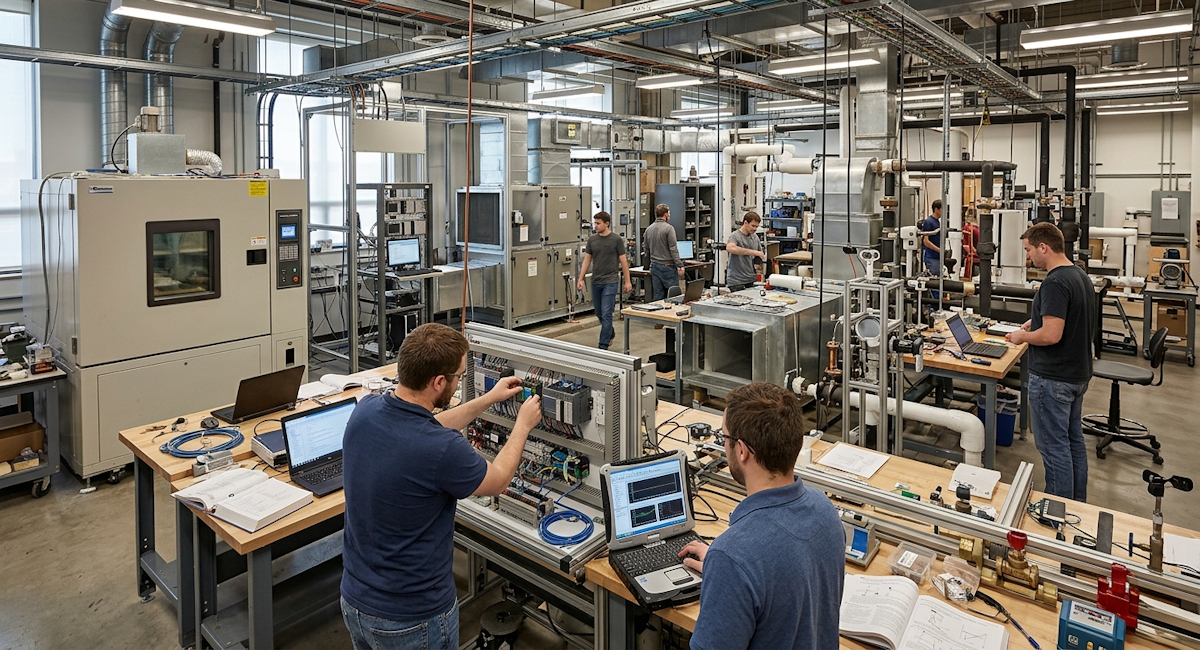
At Analex Laboratories, the Slayton Building Automation Center stands as a premier research and development facility dedicated to advancing the technologies that will transform buildings into intelligent, efficient, and responsive environments. Located in Wisconsin, Slayton serves as a vital hub for the design, engineering, testing, and prototyping of building automation systems, energy management technologies, and occupant-centric control solutions. The facility focuses exclusively on front-end development activities, providing the technical innovation and validation necessary for commercial partners to bring advanced building technologies from concept through demonstration and toward widespread market deployment. By concentrating on early-stage research, Slayton accelerates the development of intelligent building systems that reduce energy consumption, enhance occupant comfort, and enable grid-interactive capabilities.
The physical campus of Slayton encompasses a comprehensive complex designed specifically for building technology research and development. The main research building features a full-scale building systems laboratory with multiple environmental chambers capable of simulating diverse climate conditions from tropical to arctic environments. The facility includes a dedicated controls laboratory with programmable automation controllers, network infrastructure, and software development stations for programming and testing building automation sequences. A specialized building envelope testing area houses guarded hot boxes, infrared thermal imaging equipment, and air infiltration measurement systems for evaluating wall and window assemblies. The campus features an indoor air quality laboratory with environmental chambers for testing ventilation systems, contaminant generation and measurement equipment, and thermal manikin systems for comfort evaluation. An outdoor testing yard accommodates full-scale HVAC equipment including heat pumps, air handling units, and thermal storage systems for extended performance evaluation under real weather conditions. Supporting these technical spaces are collaborative engineering offices, sensor calibration laboratories, and a demonstration facility showcasing integrated building systems in a realistic office environment.
Slayton maintains an extensive inventory of specialized equipment essential for building automation and energy efficiency research. The controls laboratory operates multiple building automation system platforms with programmable logic controllers, direct digital controllers, and edge computing devices for testing control algorithms and communication protocols. The HVAC testing area features psychrometric chambers with precise temperature and humidity control, airflow measurement stations with calibrated nozzles and anemometers, and refrigerant charging and analysis equipment for heat pump evaluation. The thermal storage research laboratory houses phase change material testing apparatus, ice storage tanks, and thermal battery systems for evaluating energy storage integration with building mechanical systems. The facility includes a comprehensive sensor network testbed with wireless and wired communication systems, occupancy detection technologies including infrared, ultrasonic, and computer vision systems, and environmental sensors for temperature, humidity, carbon dioxide, and volatile organic compound measurement. The digital twin development area maintains high-performance computing resources, building information modeling software, and real-time simulation platforms for creating virtual building replicas. Lighting research equipment includes photometric measurement systems, daylight simulation chambers, and tunable LED fixtures for evaluating advanced lighting controls.
The operational methodology at Slayton follows a systematic development pipeline that transforms conceptual building technologies into validated systems ready for commercial deployment. Research teams begin with computational modeling using building energy simulation software to predict performance and optimize designs before physical prototyping. Control algorithm development progresses through software-in-the-loop testing, hardware-in-the-loop validation with actual controllers, and finally full-system integration testing. Component-level evaluation subjects sensors, actuators, and mechanical equipment to environmental testing, accuracy validation, and durability assessment. System integration combines multiple technologies into cohesive building systems, validating interoperability, communication reliability, and coordinated operation. Field testing utilizes the facility's demonstration building and partner sites to evaluate performance under real occupancy patterns and weather conditions. Throughout this process, occupant feedback studies ensure that energy efficiency improvements maintain or enhance comfort, productivity, and indoor environmental quality.
Cutting-Edge Specialties
- Intelligent Building Automation and Control Systems
Slayton maintains a leading research program focused on advanced building automation systems that integrate heating, ventilation, air conditioning, lighting, and other building systems through intelligent control algorithms. Engineers develop model predictive control strategies that anticipate building thermal behavior and optimize system operation, fault detection and diagnostic algorithms that identify equipment malfunctions before they impact comfort or efficiency, and adaptive control systems that learn from building performance data to continuously improve operation. The program encompasses communication protocol development for interoperability between diverse equipment manufacturers, edge computing architectures that enable local decision-making, and cybersecurity frameworks that protect building systems from intrusion. Testing protocols evaluate energy savings potential, response characteristics to occupancy changes, and fault detection accuracy under various operating scenarios. The research addresses cost reduction through standardized control sequences, simplified commissioning procedures, and open-source software development. This specialty supports the development of building automation systems that reduce energy consumption while maintaining optimal indoor environmental conditions.
- Digital Twin Technology for Building Energy Management
The facility operates a dedicated division for developing digital twin systems that create virtual replicas of physical buildings for real-time monitoring, prediction, and optimization. Researchers integrate building information models with Internet of Things sensor networks, physics-based simulation engines, and machine learning algorithms to create dynamic virtual representations that mirror actual building performance. The program encompasses data fusion techniques for reconciling sensor measurements with simulation predictions, reduced-order modeling methods for achieving real-time simulation performance, and visualization systems for presenting complex building data to operators and occupants. Testing facilities validate digital twin accuracy against physical building measurements, evaluate predictive capabilities for fault anticipation and energy forecasting, and assess user interface effectiveness for building operators. The research addresses scalability for application across diverse building types, integration with utility demand response programs, and automated calibration techniques that minimize commissioning effort. This specialty supports the development of virtual building management platforms that enable proactive maintenance, continuous optimization, and informed decision-making for building owners and operators.
- Advanced Heat Pump and Thermal Storage Systems
Slayton conducts intensive research into high-efficiency heat pump technologies and thermal energy storage systems that enable building electrification and load shifting capabilities. Engineers develop vapor compression heat pumps with advanced refrigerants, variable speed compressors, and optimized heat exchanger designs for improved performance in cold climates, along with thermal storage systems using phase change materials, ice storage, and thermochemical storage media. The program encompasses integration strategies combining heat pumps with thermal storage to enable load shifting, defrost optimization for maintaining efficiency during winter operation, and multi-function systems providing simultaneous heating and cooling. Testing facilities include environmental chambers capable of simulating extreme outdoor temperatures, refrigerant analysis equipment for evaluating system charge and performance, and thermal cycling apparatus for evaluating storage material durability. The research addresses cost reduction through manufacturing optimization, efficiency improvements through advanced cycles and components, and grid integration strategies for providing demand flexibility. This specialty supports the development of electrified building heating and cooling systems that reduce carbon emissions while maintaining comfort and reducing operating costs.
- Demand Response and Grid-Interactive Buildings
The facility maintains an active program developing technologies and control strategies that enable buildings to respond dynamically to electrical grid conditions, providing flexibility services that support renewable energy integration. Researchers investigate automated demand response systems using open communication standards, load flexibility algorithms that adjust building energy use without compromising occupant comfort, and predictive control strategies that anticipate grid events and price signals. The program encompasses thermal mass utilization for load shifting, battery storage integration with building systems, and vehicle-to-building technologies for electric vehicle grid integration. Testing facilities include hardware-in-the-loop platforms that simulate grid signals and building responses, along with field demonstrations validating load reduction capabilities and occupant impact. The research addresses market mechanisms for compensating building flexibility, aggregation strategies for coordinating multiple buildings, and control algorithms that balance grid services with comfort maintenance. This specialty supports the development of grid-interactive efficient buildings that function as assets for electrical system reliability while reducing energy costs for building owners.
- Indoor Environmental Quality and Occupant-Centric Systems
Slayton engineers advanced ventilation, lighting, and control systems that optimize indoor environmental quality while minimizing energy consumption through responsive operation based on actual occupant needs. The research focuses on demand-controlled ventilation using carbon dioxide and occupancy sensors, heat recovery ventilation systems with high-efficiency heat exchangers, and personalized environmental control systems that provide comfort at the individual workstation level. The program encompasses indoor air quality monitoring and control, thermal comfort modeling and prediction, and lighting systems that adjust based on daylight availability and occupant circadian needs. Testing facilities include environmental chambers with precise control of temperature, humidity, and air quality, thermal manikin systems for evaluating local comfort conditions, and human subject testing protocols for validating comfort and productivity impacts. The research addresses the balance between energy efficiency and health outcomes, ventilation effectiveness for pollutant removal, and adaptive comfort models that account for occupant expectations and behavior. This specialty supports the development of building systems that create healthy, productive indoor environments while achieving aggressive energy reduction targets through intelligent, occupant-responsive operation.