Energy Storage Systems
Located in Nevada, Analex Laboratories' Linteris Energy Storage Systems Center is a state-of-the-art facility dedicated to front-end research, design, and prototyping of next-generation energy storage solutions for the future electrical grid. Equipped with specialized laboratories, environmental chambers, and high-voltage grid simulators, the center employs a rigorous development pipeline to validate advanced storage technologies for commercial market scale-up.
Linteris Energy Storage Systems Center
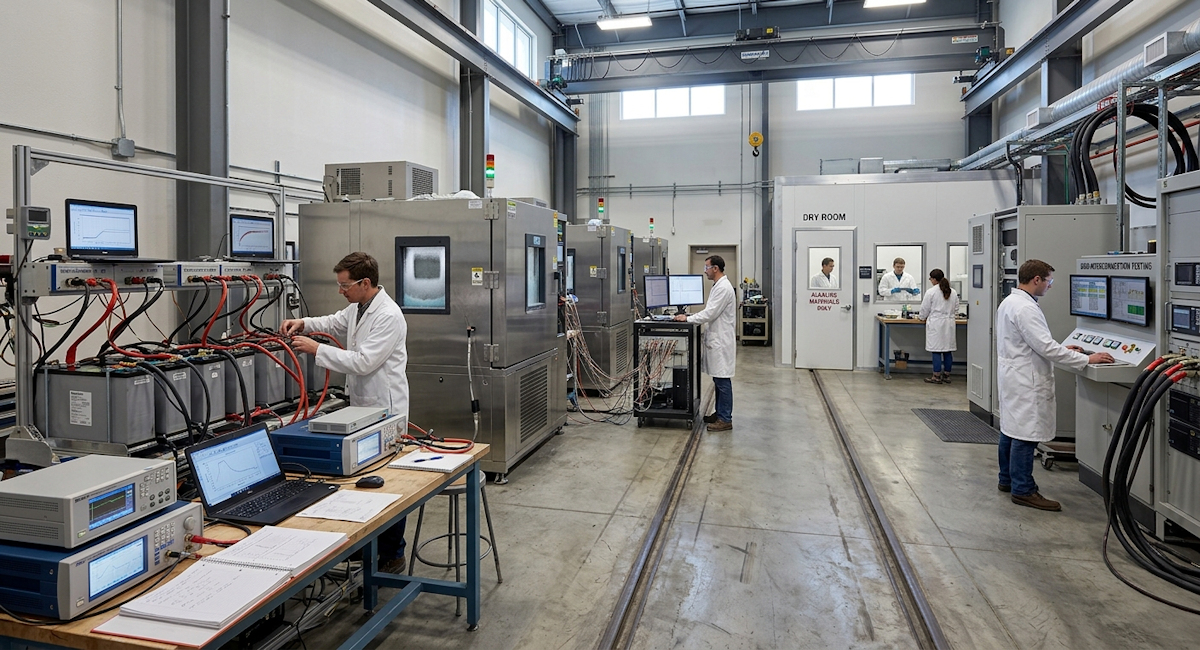
At Analex Laboratories, the Linteris Energy Storage Systems Center represents a state-of-the-art research and development facility dedicated to advancing the technologies that will power the future electrical grid. Located in Nevada, Linteris serves as a critical hub for the design, engineering, testing, and prototyping of next-generation energy storage solutions. The facility focuses exclusively on front-end development activities, providing the technical foundation and innovation pipeline that enables commercial partners to bring advanced storage technologies to market-scale manufacturing and deployment.
The physical infrastructure of Linteris comprises a multi-building complex engineered specifically for energy storage research. The primary research facility features high-bay laboratory spaces with reinforced flooring to accommodate heavy equipment and large-format battery testing stations. Climate-controlled chambers maintain precise temperature and humidity conditions across ranges from negative twenty degrees Celsius to eighty degrees Celsius, enabling validation of storage systems under diverse environmental stresses. The facility includes specialized dry rooms with dew points below negative forty degrees Celsius for handling moisture-sensitive materials such as solid-state electrolytes and alkali metal anodes. A dedicated high-voltage testing wing houses grid-interconnection laboratories capable of simulating utility-scale electrical conditions up to transmission voltage levels. Supporting these technical spaces are collaborative engineering offices, materials preparation laboratories, and a prototype assembly workshop equipped with precision manufacturing tools. The campus also features an outdoor testing yard with weather-protected enclosures for long-term field validation studies.
Linteris maintains an extensive array of specialized equipment essential for energy storage research and development. The electrochemical analysis division operates high-precision potentiostats and galvanostats capable of measuring cell performance with microampere accuracy, along with electrochemical impedance spectroscopy systems that characterize internal resistance and degradation mechanisms. Thermal analysis equipment includes differential scanning calorimeters, accelerating rate calorimeters, and infrared thermal imaging systems that monitor heat generation and distribution during charge and discharge cycles. The facility houses multiple environmental chambers that subject prototype systems to thermal cycling, vibration, and altitude simulation. For flow battery development, Linteris maintains pilot-scale stack testing stations with variable flow rates and membrane evaluation capabilities. The compressed air energy storage laboratory features high-pressure vessel testing apparatus and thermal storage material characterization equipment. Grid integration testing utilizes hardware-in-the-loop platforms that simulate complex electrical grid scenarios, enabling validation of storage system control algorithms and power conversion electronics under realistic operating conditions.
The operational methodology at Linteris follows a systematic development pipeline that transforms conceptual designs into validated prototypes ready for manufacturing scale-up. Research teams begin with materials synthesis and characterization, utilizing computational modeling to predict electrochemical behavior and optimize compositions. Cell-level prototyping progresses through iterative design cycles, with each iteration subjected to accelerated aging protocols that compress years of operational stress into weeks of testing. System integration activities combine multiple cells into modular units, developing thermal management systems and battery management electronics that ensure safe, efficient operation. Grid interconnection testing validates power conversion systems and control strategies that enable storage assets to provide grid stabilization services. Throughout this process, rigorous safety protocols govern all activities involving high-energy-density systems, reactive materials, and high-voltage equipment.
Cutting-Edge Specialties
- Solid-State Battery Architecture Development
Linteris maintains a premier research program focused on solid-state electrochemical storage systems that replace conventional liquid electrolytes with solid ionic conductors. Researchers investigate ceramic and polymer-based electrolyte materials, developing processing techniques that achieve high ionic conductivity while maintaining mechanical stability and electrochemical compatibility with high-capacity electrode materials. The program encompasses interface engineering to minimize resistance between solid components, dendrite suppression strategies for alkali metal anodes, and manufacturing process development compatible with high-throughput production. Testing protocols evaluate electrochemical performance across temperature ranges, cycle life under various duty cycles, and abuse tolerance including penetration, overcharge, and thermal runaway scenarios. This specialty addresses the critical need for energy storage systems with improved safety characteristics, higher energy density, and longer operational lifespans.
- Redox Flow Battery Systems Engineering
The facility operates a dedicated division for developing flow battery technologies that store energy in liquid electrolytes contained in external tanks. Engineers at Linteris design and test vanadium-based and iron-chromium-based flow battery systems, optimizing cell stack architectures, membrane materials, and electrolyte formulations to achieve high round-trip efficiency and extended cycle life. The research encompasses flow field design for uniform electrolyte distribution, electrode surface treatments to enhance reaction kinetics, and system integration strategies that combine power conversion equipment with energy storage subsystems. Testing facilities evaluate performance under continuous operation, response characteristics for grid frequency regulation services, and capacity retention over thousands of charge-discharge cycles. This specialty supports the development of long-duration energy storage solutions capable of providing eight to twenty-four hours of continuous discharge for renewable energy firming and grid balancing applications.
- Compressed Air Energy Storage with Thermal Integration
Linteris conducts advanced research into adiabatic compressed air energy storage systems that capture and store thermal energy generated during air compression for later use during expansion. Engineers develop high-pressure vessel designs, thermal storage media including molten salt and specialized ceramics, and turbomachinery optimized for compressed air applications. The program investigates isothermal compression techniques that minimize temperature rise, advanced heat exchanger designs for thermal energy transfer, and system control strategies that optimize round-trip efficiency. Testing capabilities include high-pressure component validation, thermal cycling of storage media, and integrated system demonstrations that validate performance models. This specialty addresses the need for bulk energy storage systems capable of delivering hundreds of megawatt-hours of capacity for seasonal storage and grid-scale renewable integration.
- Sodium-Based Electrochemical Storage
The facility maintains an active program developing sodium-ion and sodium-sulfur battery technologies that utilize abundant raw materials as alternatives to lithium-based systems. Researchers investigate cathode materials including layered transition metal oxides and polyanionic compounds, anode materials ranging from hard carbon to alloy compositions, and electrolyte formulations optimized for sodium ion transport. The program encompasses cell design for high-temperature sodium-sulfur systems as well as room-temperature sodium-ion architectures, developing sealing technologies, thermal management systems, and manufacturing processes specific to sodium-based chemistries. Testing protocols evaluate rate capability, cycle life, calendar aging, and safety characteristics including thermal stability and overcharge tolerance. This specialty supports the development of cost-effective, sustainable energy storage solutions that reduce dependence on critical mineral supply chains.
- Grid-Interactive Storage Control Systems
Linteris engineers advanced power electronics and control systems that enable energy storage assets to provide grid stabilization services and optimize renewable energy dispatch. The research focuses on bi-directional inverter designs with grid-forming capabilities, battery management systems with cell-level monitoring and balancing, and supervisory control algorithms that coordinate multiple storage assets. The program encompasses communication protocols for grid operator interfaces, predictive control strategies that anticipate renewable generation patterns, and aggregation systems that coordinate distributed storage resources. Testing utilizes hardware-in-the-loop platforms that simulate transmission and distribution grid conditions, validating control performance under fault scenarios, frequency events, and variable loading conditions. This specialty addresses the technical infrastructure necessary for integrating high penetrations of energy storage into electrical grids while maintaining reliability and power quality.