Nuclear Energy Technology
Located in Idaho, Analex Laboratories' Barron Nuclear Energy Center is a premier research and development facility that accelerates the design, testing, and prototyping of next-generation nuclear energy and fusion technologies. The campus houses state-of-the-art infrastructure—including hot cells, thermal hydraulic testing loops, computational centers, and specialized materials characterization laboratories — to advance nuclear systems through a rigorous cycle of computational modeling and experimental validation.
Barron Nuclear Energy Center
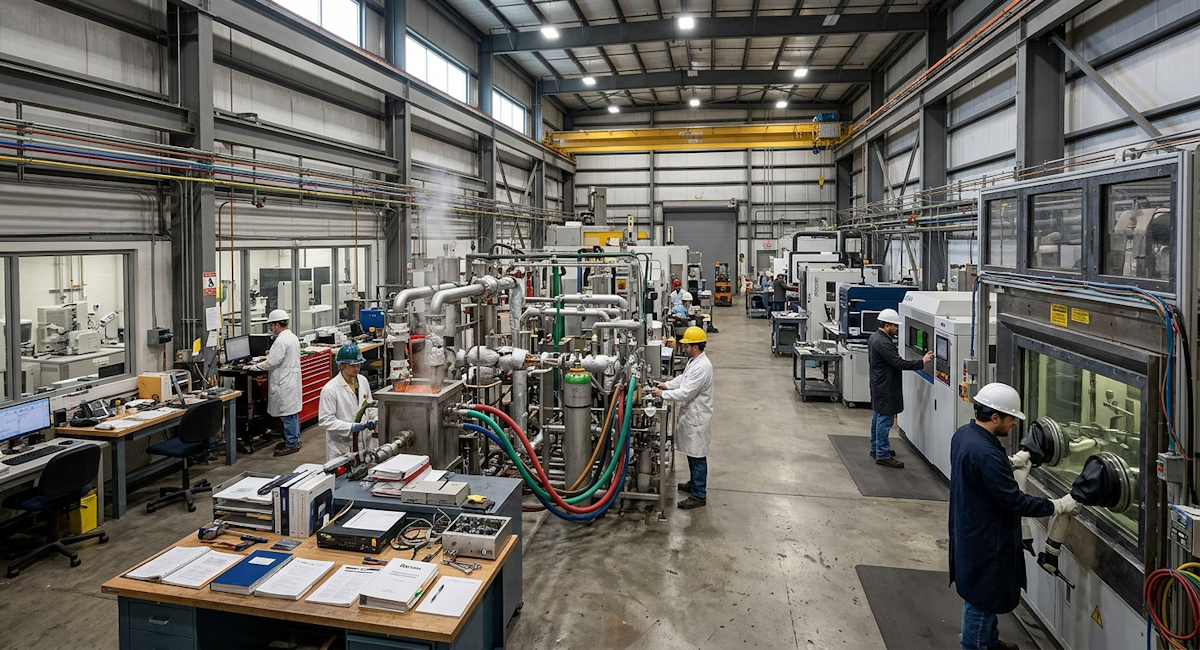
At Analex Laboratories, the Barron Nuclear Energy Center stands as a premier research and development facility dedicated to advancing the technologies that will define the next generation of nuclear energy systems. Located in Idaho, Barron serves as a critical hub for the design, engineering, testing, and prototyping of advanced nuclear reactor concepts, fuel systems, and supporting infrastructure. The facility focuses exclusively on front-end development activities, providing the technical foundation and innovation pipeline that enables commercial partners and government agencies to bring advanced nuclear technologies from concept through licensing and toward deployment. By concentrating on early-stage research and validation, Barron accelerates the development of nuclear systems that offer improved safety, enhanced efficiency, and broader applications beyond traditional electricity generation.
The physical campus of Barron encompasses a comprehensive complex engineered specifically for nuclear research and development. The main research building features high-bay hot cells with remote handling capabilities for examining radioactive materials, along with shielded laboratories for fuel fabrication and materials testing. The facility includes a dedicated non-destructive examination area equipped with radiography systems, ultrasonic testing apparatus, and eddy current inspection equipment for evaluating component integrity. A specialized materials characterization suite houses transmission electron microscopes, scanning electron microscopes with energy dispersive spectroscopy, and X-ray diffraction systems for analyzing irradiated materials. The campus features multiple thermal hydraulic testing loops capable of simulating reactor coolant conditions with various working fluids including water, helium, and molten salts. Supporting these technical spaces are collaborative engineering offices, computational modeling centers with high-performance computing clusters, and secure facilities for proprietary research. The facility also includes a dedicated fusion research laboratory with vacuum systems, plasma diagnostic equipment, and superconducting magnet testing apparatus.
Barron maintains an extensive inventory of specialized equipment essential for nuclear energy research and development. The reactor physics laboratory operates critical assemblies and subcritical testing configurations for validating neutronics models, along with gamma spectroscopy systems and neutron detection apparatus for radiation measurements. The thermal hydraulic testing area features flow loops with high-temperature and high-pressure capabilities, heat transfer test sections, and two-phase flow visualization systems. The materials testing division houses mechanical testing frames capable of evaluating material properties at elevated temperatures, creep testing furnaces for long-term deformation studies, and corrosion testing autoclaves that simulate reactor environments. The facility includes advanced manufacturing equipment such as electron beam welding systems, laser powder bed fusion additive manufacturing systems for nuclear-grade materials, and precision machining centers for fabricating complex components. Digital instrumentation and control research utilizes hardware-in-the-loop platforms, FPGA-based control systems, and cybersecurity testbeds for evaluating reactor control architectures. The fusion research area maintains vacuum chambers, plasma heating systems, and magnetic diagnostic equipment for confinement studies.
The operational methodology at Barron follows a rigorous development cycle that advances nuclear technologies from conceptual design through experimental validation. Research teams utilize advanced computational tools including neutronics codes, computational fluid dynamics software, and finite element analysis programs to model reactor behavior and optimize designs before physical testing begins. Materials development progresses through synthesis, characterization, and irradiation testing to validate performance under reactor conditions. Component prototyping employs advanced manufacturing techniques to produce test articles that undergo mechanical, thermal, and environmental testing. Systems integration activities combine multiple subsystems into cohesive demonstrations, validating control strategies and operational procedures. Throughout this process, rigorous quality assurance protocols and safety procedures govern all activities involving radioactive materials, high pressures, and high temperatures.
Cutting-Edge Specialties
- Small Modular Reactor and Microreactor Development
Barron maintains a leading research program focused on small modular reactor designs that offer factory fabrication, simplified construction, and enhanced safety through passive systems. Engineers develop integral pressurized water reactor concepts, high-temperature gas-cooled designs, and transportable microreactor systems suitable for remote power applications. The program encompasses reactor core design with optimized fuel loadings, thermal hydraulic analysis of natural circulation cooling systems, and structural evaluations of pressure vessels and containment systems. Testing protocols utilize scaled thermal hydraulic facilities to validate passive safety performance, including automatic shutdown heat removal and emergency core cooling systems. The research addresses licensing strategies specific to advanced reactor designs, including risk-informed regulatory approaches and quality assurance frameworks. This specialty supports the development of nuclear systems that can be deployed with reduced capital investment and construction timelines compared to traditional large-scale plants.
- Molten Salt Reactor and Advanced Coolant Systems
The facility operates a dedicated division for developing reactors that utilize molten salts as either coolant, fuel carrier, or both, enabling high-temperature operation and improved thermal efficiency. Researchers investigate fluoride salt and chloride salt systems, developing materials compatibility databases, corrosion mitigation strategies, and purification techniques for maintaining salt chemistry. The program encompasses pump and heat exchanger designs compatible with molten salt service, tritium management systems for lithium-bearing salts, and freeze valve concepts for passive drainage. Testing facilities include forced convection salt loops for evaluating component performance, thermal cycling chambers for materials qualification, and chemistry laboratories for analyzing salt compositions. Safety research focuses on source term evaluation, containment strategies for mobile fuels, and licensing approaches for liquid-fueled reactors. This specialty addresses the development of high-temperature nuclear systems capable of providing process heat for industrial applications and hydrogen production.
- Tristructural Isotropic Fuel and Advanced Fuel Fabrication
Barron conducts intensive research into advanced nuclear fuel forms including tristructural isotropic particle fuel and high-assay low-enriched uranium systems. Engineers develop fuel particle coating processes using chemical vapor deposition, kernel fabrication techniques for uranium oxycarbide and uranium nitride, and compacting methods for assembling particles into fuel elements. The program encompasses quality control systems for coating thickness and integrity verification, irradiation testing protocols for evaluating fuel performance under burnup and temperature conditions, and post-irradiation examination techniques for analyzing fission product retention. Testing facilities include high-temperature furnaces for accident condition simulation, mechanical testing systems for evaluating fuel element structural properties, and radiological laboratories for handling irradiated materials. This specialty supports the development of robust fuel systems capable of withstanding extreme temperatures while maintaining fission product containment for advanced reactor applications.
- Digital Instrumentation and Control Systems
The facility maintains an active program developing digital control architectures for advanced nuclear reactors, including reactor protection systems, engineered safety feature actuation systems, and plant process control platforms. Researchers investigate field programmable gate array-based safety systems, distributed control network architectures, and human-system interface designs optimized for small modular reactor operations. The program encompasses cybersecurity frameworks including intrusion detection systems, secure communication protocols, and defense-in-depth strategies for digital systems. Testing utilizes hardware-in-the-loop platforms that integrate physical control system hardware with real-time simulation of reactor dynamics, validating system response under normal and accident conditions. The research addresses common cause failure mitigation, software verification and validation methodologies, and licensing strategies for digital safety systems. This specialty supports the development of reliable, secure control systems essential for safe nuclear plant operation.
- Advanced Manufacturing for Nuclear Applications
Barron engineers manufacturing processes specifically adapted for nuclear component production, including additive manufacturing techniques for complex geometries, advanced welding processes for dissimilar metal joints, and precision machining methods for tight-tolerance reactor components. The research focuses on laser powder bed fusion and directed energy deposition systems qualified for nuclear-grade materials, process monitoring and control systems for ensuring part quality, and post-processing techniques including hot isostatic pressing for densification. The program encompasses non-destructive evaluation methods for additively manufactured components, mechanical testing protocols for qualifying novel manufacturing processes, and radiation effects studies on advanced materials. Testing facilities include mechanical property evaluation systems, microstructural characterization equipment, and irradiation testing capabilities for validating material performance. This specialty addresses the manufacturing innovations necessary to reduce reactor construction costs, enable rapid prototyping of advanced designs, and produce spare components for long-term plant operation.