Renewable Energy Generation
Located in Oklahoma, the Pogue Renewable Energy Center at Analex Laboratories is a premier research and development facility dedicated to advancing next-generation sustainable energy technologies through early-stage design, engineering, and prototyping. Equipped with state-of-the-art laboratories, outdoor testing yards, and advanced analytical instruments, the campus utilizes iterative development cycles to bridge the gap between laboratory discovery and commercial viability without engaging in mass manufacturing.
Pogue Renewable Energy Center
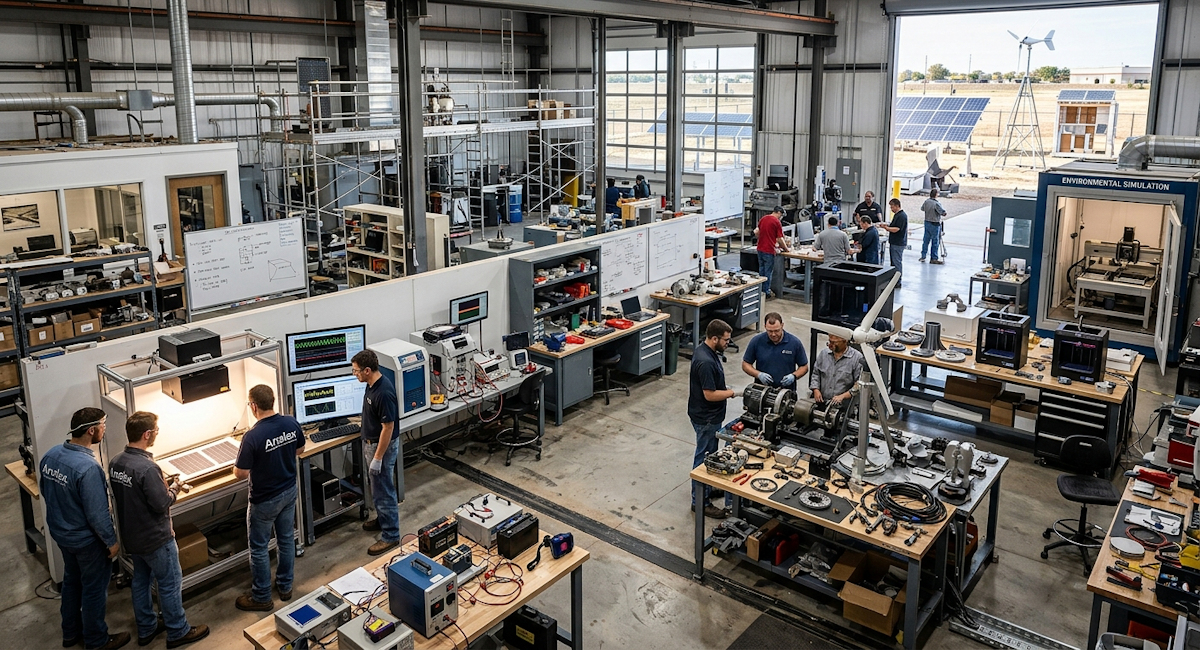
At Analex Laboratories, the Pogue Renewable Energy Center stands as a premier research and development facility dedicated to advancing the frontiers of sustainable energy technology. Situated in Oklahoma, Pogue serves as the nexus where theoretical innovation meets practical engineering, providing a comprehensive environment for the design, engineering, testing, and prototyping of next-generation renewable energy systems. The facility operates with a singular focus on early-stage development, bridging the gap between laboratory discovery and commercial viability without engaging in mass manufacturing operations.
The physical campus of Pogue spans a carefully designed complex that integrates multiple specialized structures to support diverse research activities. The main research building houses open-concept engineering laboratories equipped with modular workstations, cleanroom environments for advanced material fabrication, and climate-controlled testing chambers capable of simulating extreme environmental conditions ranging from desert heat to arctic cold. Adjacent to the main facility, a dedicated outdoor testing yard features adjustable mounting systems for prototype solar arrays, small-scale wind turbine test beds, and hybrid energy platform demonstration zones. The facility also includes a state-of-the-art materials characterization suite featuring electron microscopy stations, spectroscopic analysis equipment, and precision thermal imaging systems. Supporting these core functions are collaborative workspaces designed to foster interdisciplinary cooperation among engineers, material scientists, electrical specialists, and environmental researchers.
Pogue maintains an extensive inventory of advanced equipment essential for renewable energy research and development. The solar research division operates high-efficiency cell testing stations capable of measuring conversion efficiencies under standardized illumination conditions, along with accelerated aging chambers that simulate decades of environmental exposure in compressed timeframes. For wind energy development, the facility maintains blade material testing apparatus, drivetrain diagnostic systems, and aerodynamic modeling tools. The energy storage research area features electrochemical analysis stations, thermal management testing units, and grid-interconnection simulation platforms that replicate real-world electrical distribution scenarios. Additionally, Pogue houses additive manufacturing systems for rapid prototyping of custom components, environmental simulation chambers for durability testing, and comprehensive data acquisition systems that monitor performance metrics across all experimental setups.
The operational philosophy at Pogue centers on iterative development cycles that move concepts from initial computer modeling through physical prototyping and rigorous field testing. Engineering teams utilize advanced computational modeling software to optimize designs before physical construction begins, reducing development timelines and material waste. The prototyping workshops enable rapid fabrication of custom components, allowing researchers to test multiple design iterations efficiently. Comprehensive testing protocols evaluate not only energy output performance but also long-term durability, environmental impact, and grid integration compatibility. This systematic approach ensures that technologies developed at Pogue are technically sound, economically viable, and ready for subsequent manufacturing scale-up by commercial partners.
Cutting-Edge Specialties
- Advanced Perovskite Tandem Photovoltaic Development
Pogue maintains a leading program focused on next-generation photovoltaic systems that combine multiple light-absorbing layers to achieve conversion efficiencies beyond the theoretical limits of conventional single-junction cells. Researchers at the facility are developing tandem architectures that stack perovskite materials atop traditional silicon substrates, targeting module efficiencies exceeding thirty-five percent. The program encompasses material synthesis, interface engineering to ensure stable bonding between layers, and encapsulation techniques that protect sensitive materials from moisture and oxygen degradation. Testing protocols involve accelerated lifetime studies under varied temperature and humidity conditions, along with outdoor field deployments that validate laboratory results in real atmospheric environments. This specialty addresses the critical need for higher-efficiency solar conversion that maximizes energy output per unit of land area.
- Floating Offshore Wind Platform Engineering
The facility operates a dedicated division for developing floating foundation systems that enable wind energy generation in deep-water environments where fixed-bottom structures are impractical. Engineers at Pogue design and test semi-submersible platforms, tension-leg systems, and spar-buoy configurations that maintain turbine stability while accommodating wave motion and varying sea states. The research encompasses hydrodynamic modeling, mooring system optimization, and dynamic cable management that transmits generated electricity to shore-based grids. Prototype testing occurs in specialized wave basin facilities that simulate ocean conditions, validating computational models before open-water deployment. This specialty supports the expansion of wind energy into deeper coastal waters where wind resources are stronger and more consistent.
- Solid-State Energy Storage Systems
Pogue conducts intensive research into solid-state battery architectures that replace conventional liquid electrolytes with solid ionic conductors, offering improved safety characteristics and higher energy densities. The program investigates ceramic and polymer-based electrolyte materials, interface engineering between electrodes and solid electrolytes, and manufacturing processes compatible with high-throughput production. Testing facilities evaluate electrochemical performance, thermal stability, and cycle life under various charge-discharge protocols. Researchers also explore integration strategies that combine these advanced storage systems with renewable generation sources to provide grid stabilization services and address intermittency challenges. This specialty targets the critical need for safer, more compact energy storage solutions capable of supporting widespread renewable energy adoption.
- Green Hydrogen Production Integration
The facility maintains an active program developing electrolyzer systems that convert surplus renewable electricity into hydrogen fuel through water splitting processes. Researchers investigate both alkaline and proton exchange membrane electrolysis technologies, optimizing catalyst materials and system architectures to improve efficiency and reduce operational costs. The program encompasses power electronics that enable direct coupling with variable solar and wind outputs, buffer storage systems that smooth intermittent generation patterns, and purification systems that deliver high-purity hydrogen suitable for industrial and transportation applications. Testing protocols validate system performance under dynamic operating conditions that mirror real-world renewable energy profiles. This specialty addresses the growing demand for long-duration energy storage and carbon-free fuel alternatives.
- Grid-Forming Inverter and Microgrid Technologies
Pogue engineers advanced power electronic systems that enable renewable energy sources to provide grid stabilization services traditionally supplied by conventional rotating generators. The research focuses on grid-forming inverter architectures that can establish and maintain stable voltage and frequency references, enabling high penetrations of renewable generation without compromising grid reliability. The program encompasses hardware-in-the-loop testing platforms that simulate complex grid scenarios, control algorithms that coordinate multiple distributed energy resources, and protection schemes that ensure safe operation during fault conditions. Researchers also develop microgrid control systems that enable localized energy networks to operate independently from centralized grids during emergencies. This specialty supports the technical infrastructure necessary for transitioning electrical systems toward high renewable energy penetration.