Smart Grid & Power Transmission
The Jernigan Smart Grid Center at Analex Laboratories in Tennessee is a premier research facility dedicated to advancing next-generation electrical power and transmission systems. Featuring high-voltage yards, real-time simulation labs, and microgrid testbeds, it accelerates grid modernization by validating innovative power technologies from initial design to full-scale prototype testing.
Jernigan Smart Grid Center
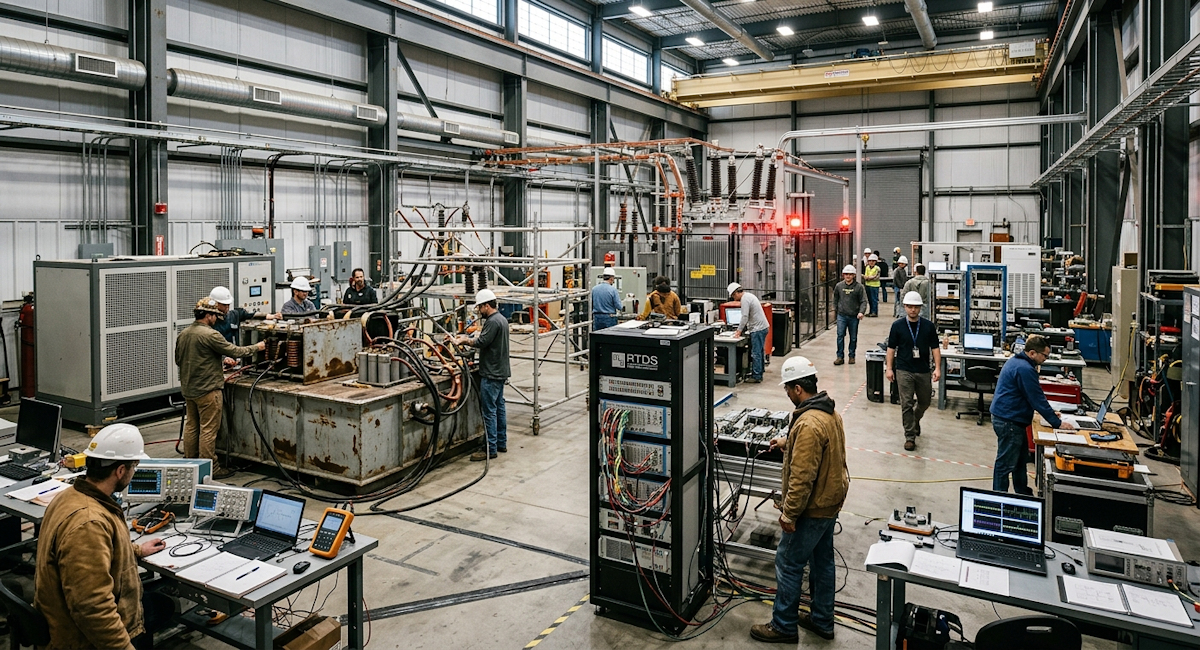
At Analex Laboratories, the Jernigan Smart Grid Center stands as a premier research and development facility dedicated to advancing the technologies that will define the electrical grid of the future. Located in Tennessee, Jernigan serves as a vital hub for the design, engineering, testing, and prototyping of next-generation smart grid and power transmission systems. The facility concentrates exclusively on front-end development activities, providing the technical innovation and validation necessary for commercial partners to deploy advanced grid infrastructure at scale. By bridging the gap between theoretical research and practical implementation, Jernigan accelerates the transition toward a more resilient, efficient, and intelligent electrical grid.
The physical campus of Jernigan encompasses a purpose-built complex designed specifically for power systems research. The main research building features high-bay laboratory spaces with reinforced structural elements capable of supporting heavy electrical equipment and full-scale transmission hardware. The facility includes a dedicated high-voltage testing yard with safety-rated enclosures for experiments involving transmission-level voltages, complete with grounding systems and protective barriers that meet utility industry standards. Climate-controlled indoor laboratories house sensitive electronic equipment and communication systems testing apparatus. A specialized control room facility replicates utility control center environments, featuring multiple operator workstations and large-format display systems for monitoring grid simulations. The campus also includes a distributed energy resource testing area with interconnected microgrid demonstration zones, rooftop solar arrays, and battery storage systems that provide real-world testing environments. Supporting these technical spaces are collaborative engineering suites, software development laboratories, and secure facilities for cybersecurity research.
Jernigan maintains an extensive inventory of specialized equipment essential for smart grid and transmission system research. The power systems laboratory houses high-voltage test equipment including impulse generators, partial discharge detection systems, and thermal imaging cameras for insulation analysis. The power electronics testing area features converter test benches capable of evaluating high-power switching devices, along with grid simulators that replicate transmission and distribution network conditions. Communication systems research utilizes protocol analyzers, network emulation platforms, and radio frequency testing equipment for evaluating wireless and powerline carrier technologies. The facility includes hardware-in-the-loop simulation platforms that integrate physical equipment with real-time digital simulators, enabling validation of control systems under realistic grid scenarios. Cybersecurity research employs specialized testbeds with isolated network segments, intrusion detection systems, and vulnerability assessment tools. The control systems laboratory features programmable logic controllers, remote terminal units, and intelligent electronic devices commonly deployed in utility infrastructure. Data acquisition systems throughout the facility capture high-resolution measurements of voltage, current, power quality, and communication traffic.
The operational methodology at Jernigan follows a comprehensive development cycle that advances concepts from initial modeling through prototype validation. Research teams utilize power system simulation software to model transmission networks, distribution feeders, and grid dynamics before physical implementation begins. Hardware prototyping progresses through iterative design cycles, with components subjected to environmental testing, electrical stress validation, and accelerated aging protocols. System integration activities combine multiple technologies into cohesive demonstrations, validating interoperability and control coordination. Field deployment testing utilizes the facility's interconnected microgrid zones to evaluate performance under realistic operating conditions. Throughout this process, rigorous safety protocols govern all activities involving high voltages, high currents, and energized electrical equipment.
Cutting-Edge Specialties
- Advanced Metering Infrastructure and Grid Edge Intelligence
Jernigan maintains a leading research program focused on next-generation advanced metering infrastructure that extends beyond traditional data collection to enable sophisticated grid edge intelligence. Researchers develop smart metering platforms with enhanced computational capabilities, multi-carrier communication architectures, and integrated sensor functions that monitor power quality, detect outages, and identify grid anomalies. The program encompasses communication protocol development for secure, low-latency data transmission, edge computing architectures that process data locally for rapid response, and cybersecurity frameworks that protect against intrusion and data manipulation. Testing protocols evaluate meter accuracy across varying load conditions, communication reliability in challenging environments, and system scalability for utility-wide deployments. This specialty addresses the foundational infrastructure necessary for utilities to monitor and manage increasingly complex distribution networks with high penetrations of distributed energy resources.
- High-Voltage Direct Current and Flexible AC Transmission Systems
The facility operates a dedicated division for developing advanced transmission technologies including voltage source converter-based direct current systems and flexible alternating current transmission controllers. Engineers at Jernigan design and test modular multilevel converter architectures, develop control algorithms for power flow optimization, and investigate multi-terminal direct current configurations that enable asynchronous grid interconnection. The research encompasses line-commutated and self-commutated converter technologies, harmonic filtering systems, and fault protection schemes specific to direct current transmission. Testing facilities include power electronics laboratories capable of evaluating converter prototypes at scaled power levels, along with simulation platforms that model electromagnetic transients and steady-state operation. This specialty supports the development of transmission infrastructure capable of efficiently moving bulk power over long distances and interconnecting regional grids with improved stability and control.
- Virtual Power Plant and Distributed Resource Aggregation
Jernigan conducts intensive research into virtual power plant architectures that aggregate distributed energy resources to provide grid-scale services. Engineers develop aggregation platforms that coordinate rooftop solar installations, behind-the-meter battery systems, electric vehicle charging equipment, and flexible loads into unified resources capable of bidding into wholesale electricity markets. The program encompasses forecasting algorithms that predict renewable generation and load patterns, optimization systems that dispatch resources for maximum economic value, and communication frameworks that maintain secure connectivity with thousands of endpoints. Testing utilizes the facility's interconnected microgrid demonstration zones to validate aggregation strategies, evaluate response times, and verify grid service provision under various scenarios. This specialty addresses the technical and market mechanisms necessary to transform distributed resources into reliable, dispatchable assets that support grid reliability and renewable energy integration.
- Microgrid Control and Resilient Distribution Systems
The facility maintains an active program developing microgrid control systems and resilient distribution architectures capable of maintaining power quality during grid disturbances and operating independently when necessary. Researchers investigate hierarchical control strategies that coordinate multiple distributed resources, develop synchronization techniques for seamless grid connection and disconnection, and design protection schemes that function effectively in both grid-connected and islanded modes. The program encompasses power management systems that balance generation and load, energy storage integration for ride-through capability, and communication networks that maintain coordination during islanded operation. Testing protocols evaluate transient response during switching events, power quality during islanded operation, and resynchronization procedures for reconnection to the main grid. This specialty supports the development of resilient electrical infrastructure capable of serving critical loads during emergencies and providing reliable power in remote or infrastructure-constrained locations.
- Artificial Intelligence and Machine Learning for Grid Optimization
Jernigan engineers advanced computational systems that apply artificial intelligence and machine learning to power grid planning, operation, and control. The research focuses on predictive analytics for load forecasting and renewable generation prediction, reinforcement learning algorithms for real-time grid optimization, and anomaly detection systems that identify equipment degradation or cybersecurity threats. The program encompasses digital twin development for distribution network modeling, natural language processing for automated analysis of operational data, and computer vision systems for infrastructure inspection. Testing utilizes historical operational data and real-time sensor feeds to validate algorithm performance, evaluate prediction accuracy, and verify control recommendations. Hardware-in-the-loop platforms integrate artificial intelligence controllers with physical grid equipment to validate real-time performance under simulated conditions. This specialty addresses the computational intelligence necessary to manage increasingly complex electrical grids with high renewable penetration, dynamic loads, and distributed control architectures.