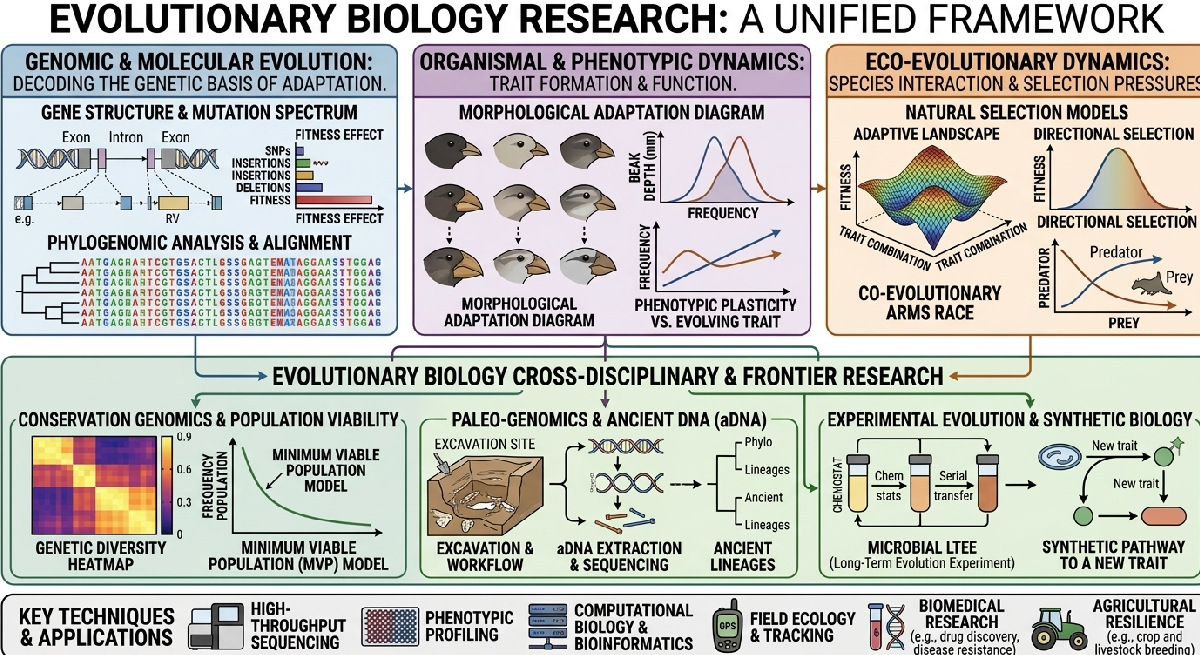
Evolutionary Biology
Evolutionary biology research, development, and innovation leverage cutting-edge genomic sequencing, computational modeling, and real-time field observations to map how life adapts across generations. Modern efforts integrate big data and artificial intelligence to trace deep lineage, predict pathogen adaptation, and optimize bioengineering applications. By applying nature's problem-solving mechanisms to fields like medicine and synthetic biology, these innovations actively transform how we address complex biological challenges.
The Ernst Mayr Evolutionary Biology Center
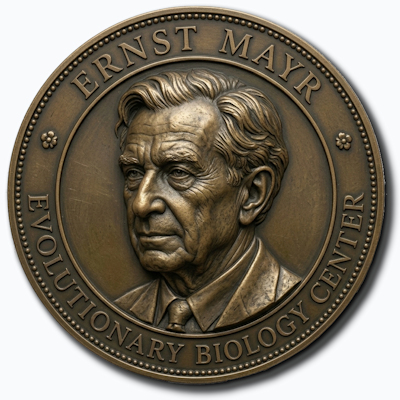 Named in honor of Ernst Mayr, the monumental evolutionary biologist and architect of the Modern Synthesis who formulated the biological species concept — serves as the central macroevolutionary and diversification engine at Analex Laboratories. The facility integrates high-throughput phylogenomics with quantitative phenomics, specializing in modeling speciation dynamics, adaptive radiation, developmental constraint, and the genomic architecture of complex adaptations across deep time.
Core Capabilities & Equipment
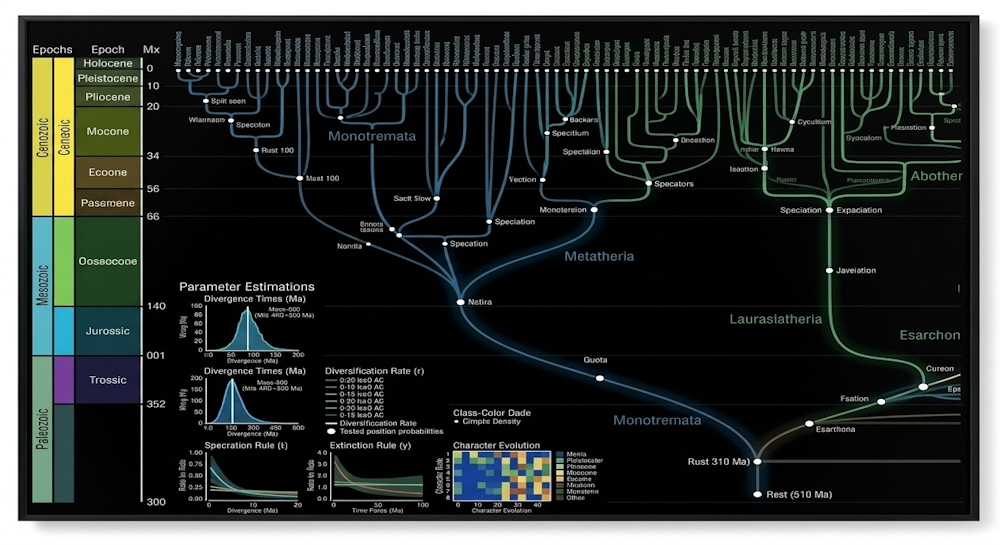
- High-Performance Phylogenomics & Coalescent Modeling Cluster: Dedicated supercomputing arrays run complex coalescent models and Bayesian phylodynamic algorithms to resolve deep macroevolutionary tree topologies, species tree incongruences, and ancestral state reconstructions.
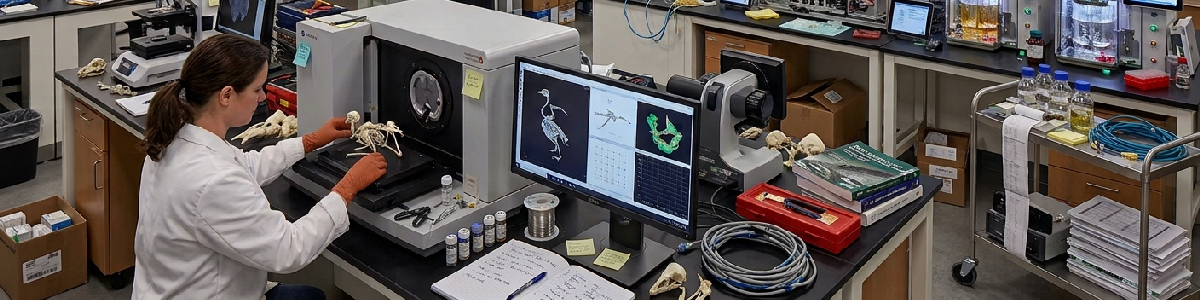
- Geometric Morphometrics & Micro-CT Phenomics Suite: High-resolution optical surface scanners and micro-tomography systems capture 3D anatomical landmark coordinates across vast biological series, quantifying phenotypic variation, developmental canalization, and convergent evolution.
- Experimental Experimental Evolution & Bioreactor Array: Automated micro-fluidic culture systems and environmental chambers track real-time genomic shifts across thousands of generations in microbial and short-generation model organisms to quantify adaptation dynamics.
- Comparative Functional Genomics & Epigenomics Unit: High-throughput long-read sequencers paired with chromatin conformation profiling quantify regulatory network evolution, non-coding element divergence, and epigenomic modifications driving morphological novelty.
At Analex Laboratories, research in evolutionary biology focuses on decoded mechanisms of adaptation, specilizing in how genetic variation translates into functional phenotypic shifts across complex natural ecosystems. By merging high-throughput genomics, ancient DNA (aDNA) sequencing, and computational systems biology, our teams map deep phylogenetic lineages to uncover the molecular drivers behind major evolutionary transitions. This foundation allows us to observe evolutionary dynamics not merely as historical retrospectives, but as predictable, ongoing biological processes.
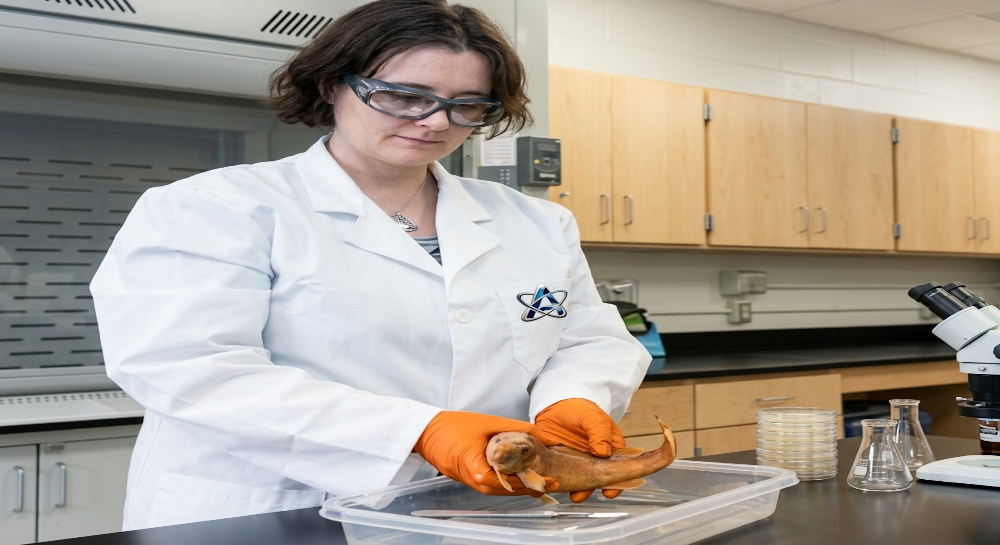
Central to our work is the development of non-invasive population monitoring frameworks coupled with real-time bio-analytic tracking. Analex researchers utilize ultra-deep environmental DNA (eDNA) sampling alongside targeted genomic assays to isolate rapid evolutionary changes within threatened populations. By capturing subtle allele frequency shifts across generations in high-stress environments, our models identify critical stress-tolerance markers, detailing how species adjust to accelerating climate pressures and habitat fragmentation.
To bridge experimental biology with theoretical dynamics, Analex Laboratories leverages proprietary machine learning architectures designed to model complex fitness landscapes. These predictive frameworks simulate mutational pathways, enabling our scientists to forecast viral mutational escape, antibiotic resistance profiles, and host-pathogen coevolutionary arms races. By evaluating these micro-level evolutionary mechanics, we provide critical strategic foresight into global biosecurity, agricultural resilience, and epidemiological preparedness.
Translating theoretical insights into practical application, Analex teams pioneer directed evolution techniques and evolutionary developmental biology ("evo-devo") to engineer scalable biological solutions. By applying nature's selective pressures in controlled bioreactor environments, we guide the emergence of novel enzymes for bio-remediation and cellular therapies. This dual approach—simultaneously investigating fundamental evolutionary principles while harnessing them for technological innovation—positions Analex Laboratories at the vanguard of modern biological discovery.