Geochemistry
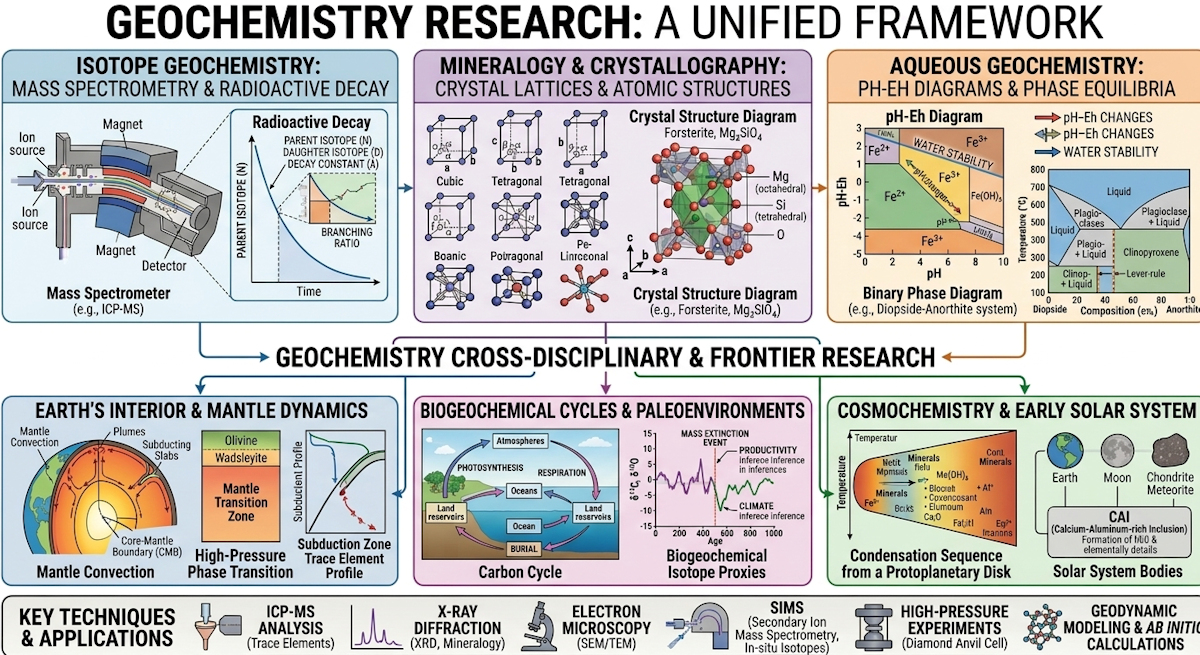
Research and development in geochemistry combine chemical principles with geological observations to decode the Earth's history, mantle dynamics, and surface processes. Recent innovations focus on high-precision analytical techniques, such as advanced mass spectrometry and nanoscale imaging, enabling scientists to trace environmental changes and planetary evolution with unprecedented resolution. These advancements drive sustainable solutions in critical mineral exploration, carbon capture, and understanding anthropogenic impacts on global biogeochemical cycles.
The Goldschmidt Elemental & Isotopic Geochemistry Laboratory
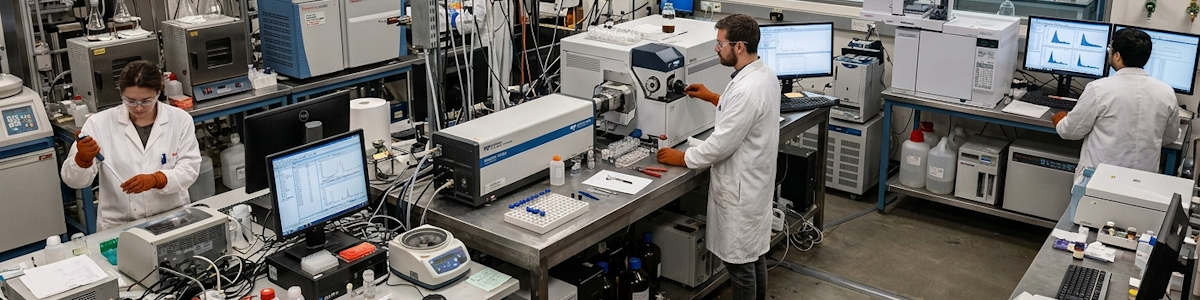
The laboratory is named for Victor Moritz Goldschmidt, the Oslo mineralogist who founded crystal chemistry, codified the rules governing which elements hide inside which minerals, and wrote the whole scheme up while detained under German occupation — it serves as the geochemistry division of Analex Laboratories. Its remit covers elemental abundance, isotope systematics, and the movement of elements between rock, water, and life.
Core Capabilities & Equipment
- Trace Element & Radiogenic Isotope Mass Spectrometry: Laser ablation and solution ICP-MS coupled to multi-collector platforms read element concentrations and isotope ratios down to parts per trillion, isolating magmatic sources, crustal contamination, and ore-fluid histories grain by grain.
- Thermal Ionization & Noble Gas Geochronology Line: Purified element fractions are loaded onto filaments and measured as ion beams, while step-heating argon and noble gas release spectra attach absolute ages to crystallisation, cooling, and fluid events recorded in the rock.
- Stable Isotope Ratio Mass Spectrometry Suite: Carbon, nitrogen, oxygen, sulphur, and hydrogen compositions — including multiply-substituted clumped species — are measured from carbonates, sulphides, waters, and organic matter, translating fractionation into temperature and process.
- Ultra-Clean Preparation & Speciation Laboratory: Positive-pressure clean rooms with sub-boiling acid stills strip samples down to picogram blanks, while X-ray absorption spectroscopy and Raman work sort which chemical form an element actually occupies in a natural material.
Element and isotope ratios are geochemistry's alphabet, and the discipline's progress has always tracked the ability to read more letters at lower concentrations. What distinguishes the current era is that the alphabet is now legible at parts-per-trillion in single mineral zones, in individual fluid inclusions, and in organic molecules preserved for hundreds of millions of years. Analex Laboratories, a consortium of isotope geochemists, experimental petrologists, aqueous chemists, and computational modelers, has organized its research around that capability. Its scientists treat the chemical composition of rocks, waters, gases, and biota as a forensic record — a fingerprint of source, temperature, pressure, redox state, and time — and their goal is to decode that fingerprint with enough precision that competing explanations can be distinguished rather than merely asserted.
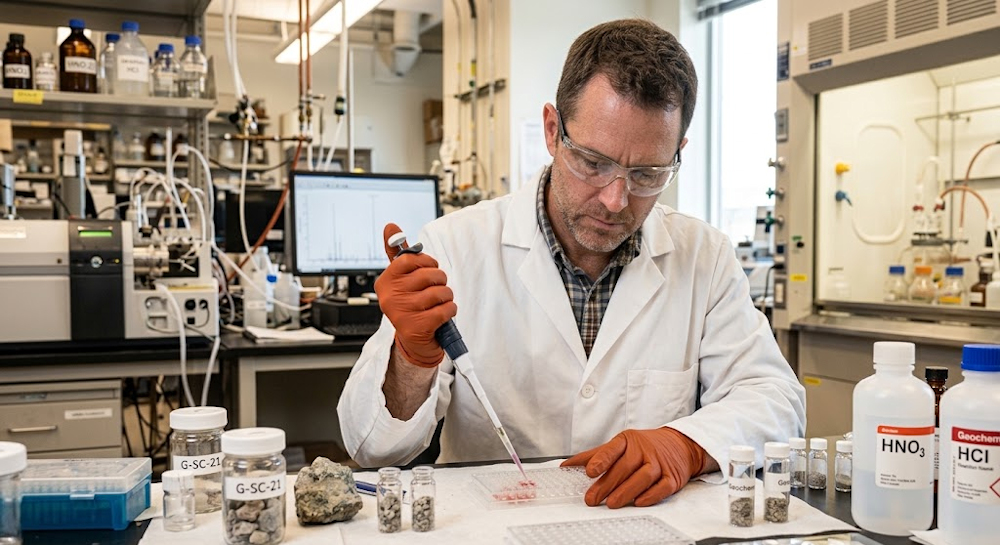
The analytical foundation is a suite of instruments and protocols built for extreme sensitivity and cleanliness. Thermal ionization and multi-collector inductively coupled plasma mass spectrometry resolve radiogenic systems — strontium, neodymium, hafnium, lead, osmium — at the fifth decimal place, while secondary-ion and nanoscale secondary-ion probes map isotopic variation across growth zones microns wide. Laser-ablation systems deliver spatially resolved trace-element and isotope data from thin sections without dissolution, X-ray absorption spectroscopy and synchrotron microprobe methods determine oxidation state and coordination environment in situ, and clumped-isotope and compound-specific analyses extract temperature and source information from carbonates and lipids alike. Ultra-clean laboratory design, isotope-dilution spikes, and inter-laboratory standards underpin the whole enterprise, because at these precisions contamination is the limiting reagent.
Experimental and theoretical work supplies the interpretive rules. Analex measures mineral-melt and mineral-fluid partition coefficients across pressure-temperature-composition space, determines equilibrium and kinetic isotope fractionation factors for metals, sulfur, and carbon, and quantifies reaction rates for dissolution, precipitation, and redox transformation. Ab initio and density functional calculations predict fractionation where experiments are impractical, closing the loop between theory and measurement. Aqueous chemistry receives sustained attention: speciation modeling, surface complexation, sorption isotherms, and reaction-path simulation of hydrothermal, diagenetic, and low-temperature systems, all calibrated against laboratory data rather than assumed. Microbial catalysis is treated as a genuine geochemical process, with consortium work on enzymatic isotope effects and syntrophic metal cycling.
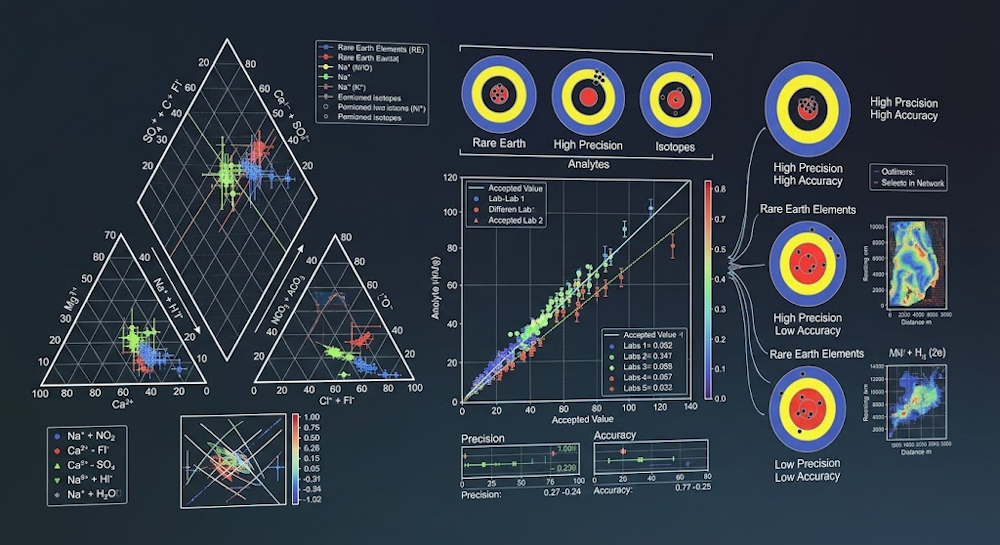
Read outward, these tools address the largest questions in Earth history. Analex uses redox-sensitive isotope systems and trace-metal enrichments to reconstruct atmospheric and oceanic oxygenation across the Precambrian, applies boron, lithium, and magnesium isotopes to constrain past seawater chemistry and weathering flux, and deploys radiogenic isotope tracers to map mantle heterogeneity and crustal recycling. Ore-forming systems are studied through fluid-inclusion chemistry, metal isotope provenance, and reaction-transport modeling that reproduces the zonation observed in porphyry, epithermal, and sediment-hosted deposits. Cosmochemistry is pursued with equal rigor: nucleosynthetic isotope anomalies and presolar grain compositions constrain the solar nebula's ingredients, and volatile inventories of chondrites inform how Earth acquired its carbon, nitrogen, and water.
Environmental and industrial applications follow naturally. Analex characterizes contaminant speciation and mobility for arsenic, chromium, selenium, and uranium, evaluates acid-rock drainage and mine-waste geochemistry, and traces nitrate and organic pollutants to their sources using isotope fingerprinting. Carbon capture and storage benefits from the group's work on CO₂-water-rock interaction, mineral trapping kinetics, and the isotopic monitoring tools that verify plume residence, while natural hydrogen, helium, and lithium exploration all depend on the same provenance methods. A planetary branch applies identical reasoning to Martian alteration minerals, lunar volatiles, and icy-moon brines. The consortium's position is that chemistry tells you what a system is made of, where it came from, and what it can become — and that the groups which measure most carefully will be the ones whose conclusions survive.