Hydrogeology
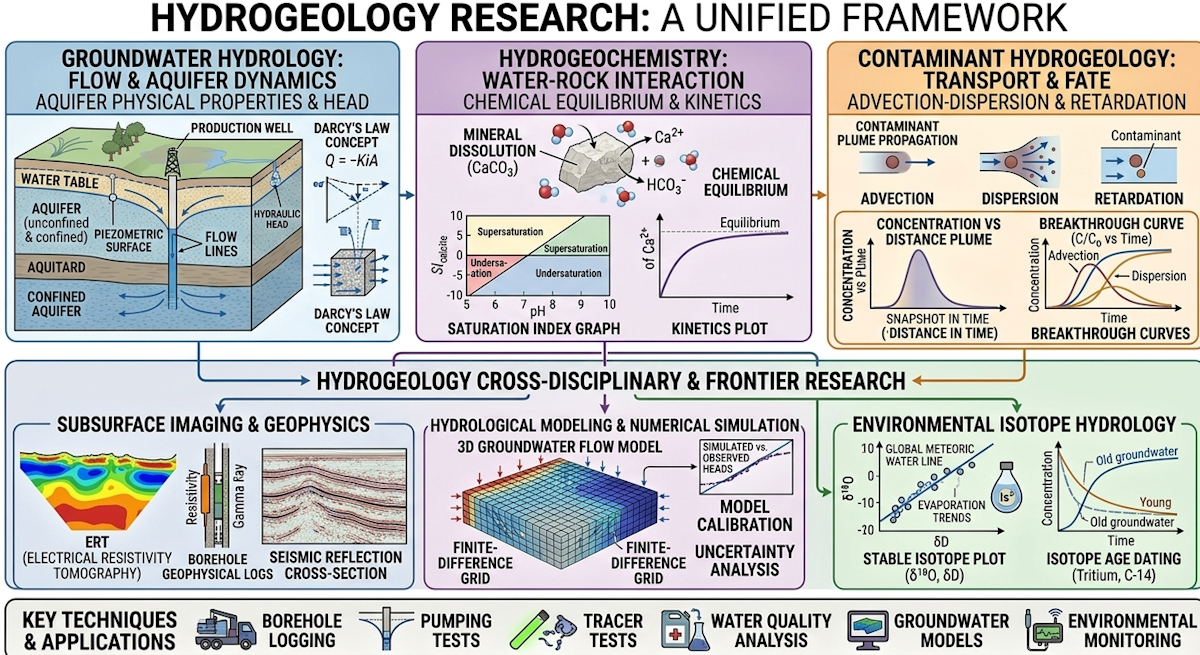
Research and innovation in hydrogeology increasingly leverage advanced technologies like machine learning, high-resolution remote sensing, and isotopic tracing to map, model, and manage complex subsurface water systems. Modern studies focus heavily on climate change resilience, sustainable groundwater extraction, and protecting aquifers from contamination in the face of growing global water scarcity. Additionally, interdisciplinary approaches integrating hydrogeology with ecology and civil engineering are driving smarter urban water infrastructure and enhanced managed aquifer recharge techniques.
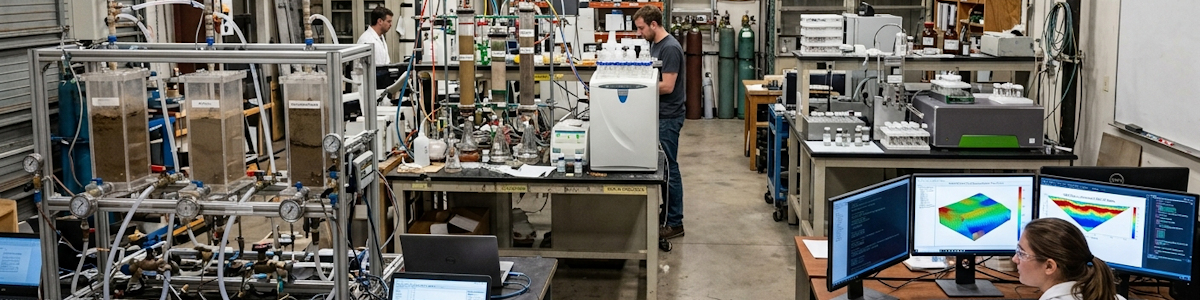
The Darcy Groundwater Systems Laboratory
The laboratory commemorates Henry Darcy, the Dijon engineer whose sand-column experiments for the city fountains produced the permeability law that still underwrites every calculation of subsurface flow — and it constitutes the hydrogeology arm of Analex Laboratories. Its brief spans aquifer characterisation, contaminant migration, and the recharge and discharge behaviour of groundwater bodies.
Core Capabilities & Equipment
- Aquifer Testing & Well Hydraulics Bay: Constant-head permeameters, double-packer straddle tests, and supervised pumping tests run with pressure transducers and multilevel sampling ports constrain hydraulic conductivity, storativity, and inter-unit leakage across three orders of magnitude.
- Environmental Isotope & Tracer Laboratory: Stable water isotopes, tritium, radiocarbon, dissolved noble gases, and sulphur hexafluoride pass through IRMS and liquid scintillation counting, apportioning recharge elevation, residence time, and the share of young water reaching a wellhead.
- Groundwater Geochemistry & Contaminant Transport Line: Ion chromatography, ICP-MS, and sorption column rigs define the aqueous chemistry of a plume, partition contaminants between dissolved and sorbed phases, and delineate the redox zonation deciding whether a species degrades or lingers.
- Numerical Modelling & Borehole Geophysics Suite: MODFLOW-family flow and transport codes run on calibrated parameter fields, while electrical resistivity tomography, borehole flowmetry, and downhole camera work index fracture apertures and preferential pathways wherever core is absent.
Groundwater is the hidden half of the hydrological cycle, and for most of the twentieth century the science built around it was essentially extractive: drill, test, pump, and hope the numbers held. Analex Laboratories, a consortium of hydrogeologists, geophysicists, geochemists, and stochastic modelers, has reframed the discipline around a harder truth — that subsurface water is a slow, finite, and spatially perverse resource whose behavior can only be predicted if heterogeneity is measured rather than averaged away. The consortium's researchers approach every aquifer as a coupled system in which flow, chemistry, heat, biology, and human withdrawal interact, and in which the dominant uncertainty is almost never the physics but the geometry.
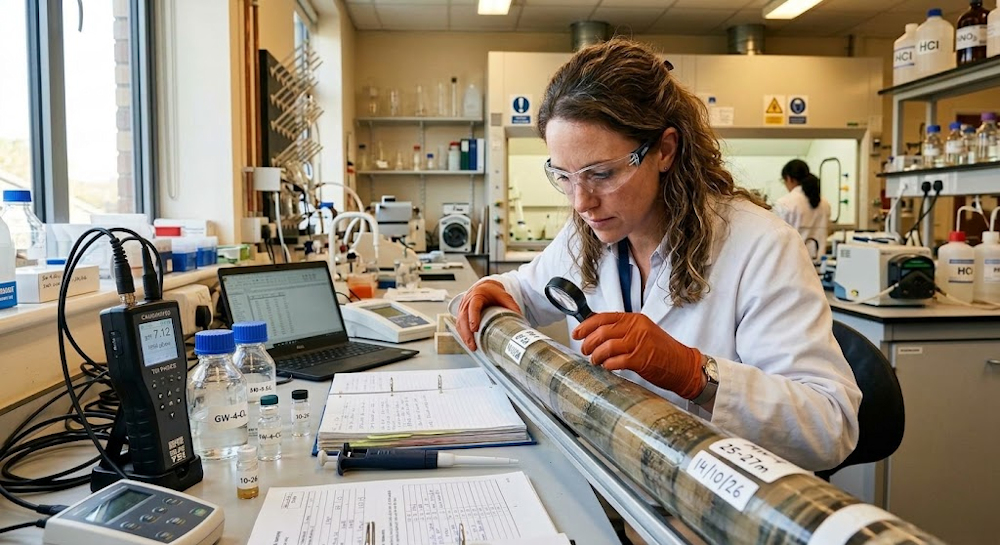
Mapping that geometry is the group's first preoccupation. Analex combines surface geophysics — electrical resistivity, transient electromagnetics, seismic reflection, gravity — with borehole logging, cross-hole tomography, and distributed fiber-optic temperature and acoustic sensing to build three-dimensional frameworks of permeable and confining units, including the fracture networks and karst conduits that carry most of the flow in hard-rock and carbonate terranes. Satellite gravimetry detects basin-scale storage loss, interferometric radar measures the land subsidence that accompanies over-pumping, and heat and helium surveys trace deep circulation paths. Residence time and provenance are established through a tracer suite: tritium, chlorofluorocarbons, sulfur hexafluoride, radiocarbon, noble gases, and stable water isotopes, often combined to distinguish modern recharge from fossil water drawn down over decades.
Process-level research supplies the mechanism behind those patterns. Analex runs column and mesocosm experiments on reactive transport, tracking how nitrate, arsenic, fluoride, per- and polyfluoroalkyl substances, and organic solvents migrate, sorb, and biodegrade under varying redox conditions and microbial communities. Flow through dual-porosity media, matrix diffusion into dead-end fractures, and density-driven convection receive sustained attention because they govern how long a contaminant plume lingers after the source is removed. A dedicated program quantifies exchange between streams and shallow aquifers — hyporheic flux, bank storage, and baseflow generation — since surface water and groundwater are legally and ecologically inseparable even where management pretends otherwise.
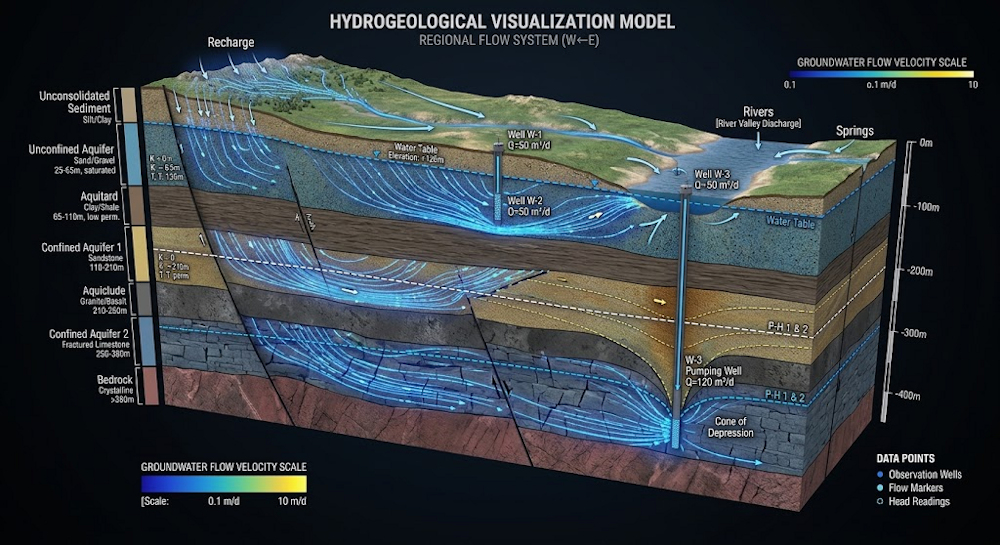
Modeling at Analex is deliberately probabilistic. Inverse calibration with formal uncertainty quantification, ensemble forecasting, and data assimilation produce not single water budgets but distributions of plausible ones, which is what water managers can actually act on. The group couples recharge projections from downscaled climate scenarios into these models to explore how wet and dry regions diverge in aquifer response, and simulates the classic failure modes: water-table decline, land subsidence and permanent storage loss, and saltwater intrusion at coastal margins driven by both pumping and sea-level rise. Managed recharge and aquifer storage and recovery are studied as countermeasures, with attention to clogging, geochemical incompatibility, and the recovery efficiency that determines whether a scheme is genuinely useful.
Water security keeps the work anchored to consequences. Analex advises on agricultural and municipal supply, transboundary aquifer allocation, mine dewatering and pit-lake chemistry, and the groundwater demands of geothermal, hydrogen, and carbon-storage projects, where pressure interference between neighboring operations is the emerging conflict. Deep saline formations, long dismissed as irrelevant to supply, are now modeled as active participants in the energy transition. A planetary thread extends the same reasoning to Martian groundwater and ice, lunar volatile deposits, and the subsurface oceans of icy moons. The consortium's premise is unglamorous but durable: you cannot manage a reservoir you have never properly characterized, and the aquifers that fail are the ones nobody bothered to instrument.