Subsea & Deep-Sea Technology
Located along the Hawaiian coast within the Analex Laboratories research consortium, the Onizuka Deep-Sea Technology Center is an 82,000-square-foot facility dedicated to developing and testing technologies for deep-ocean exploration. Its specialized laboratories, testing complexes, and ocean access enable interdisciplinary teams to advance subsea vehicles, materials, sensors, and persistent monitoring infrastructure.
Onizuka Deep-Sea Technology Center
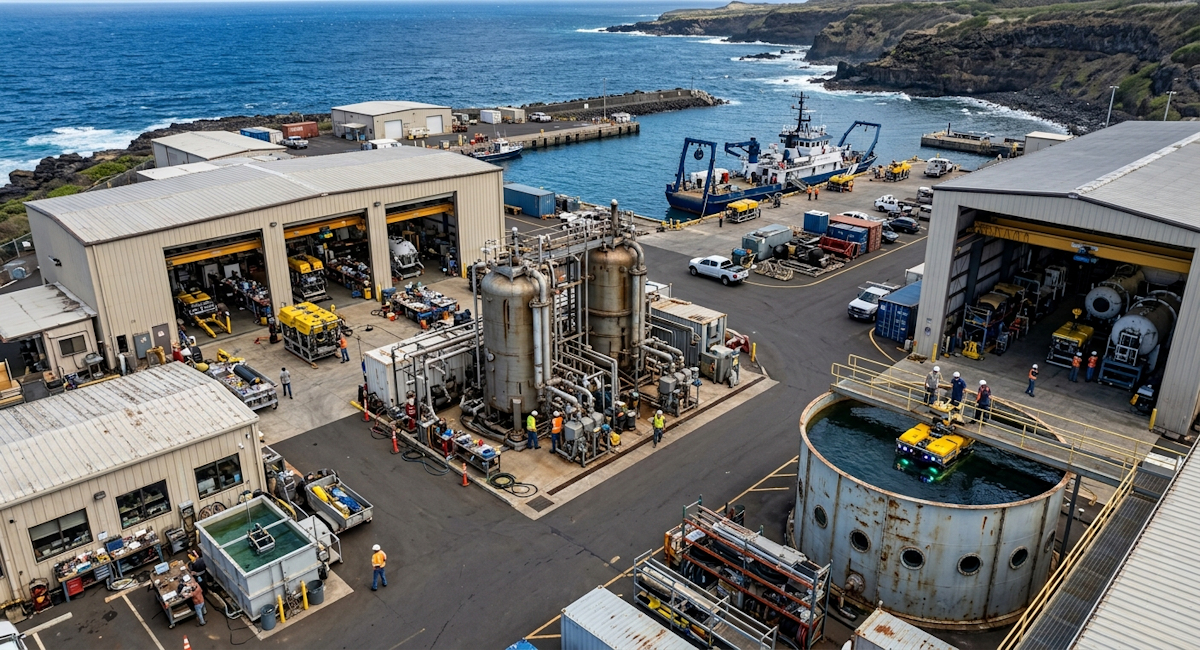
Perched along the dramatic coastline of Hawaii within the Analex Laboratories research consortium, the Onizuka Deep-Sea Technology Center represents a world-class facility dedicated to advancing the technologies that enable human access to and understanding of the deepest ocean environments. Onizuka occupies a specialized research complex of approximately 82,000 square feet, strategically positioned to leverage Hawaii's unique geographic advantages as a gateway to the Pacific Ocean and its proximity to deep ocean trenches that provide natural testbeds for extreme environment technologies. The facility serves as a comprehensive front-end development hub where subsea systems evolve from initial concepts through rigorous pressure testing and engineering validation to operational prototypes capable of withstanding the crushing pressures and corrosive conditions found thousands of meters beneath the ocean surface.
The physical architecture of Onizuka integrates multiple specialized zones designed to support the demanding requirements of deep-sea technology development. The pressure testing complex forms the heart of the facility, featuring large-diameter hyperbaric chambers capable of simulating depths equivalent to full ocean access, enabling engineers to validate hull integrity, sealing systems, and material performance under extreme hydrostatic pressure. These chambers incorporate sophisticated pressurization systems that can replicate the descent and ascent profiles experienced by subsea equipment, complete with temperature cycling capabilities that simulate the thermal gradients encountered in deep ocean environments. Adjacent to the pressure testing area, the materials research laboratories investigate high-strength alloys, ceramic composites, and polymer systems specifically formulated for deep-sea applications, conducting fatigue testing, corrosion studies, and long-term exposure evaluations that inform material selection for critical subsea components.
The subsea vehicle development wing at Onizuka encompasses specialized assembly bays for constructing and integrating autonomous underwater vehicles, remotely operated platforms, and hybrid systems capable of operating at extreme depths. This area features precision machining centers for fabricating pressure-resistant housings, cleanroom environments for assembling sensitive electronic packages, and integration stations equipped with overhead crane systems for handling large vehicle assemblies. The sensor and instrumentation laboratories focus on developing specialized equipment for deep ocean observation, including high-resolution imaging systems, chemical analysis instruments, and physical parameter sensors capable of operating reliably in the hadal zone. The facility maintains dedicated tank testing areas with viewing ports and instrumentation access that allow engineers to evaluate vehicle hydrodynamics, sensor performance, and manipulation capabilities in controlled freshwater environments before progressing to open ocean trials.
The ocean observation systems division at Onizuka develops the infrastructure required for persistent deep-sea monitoring and data collection. This area includes laboratories for designing seabed observatory components, underwater communication systems, and power distribution networks that enable long-term deployment of instrumentation on the ocean floor. The facility supports the development of docking stations for autonomous vehicles, inductive power transfer systems for recharging subsea batteries, and fiber optic data transmission equipment capable of relaying high-bandwidth information from extreme depths. The systems integration hall provides space for assembling complete subsea packages, including pressure vessels, buoyancy systems, ballast control mechanisms, and tether management systems that enable precise positioning and station-keeping in deep ocean currents. The facility maintains direct ocean access through a protected harbor facility equipped with specialized handling equipment for launching and recovering deep-sea vehicles and equipment.
Research personnel at Onizuka comprise ocean engineers, materials scientists, pressure vessel specialists, and marine technologists working in interdisciplinary teams focused on civilian applications of deep-sea technology. The facility maintains active partnerships with oceanographic institutions, marine resource exploration companies, and environmental monitoring organizations throughout the Pacific region. Through this collaborative approach, Onizuka contributes to the development of technologies that support scientific exploration of the deep ocean, sustainable resource assessment, marine ecosystem monitoring, and the infrastructure required for understanding Earth's least accessible environments.
Cutting-Edge Specialties
- Extreme Environment Pressure System Engineering
Onizuka specializes in the development of pressure-resistant systems capable of withstanding the crushing forces encountered at full ocean depths. Researchers investigate novel hull geometries, sealing methodologies, and pressure compensation techniques that enable sensitive equipment to operate reliably in the deepest ocean trenches. This specialty encompasses the design of spherical and cylindrical pressure vessels, penetrator systems for electrical and optical feedthroughs, and oil-filled compensation schemes that balance internal and external pressures. The facility supports the creation of advanced composite pressure housings that combine high strength-to-weight ratios with corrosion resistance, enabling the deployment of sophisticated instrumentation packages that would otherwise be impossible at extreme depths.
- Autonomous Deep-Sea Exploration Platforms
The center maintains an active research program developing untethered vehicles capable of independent operation in the deepest ocean environments for extended duration missions. Researchers investigate buoyancy engine systems that enable vehicles to traverse the full water column without expending electrical energy, high-density battery technologies optimized for pressure-compensated operation, and autonomous navigation algorithms that function in GPS-denied deep ocean conditions. This specialty includes the development of precision landing systems that enable vehicles to rendezvous with seabed docking stations, sample collection mechanisms that can retrieve geological and biological specimens without contamination, and adaptive mission planning software that responds to unexpected discoveries or changing environmental conditions during autonomous operations.
- Subsea Observation and Sensing Networks
Onizuka develops the distributed sensor systems and communication infrastructure required for persistent monitoring of deep ocean environments. Researchers investigate seabed observatory platforms that combine physical, chemical, and biological sensors with high-bandwidth data transmission capabilities, enabling continuous monitoring of deep ocean conditions over multi-year deployment periods. This specialty encompasses the design of underwater connector systems, fiber optic cable terminations, and inductive coupling technologies that transfer power and data across the seawater interface without physical penetration. The facility supports the creation of modular sensor packages that can be serviced or upgraded by autonomous vehicles, extending the operational lifetime of deep ocean observation networks while reducing the need for costly human-occupied intervention missions.
- Deep-Seabed Exploration and Sampling Systems
The center specializes in developing technologies for investigating and sampling the mineral and biological resources found on the deep ocean floor. Researchers investigate selective collection mechanisms that can harvest polymetallic nodules, sulfide deposits, or cobalt crusts while minimizing disturbance to surrounding sediments and ecosystems. This specialty includes the design of tracked and wheeled vehicles capable of traversing soft seabed sediments, hydraulic collection systems that transport materials from the seafloor to surface vessels, and environmental monitoring instrumentation that characterizes the impacts of exploration activities. The facility supports the development of precision sampling tools that can retrieve intact geological cores, biological specimens, and water samples from specific depths within the sediment column while maintaining the pressure and temperature conditions required for sample integrity.
- Underwater Intervention and Manipulation Technologies
Onizuka develops the robotic systems required for performing complex tasks in the deep ocean without direct human presence. Researchers investigate dexterous manipulator arms capable of operating under extreme pressure, force feedback control systems that provide operators with tactile sensation despite the intervening water column, and tool integration systems that enable subsea vehicles to perform maintenance, repair, and installation tasks on deep ocean infrastructure. This specialty encompasses the development of hydraulic and electromechanical actuator systems optimized for pressure-compensated operation, end effector designs for grasping and manipulating objects in the deep sea, and supervisory control architectures that enable remote operators to perform complex intervention tasks with minimal training. The facility supports the creation of hybrid vehicles that combine the endurance of autonomous systems with the manipulation capabilities of remotely operated platforms, enabling efficient execution of complex deep ocean missions.