Marine Hydroacoustics & Sonar Technology
Situated within Florida's Analex Laboratories, the Thagard Hydroacoustics Center is a 75,000-square-foot facility dedicated to advancing marine acoustic sensing, imaging, and communication technologies from theoretical concepts to field-ready prototypes. Its specialized infrastructure includes anechoic testing tanks, signal processing laboratories, and waterfront deployment access, allowing interdisciplinary teams to collaborate on oceanographic mapping, environmental monitoring, and sustainable resource exploration.
Thagard Hydroacoustics Center
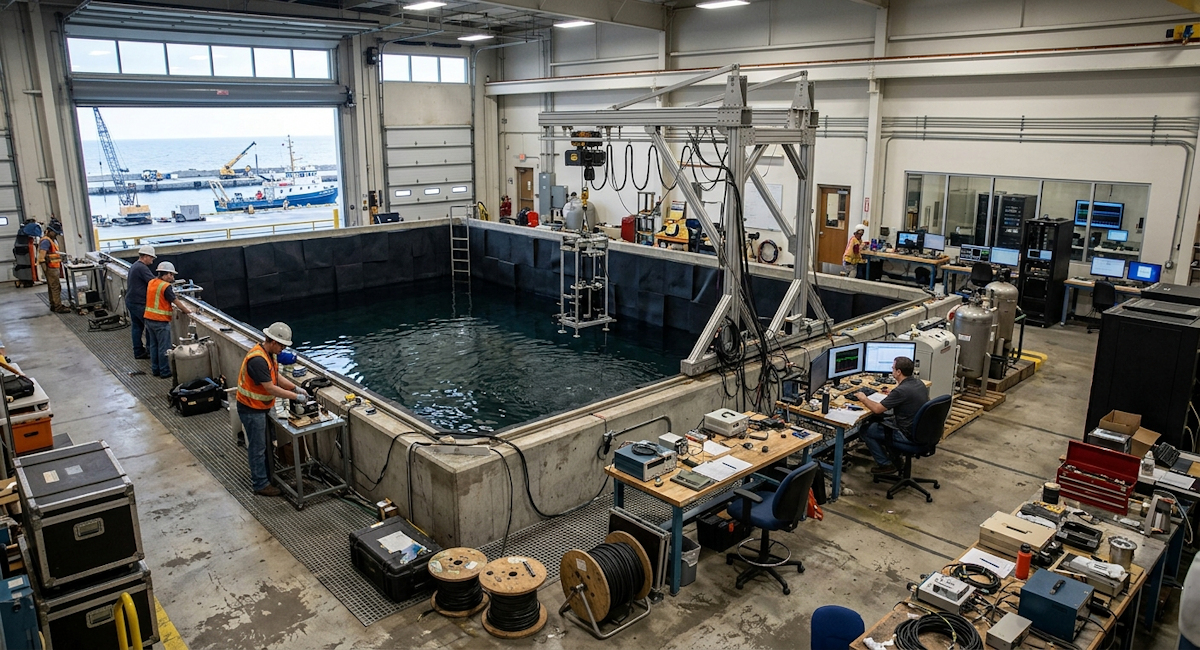
Situated along Florida's vibrant Atlantic coastline within the Analex Laboratories research consortium, the Thagard Hydroacoustics Center stands as a premier facility dedicated to advancing the technologies that enable acoustic sensing, imaging, and communication in the marine environment. Thagard occupies a specialized research complex of approximately 75,000 square feet, strategically positioned to leverage Florida's diverse marine ecosystems ranging from shallow estuarine environments to deep ocean access. The facility serves as a comprehensive front-end development hub where hydroacoustic systems evolve from theoretical concepts through rigorous laboratory testing and calibration to field-ready prototypes capable of operating across the full spectrum of underwater conditions.
The physical architecture of Thagard integrates multiple specialized zones designed to support the demanding requirements of acoustic technology development. The acoustic testing complex forms the core of the facility, featuring large-scale freshwater test tanks with anechoic lining systems that eliminate boundary reflections and create controlled free-field acoustic environments. These tanks incorporate precision positioning systems that enable automated scanning of acoustic transducers, along with calibrated hydrophone arrays for measuring sound pressure fields with high spatial resolution. The facility maintains pressure-rated test chambers capable of simulating deep ocean conditions for validating transducer performance under hydrostatic loading. Adjacent to the test tanks, the transducer development laboratories house cleanroom environments for assembling piezoelectric elements, precision machining centers for fabricating acoustic windows and housings, and electrical characterization stations for measuring impedance, admittance, and radiation patterns across the frequency spectrum.
The signal processing and electronics development wing at Thagard encompasses specialized laboratories for designing the computational systems that transform raw acoustic data into actionable information. This area features high-performance computing clusters capable of processing massive datasets generated by multibeam and synthetic aperture systems, along with hardware-in-the-loop simulation platforms that enable real-time algorithm development. The beamforming and array processing laboratories investigate advanced signal processing techniques including adaptive beamforming, matched field processing, and machine learning approaches for target detection and classification. The facility maintains specialized chambers for electromagnetic compatibility testing, ensuring that acoustic electronics operate reliably in the presence of other marine systems and meet stringent emission standards for environmental sensitivity.
The systems integration hall at Thagard provides dedicated spaces for assembling complete sonar packages and preparing them for field deployment. This area includes pressure vessel assembly stations, cable and connector integration benches, and environmental testing chambers that simulate temperature extremes, humidity conditions, and vibration profiles encountered during marine operations. The facility maintains a protected waterfront facility with vessel handling equipment for launching and recovering instrumented platforms, along with workshop spaces for maintaining and repairing field equipment between deployments. The calibration and metrology laboratories maintain traceable standards for acoustic measurements, ensuring that systems developed at Thagard meet international specifications for accuracy and repeatability.
Research personnel at Thagard comprise acoustic physicists, electrical engineers, signal processing specialists, and oceanographers working in interdisciplinary teams focused on civilian applications of hydroacoustic technology. The facility maintains active partnerships with marine research institutions, offshore energy operators, environmental monitoring organizations, and hydrographic survey companies throughout the Gulf and Atlantic coastal regions. Through this collaborative approach, Thagard contributes to the development of acoustic technologies that support seafloor mapping, marine mammal monitoring, underwater navigation, and the sustainable exploration of ocean resources.
Cutting-Edge Specialties
- High-Resolution Seabed Imaging and Characterization
Thagard specializes in developing advanced sonar systems that provide detailed acoustic images of the seafloor for scientific, commercial, and environmental applications. Researchers investigate synthetic aperture processing techniques that synthesize data from multiple acoustic transmissions to achieve resolution levels comparable to optical imaging at depths where light cannot penetrate. This specialty encompasses the design of multibeam echosounder arrays capable of simultaneously mapping wide swaths of seabed while measuring backscatter characteristics that indicate sediment type, habitat features, and geological structures. The facility supports the creation of interferometric processing algorithms that extract three-dimensional bathymetric data from acoustic returns, enabling precise characterization of underwater terrain for habitat mapping, infrastructure siting, and geological assessment.
- Acoustic Telemetry and Underwater Communications
The center maintains an active research program developing reliable data transmission systems that function in the challenging underwater environment where radio waves cannot propagate effectively. Researchers investigate modulation schemes, error correction protocols, and networking architectures that enable high-bandwidth communication between underwater vehicles, surface platforms, and seabed instruments. This specialty includes the development of acoustic positioning systems that use time-of-flight measurements and array processing to determine the three-dimensional location of submerged assets with meter-level accuracy. The facility supports the creation of integrated communication and positioning networks that enable coordinated operations among multiple underwater platforms while providing telemetry links for monitoring system status and transferring scientific data.
- Passive Acoustic Monitoring and Bioacoustics
Thagard develops the sensor systems and analytical tools required for continuous monitoring of underwater soundscapes and the marine life that produces them. Researchers investigate low-power recording systems capable of long-term autonomous deployment, automated detection algorithms that identify marine mammal vocalizations, and classification techniques that distinguish between species based on acoustic signatures. This specialty encompasses the design of sparse array configurations that provide directional information about sound sources, noise reduction techniques that enhance signal detection in high-ambient environments, and soundscape analysis methods that characterize the temporal and spatial patterns of biological and anthropogenic noise. The facility supports the creation of monitoring systems that contribute to marine mammal conservation, fisheries management, and the assessment of human impacts on underwater acoustic environments.
- Advanced Transducer Design and Calibration
The center specializes in the development of electroacoustic transducers that convert between electrical signals and acoustic energy with high efficiency and precision across targeted frequency bands. Researchers investigate piezoelectric materials, composite structures, and matching layer configurations that optimize radiation patterns, bandwidth, and power handling for specific applications. This specialty includes the design of compact arrays that achieve directional beams through element phasing, broadband transducers that operate effectively across multiple octaves, and high-power projectors capable of long-range propagation. The facility supports comprehensive calibration protocols that characterize transducer sensitivity, directivity, and impedance properties under controlled conditions, ensuring that acoustic systems perform according to specifications and enabling accurate quantitative measurements in field applications.
- Acoustic Environmental Monitoring and Sensing
Thagard develops integrated acoustic systems for monitoring physical, chemical, and biological parameters in the water column and seabed. Researchers investigate inversion techniques that extract water column properties such as temperature, salinity, and current velocity from acoustic propagation measurements, along with scatterometry methods that characterize suspended sediments, plankton concentrations, and bubble fields. This specialty encompasses the design of autonomous acoustic observatories that combine multiple sensing modalities, power management systems that enable multi-year deployments, and data telemetry links that relay information to shore-based facilities. The facility supports the creation of monitoring networks that contribute to oceanographic research, climate studies, and the sustainable management of marine resources through continuous observation of underwater conditions.