Autonomous Maritime Systems & Robotics
Located within Rhode Island's Analex Laboratories research consortium, the 78,000-square-foot Readdy Autonomous Maritime Systems Center is a premier facility dedicated to advancing unmanned marine vehicles and ocean robotics. Its multidisciplinary teams leverage specialized development wings, testing tanks, cleanrooms, and simulation suites to take autonomous surface and underwater systems from concept to field-ready deployment.
Readdy Autonomous Maritime Systems Center
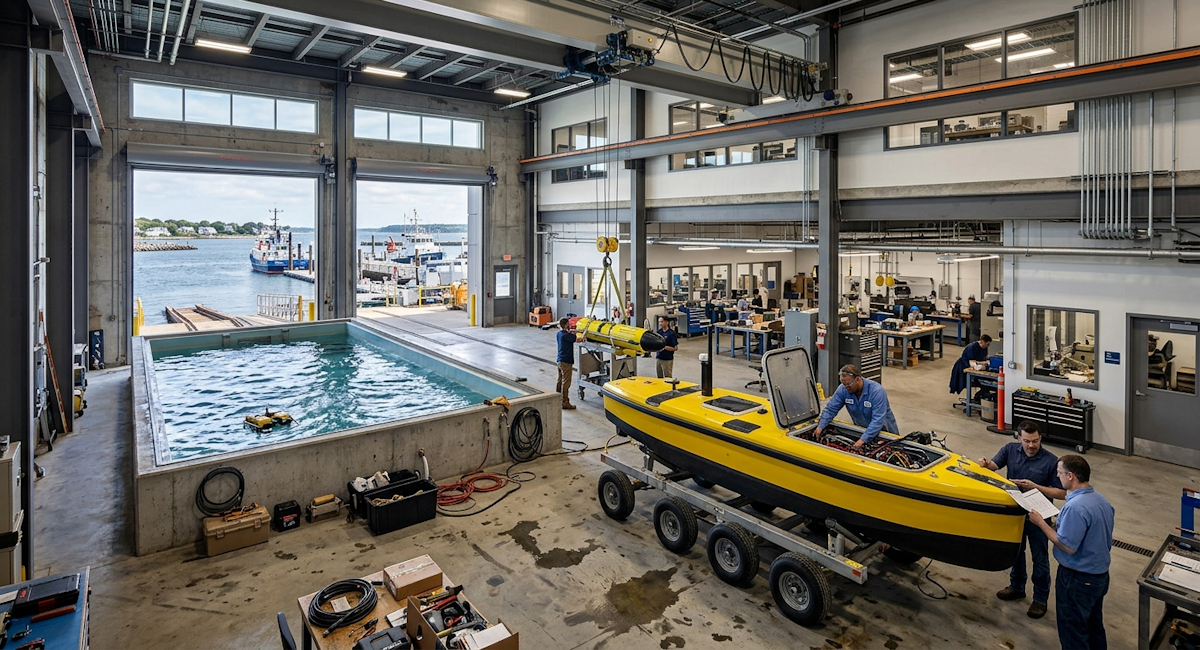
Located within the Analex Laboratories research consortium along the scenic shores of Rhode Island, the Readdy Autonomous Maritime Systems Center stands as a premier research and development facility dedicated to advancing the frontiers of unmanned marine vehicles and ocean robotics. Readdy occupies a purpose-designed complex of approximately 78,000 square feet, strategically positioned to leverage the state's robust blue economy infrastructure and proximity to diverse maritime environments ranging from sheltered estuaries to open ocean access. The facility serves as a comprehensive front-end development hub where autonomous maritime technologies evolve from conceptual frameworks through rigorous engineering validation to operational prototype systems ready for field deployment.
The architectural layout of Readdy integrates multiple specialized zones configured to support the complete development lifecycle of autonomous marine systems. The surface vehicle development wing features a two-story high-bay staging area equipped with overhead bridge crane systems capable of handling vessels up to fifteen meters in length, enabling assembly and integration of autonomous surface vehicles at various scales. Adjacent to this, the indoor testing complex houses a precision-engineered freshwater test tank measuring twelve meters by eight meters with variable depth capabilities and integrated wave generation systems. This controlled environment allows engineers to evaluate vehicle hydrodynamics, sensor performance, and control algorithms under repeatable conditions before transitioning to open water trials. The facility maintains direct water access through a dedicated marine railway and launch ramp, facilitating seamless transfer of prototype systems between indoor laboratories and the adjacent harbor for field testing operations.
The underwater robotics division at Readdy encompasses specialized laboratories for developing autonomous underwater vehicles and remotely operated systems. This area features pressure testing chambers capable of simulating depths equivalent to full ocean access, enabling validation of hull integrity and sealing systems under extreme conditions. The electronics integration laboratories provide cleanroom environments for assembling sensor packages, navigation systems, and communication modules with precision soldering stations, environmental control systems, and electromagnetic compatibility testing equipment. A dedicated docking and charging research area investigates autonomous rendezvous systems, underwater docking mechanisms, and inductive power transfer technologies that enable extended-duration operations through automated energy replenishment. The facility maintains comprehensive machine shops with computer-controlled cutting systems, additive manufacturing capabilities, and composite fabrication stations for producing pressure-resistant housings, buoyancy modules, and specialized structural components.
The perception and navigation laboratories at Readdy focus on developing the sensory and computational systems that enable autonomous operation in complex marine environments. This area houses sensor calibration facilities for evaluating camera systems, scanning laser systems, and radio detection equipment under controlled lighting and environmental conditions. The software development environment integrates high-performance computing clusters capable of processing massive datasets generated during field operations, supporting the training of machine learning models for object detection, classification, and tracking. Simulation suites equipped with immersive display systems allow engineers to visualize vehicle behavior, test collision avoidance algorithms, and evaluate multi-vehicle coordination strategies in virtual environments that replicate real-world maritime scenarios. The facility maintains extensive data storage infrastructure and high-bandwidth connectivity to support collaborative research with partner institutions and remote monitoring of field operations.
Research personnel at Readdy comprise robotics engineers, marine scientists, autonomy specialists, and software developers working in interdisciplinary teams focused on civilian applications of marine robotics. The facility maintains active partnerships with commercial fishing operations, offshore energy companies, environmental monitoring organizations, and oceanographic research institutions throughout the New England region. Through this collaborative approach, Readdy contributes to the development of autonomous systems that support sustainable fisheries management, oceanographic data collection, marine infrastructure inspection, and environmental stewardship while advancing the technological capabilities that define the emerging blue economy.
Cutting-Edge Specialties
- Autonomous Surface Vehicle Navigation and Control
Readdy specializes in developing intelligent navigation systems that enable unmanned surface vessels to operate safely and efficiently in complex maritime traffic environments. Researchers investigate path planning algorithms that account for dynamic obstacles, changing weather conditions, and regulatory compliance requirements while optimizing routes for fuel efficiency and mission objectives. This specialty encompasses the development of robust control architectures that maintain vessel stability across varying sea states, adaptive speed management systems that respond to environmental conditions, and autonomous docking capabilities that enable vessels to berth without human intervention. The facility supports the creation of supervisory control systems that allow remote operators to monitor multiple autonomous vessels simultaneously, intervening only when necessary while the onboard systems handle routine navigation decisions.
- Multi-Vehicle Coordination and Swarm Robotics
The center maintains an active research program investigating collaborative behaviors among multiple autonomous marine vehicles operating as coordinated fleets. Researchers develop distributed algorithms that enable task sharing, formation maintenance, and cooperative mapping across groups of surface and underwater vehicles without centralized control architectures. This specialty addresses the unique challenges of underwater communication limitations, including low-bandwidth acoustic links and intermittent connectivity, by investigating decentralized decision-making strategies and predictive coordination protocols. The facility supports testing of swarm behaviors in controlled tank environments before progressing to open water demonstrations, validating concepts such as collaborative search patterns, distributed sensing networks, and redundant mission execution that enhance operational reliability through vehicle multiplicity.
- Maritime Perception and Situational Awareness Systems
Readdy conducts intensive research into sensor fusion and machine perception technologies that provide autonomous vessels with comprehensive understanding of their surrounding environment. Researchers investigate the integration of visual spectrum cameras, thermal imaging systems, scanning laser sensors, and radio detection equipment to create redundant detection capabilities that operate effectively across varying visibility conditions. This specialty encompasses the development of neural network architectures trained to recognize and classify maritime objects including other vessels, navigation aids, swimmers, and marine mammals, enabling appropriate collision avoidance responses. The facility supports the creation of real-time tracking systems that predict object trajectories, assess collision risks, and generate optimal avoidance maneuvers that comply with maritime regulations while maintaining mission progress.
- Autonomous Docking and Energy Management
The center specializes in developing technologies that extend the operational endurance of autonomous marine vehicles through automated rendezvous, docking, and energy replenishment capabilities. Researchers investigate precision localization systems that enable vessels to navigate to fixed or mobile docking stations, mechanical capture mechanisms that secure vehicles in varying sea conditions, and power transfer technologies that recharge battery systems without human intervention. This specialty includes the development of mission planning optimization algorithms that coordinate the movements of working vehicles and charging stations to ensure complete area coverage while minimizing energy expenditure and downtime. The facility supports testing of docking systems in controlled tank environments before progressing to dynamic field conditions, validating the mechanical, electrical, and software integration required for reliable autonomous energy management.
- Hybrid Underwater Robotics and Intervention Systems
Readdy develops advanced underwater vehicles that combine the autonomous endurance of untethered systems with the manipulation capabilities traditionally associated with remotely operated platforms. Researchers investigate vehicle architectures that can transition between autonomous survey modes and supervised intervention operations, enabling efficient data collection followed by targeted physical interaction with underwater infrastructure or equipment. This specialty encompasses the development of dexterous manipulator systems, tool integration interfaces, and force-feedback control strategies that enable precise underwater operations without direct visual observation. The facility supports the creation of hybrid vehicles capable of operating in deep ocean environments, maintaining position through dynamic positioning systems, and performing complex tasks such as sample collection, equipment deployment, and infrastructure inspection with minimal surface support requirements.