Naval Architecture & Hull Design
Situated in Virginia within Analex Laboratories, the Bowersox Naval Architecture Center is an 85,000-square-foot facility dedicated to advancing marine vessel design through an integrated workflow of computational modeling, hydrodynamic testing, and additive fabrication. Its interdisciplinary research team collaborates across specialized laboratories—including a 120-meter wave-capable towing tank and environmental testing chambers—to develop and validate innovative solutions for commercial, offshore, and civilian maritime operations.
Bowersox Naval Architecture Center
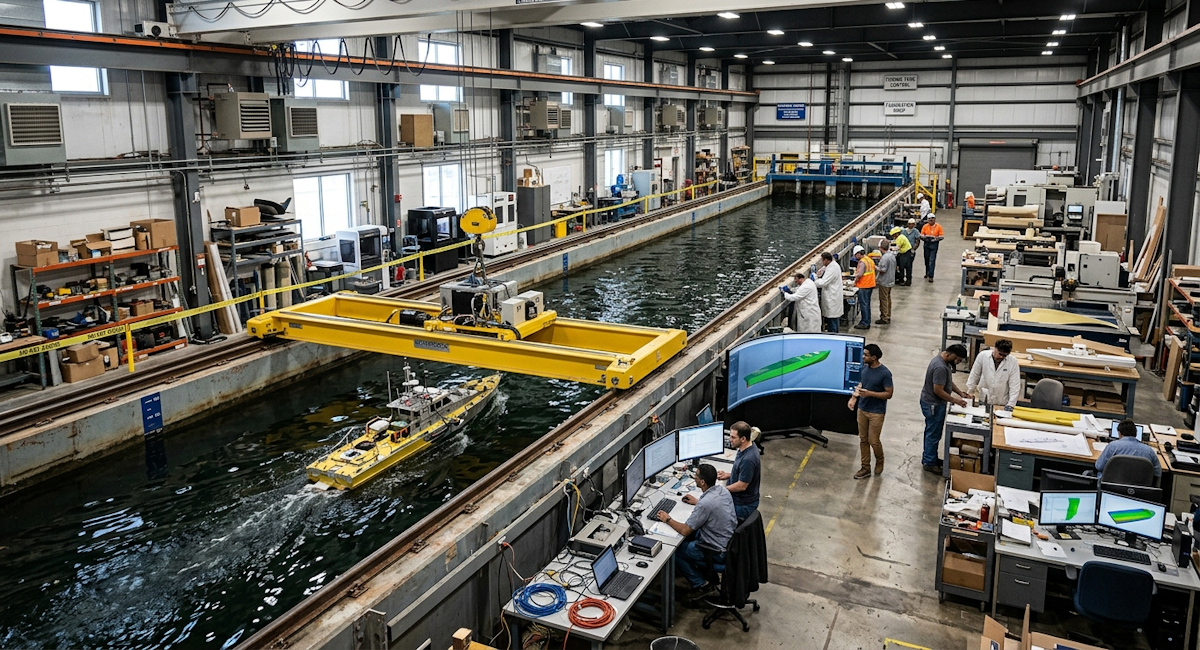
Nestled within the Analex Laboratories research consortium in Virginia, the Bowersox Naval Architecture Center stands as a premier destination for advancing the frontiers of marine vessel design and hydrodynamic engineering. Bowersox represents a comprehensive research and development environment where theoretical naval architecture transforms into tangible innovation. The facility encompasses approximately 85,000 square feet of specialized laboratory space, architecturally configured to support the full spectrum of early-stage vessel development—from initial concept generation through advanced prototyping and validation testing.
The physical layout of Bowersox reflects a deliberate workflow optimization, with interconnected zones dedicated to computational design, materials research, hydrodynamic testing, and prototype fabrication. The computational design wing houses high-performance simulation clusters capable of processing complex fluid dynamics calculations, enabling researchers to model hull behavior across diverse maritime conditions before physical construction begins. Adjacent to this, the visualization laboratories feature immersive display systems that allow engineering teams to evaluate hull geometries and interior configurations at full scale, facilitating collaborative design reviews and ergonomic assessments.
At the heart of Bowersox lies the hydrodynamic testing complex, featuring a precision-engineered towing tank measuring 120 meters in length with advanced wave generation capabilities. This facility enables comprehensive resistance and propulsion testing through a computer-controlled carriage system that captures real-time force measurements, flow visualization data, and motion response characteristics. Complementing the towing tank, the facility maintains a dedicated cavitation research tunnel for investigating propeller performance and flow phenomena under controlled pressure conditions. The planar motion mechanism integrated into the testing infrastructure allows for sophisticated maneuvering studies, capturing dynamic stability parameters and directional response behaviors essential for validating hull designs.
The prototyping and fabrication wing at Bowersox bridges the gap between digital models and physical reality. This space houses advanced additive manufacturing systems capable of producing large-scale hull sections and complex geometric components with high-precision polymer and composite materials. Traditional fabrication capabilities, including precision machining and composite layup stations, support the creation of scale models for tank testing as well as full-scale structural mockups for validation studies. Environmental testing chambers within the facility simulate extreme maritime conditions—including salt spray exposure, temperature cycling, and humidity variations—to evaluate material durability and coating performance under accelerated aging protocols.
The research staff at Bowersox comprises naval architects, marine engineers, hydrodynamicists, and materials scientists working in interdisciplinary teams. The facility maintains active collaborative partnerships with academic institutions, commercial maritime operators, and environmental research organizations, ensuring that development activities address real-world operational challenges while advancing sustainable practices. Through this integrated approach, Bowersox serves as a catalyst for innovation in civilian maritime transportation, offshore operations, and marine resource exploration.
Cutting-Edge Specialties
- Advanced Hydrodynamic Optimization and Hull Form Development
Bowersox maintains a dedicated research focus on developing next-generation hull geometries that maximize hydrodynamic efficiency while minimizing environmental impact. Researchers employ sophisticated computational fluid dynamics methodologies integrated with machine learning algorithms to explore vast design spaces and identify optimal hull configurations for specific operational profiles. This specialty encompasses the development of innovative bow and stern geometries, bulbous bow optimizations for diverse speed ranges, and the integration of drag-reduction surface technologies. The facility's capabilities enable systematic exploration of multihull configurations, semi-planing hull forms, and advanced displacement geometries that offer superior seakeeping characteristics while reducing power requirements and emissions.
- Sustainable Marine Materials and Composite Structures
The materials research division at Bowersox pioneers the development and application of environmentally responsible composite materials for hull construction and marine structures. Researchers investigate bio-derived resin systems, recyclable fiber reinforcements, and hybrid material combinations that reduce the environmental footprint of vessel construction while maintaining structural integrity and durability. This specialty includes the development of lightweight structural cores, advanced sandwich panel configurations, and innovative joining techniques that simplify end-of-life material recovery. The facility maintains comprehensive testing protocols for evaluating material performance under cyclic loading, impact conditions, and long-term environmental exposure to ensure that sustainable alternatives meet or exceed the performance characteristics of traditional marine materials.
- Integrated Propulsion and Flow Systems Engineering
Bowersox conducts advanced research into the integration of hull geometry with propulsion system hydrodynamics, focusing on achieving optimal energy efficiency through comprehensive flow management. This specialty encompasses the design and testing of integrated propulsor configurations, wake-adapted hull forms, and flow-smoothing appendage geometries that minimize resistance and maximize thrust efficiency. Researchers investigate boundary layer manipulation techniques, vortex reduction strategies, and the hydrodynamic interaction between hull, propeller, and rudder systems. The facility's testing infrastructure supports detailed investigation of cavitation phenomena, pressure fluctuation characteristics, and flow-induced vibration to develop propulsion systems that operate efficiently across the full range of anticipated operating conditions.
- Digital Twin and Predictive Performance Modeling
The center specializes in developing comprehensive digital twin frameworks that enable real-time performance prediction and operational optimization for marine vessels. This research area focuses on creating high-fidelity virtual representations of hull structures and systems that integrate hydrodynamic models, structural response predictions, and operational data analytics. Researchers at Bowersox develop physics-based machine learning models that can predict vessel performance under varying loading conditions, sea states, and operational scenarios. These predictive capabilities support the optimization of vessel routing, trim configuration, and operational parameters to maximize efficiency while ensuring safety and structural integrity throughout the vessel's service life.
- Autonomous and Intelligent Vessel Platform Development
Bowersox maintains an active research program focused on the hull design and hydrodynamic requirements of autonomous marine platforms operating without continuous human oversight. This specialty addresses the unique challenges of designing vessels optimized for remote operation, including enhanced stability characteristics for sensor platform integration, hull forms optimized for predictable motion responses, and the integration of autonomous navigation and collision avoidance systems. Researchers investigate the hydrodynamic implications of distributed propulsion architectures, hull-mounted sensor arrays, and the dynamic positioning requirements of autonomous platforms engaged in oceanographic research, environmental monitoring, and commercial survey operations. The facility supports the development of scaled autonomous test platforms for validating control algorithms and operational concepts in controlled maritime environments.