Oceanographic Instrumentation & Monitoring
Located on Maine's coast within the Analex Laboratories research consortium, the Hobaugh Oceanographic Center is a 72,000-square-foot facility dedicated to developing, engineering, and testing autonomous ocean instrumentation and observing platforms. Its specialized laboratories, waterfront testing infrastructure, and interdisciplinary teams allow researchers to design and deploy high-precision technology that supports global climate research, fisheries management, and marine conservation.
Hobaugh Oceanographic Center
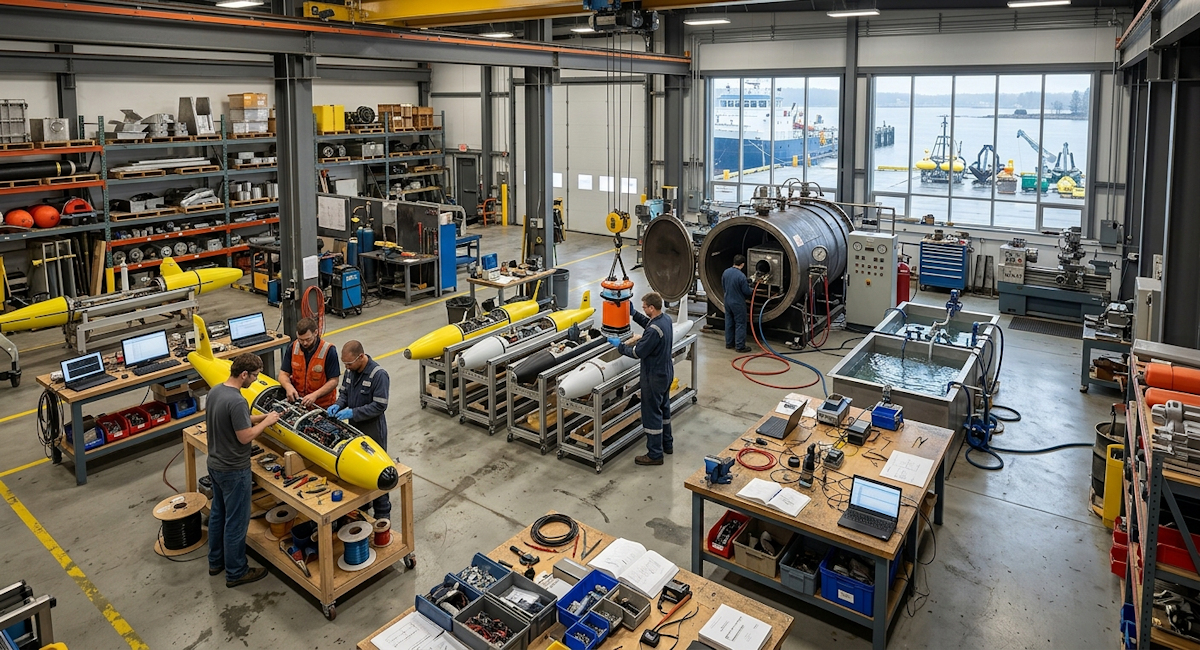
Located along the rugged coastline of Maine within the Analex Laboratories research consortium, the Hobaugh Oceanographic Center stands as a premier facility dedicated to advancing the instruments and platforms that enable comprehensive understanding of ocean processes. Hobaugh occupies a specialized research complex of approximately 72,000 square feet, strategically positioned to leverage the diverse marine environments of the Gulf of Maine ranging from productive coastal waters to the dynamic offshore regions. The facility serves as a comprehensive front-end development hub where oceanographic instrumentation evolves from scientific requirements through rigorous engineering design and testing to deployment-ready systems capable of operating autonomously for extended periods in challenging marine conditions.
The physical architecture of Hobaugh integrates multiple specialized zones designed to support the complete development lifecycle of ocean observing systems. The sensor development laboratories form the core of the facility, featuring precision environmental chambers capable of simulating the temperature, salinity, and pressure conditions encountered across the full ocean depth. These laboratories house calibration systems for characterizing conductivity, temperature, and depth sensors, along with specialized tanks for evaluating optical sensors including chlorophyll fluorometers, turbidity meters, and dissolved oxygen optodes. The facility maintains gas standard mixing systems for calibrating carbon dioxide and pH sensors, along with biological culture facilities for testing biofouling mitigation strategies that extend the operational lifetime of deployed instruments. Cleanroom environments within the sensor laboratories support the assembly of delicate optical components and the fabrication of microfluidic systems used in nutrient analyzers.
The platform integration wing at Hobaugh encompasses specialized assembly areas for constructing autonomous observing platforms including profiling floats, ocean gliders, and surface drifters. This area features pressure testing vessels for validating hull integrity, ballast calibration tanks for tuning buoyancy engines, and integration stations equipped with overhead handling systems for assembling large vehicle structures. The electronics development laboratories investigate power management systems, data logging architectures, and satellite telemetry modules that enable long-duration autonomous operations. The facility maintains machine shops for fabricating specialized structural components, along with composite fabrication stations for producing pressure-resistant housings and buoyancy elements. The mooring systems laboratory designs and tests anchored observing platforms including surface buoys, subsurface floats, and bottom-mounted instrumentation packages capable of withstanding high-energy ocean conditions.
The field testing and validation division at Hobaugh provides the infrastructure required for evaluating instrument performance in realistic marine environments before full-scale deployment. This area includes a protected waterfront facility with vessel handling equipment for launching and recovering test platforms, along with workshop spaces for maintaining and repairing field equipment. The facility maintains direct access to coastal waters that provide natural testbeds for evaluating instrument behavior across the range of conditions encountered in operational deployments. The data management and analysis laboratories house computing systems for processing observational datasets, quality control algorithms for identifying sensor drift or malfunction, and visualization tools for presenting oceanographic information to scientific and operational users. The calibration and metrology laboratories maintain traceable standards for all measured parameters, ensuring that data collected by systems developed at Hobaugh meet international accuracy requirements and can be integrated into global observing networks.
Research personnel at Hobaugh comprise oceanographers, marine chemists, mechanical engineers, and data scientists working in interdisciplinary teams focused on civilian applications of ocean observing technology. The facility maintains active partnerships with research institutions, fisheries management organizations, climate research programs, and environmental monitoring agencies throughout the North Atlantic region. Through this collaborative approach, Hobaugh contributes to the development of observing systems that support ecosystem-based fisheries management, climate change research, harmful algal bloom monitoring, and the sustainable stewardship of marine resources.
Cutting-Edge Specialties
- Autonomous Profiling Float Technology
Hobaugh specializes in developing buoyancy-driven platforms that autonomously traverse the water column to collect vertical profiles of physical and biogeochemical parameters. Researchers investigate buoyancy engine mechanisms that enable efficient depth cycling, energy management systems that extend operational endurance to multi-year deployments, and sensor integration architectures that accommodate expanding measurement capabilities. This specialty encompasses the design of compact CTD sensors optimized for low-power operation, optical sensors for measuring chlorophyll fluorescence and particle backscatter, and electrochemical sensors for dissolved oxygen and nitrate detection. The facility supports the creation of profiling systems that contribute to global observing networks, providing sustained measurements of ocean temperature, salinity, and biogeochemical properties that inform climate research and ecosystem assessments.
- Ocean Glider Systems and Dynamic Sampling
The center maintains an active research program developing winged underwater vehicles that use changes in buoyancy and hydrodynamic lift to achieve efficient horizontal transit while collecting vertical profile data. Researchers investigate flight control algorithms that optimize energy expenditure, adaptive sampling strategies that respond to detected ocean features, and navigation techniques that enable gliders to operate effectively in challenging current regimes. This specialty includes the design of modular payload systems that accommodate diverse sensor complements, acoustic communication systems that enable coordinated fleet operations, and surfacing protocols that maximize data telemetry while minimizing exposure to surface hazards. The facility supports the development of glider systems that provide sustained presence in dynamic ocean regions, enabling process studies and operational monitoring that would be impractical with traditional ship-based methods.
- Biogeochemical Sensor Development
Hobaugh develops the specialized instrumentation required for monitoring the chemical and biological processes that govern ocean ecosystem function. Researchers investigate optical techniques for measuring pH and carbon dioxide partial pressure, microfluidic systems for automated nutrient analysis, and bio-optical sensors for characterizing phytoplankton communities and suspended particle loads. This specialty encompasses the design of antifouling strategies that maintain sensor performance during extended deployments, calibration protocols that ensure measurement accuracy across varying environmental conditions, and data processing algorithms that convert raw sensor signals into scientifically meaningful quantities. The facility supports the creation of biogeochemical observing capabilities that enable assessment of ocean acidification, deoxygenation, and primary productivity trends essential for understanding marine ecosystem health.
- Lagrangian Drifter and Surface Observing Platforms
The center specializes in developing drifting platforms that move with ocean currents to map circulation patterns and collect distributed measurements across broad spatial scales. Researchers investigate drogue designs that ensure faithful tracking of water masses, surface float configurations that accommodate satellite telemetry and solar power generation, and sensor packages that measure sea surface temperature, salinity, and atmospheric parameters. This specialty includes the design of compact positioning systems, wave-powered energy harvesting mechanisms, and biofouling-resistant hull materials that maintain platform performance during extended ocean transits. The facility supports the development of drifter networks that provide ground truth for ocean circulation models, validate satellite observations, and track the dispersion of water masses and any materials they may contain.
- Moored Observatory Systems and Persistent Monitoring
Hobaugh develops the anchored platforms and associated instrumentation required for continuous observation of ocean conditions at fixed geographic locations. Researchers investigate mooring line designs that withstand high loads while minimizing flow-induced vibration, inductive telemetry systems that transfer power and data along mooring cables, and seafloor junction boxes that distribute resources to multiple instruments. This specialty encompasses the design of surface buoys that accommodate meteorological sensors and satellite communications, subsurface floats that house data loggers and battery systems, and bottom-mounted instrumentation packages for measuring near-bed processes. The facility supports the creation of observing systems that provide sustained time series measurements essential for detecting trends, resolving seasonal cycles, and capturing episodic events in ocean and coastal environments.