Marine Propulsion & Power Systems
The Arceneaux Marine Propulsion Center is a 95,000-square-foot R&D facility in Louisiana dedicated to developing and prototyping next-generation marine power and propulsion systems. Operating under the Analex Laboratories consortium, its interdisciplinary team utilizes specialized laboratories, advanced manufacturing, and multi-fuel testing infrastructure to advance sustainable maritime technologies.
Bowersox Naval Architecture Center
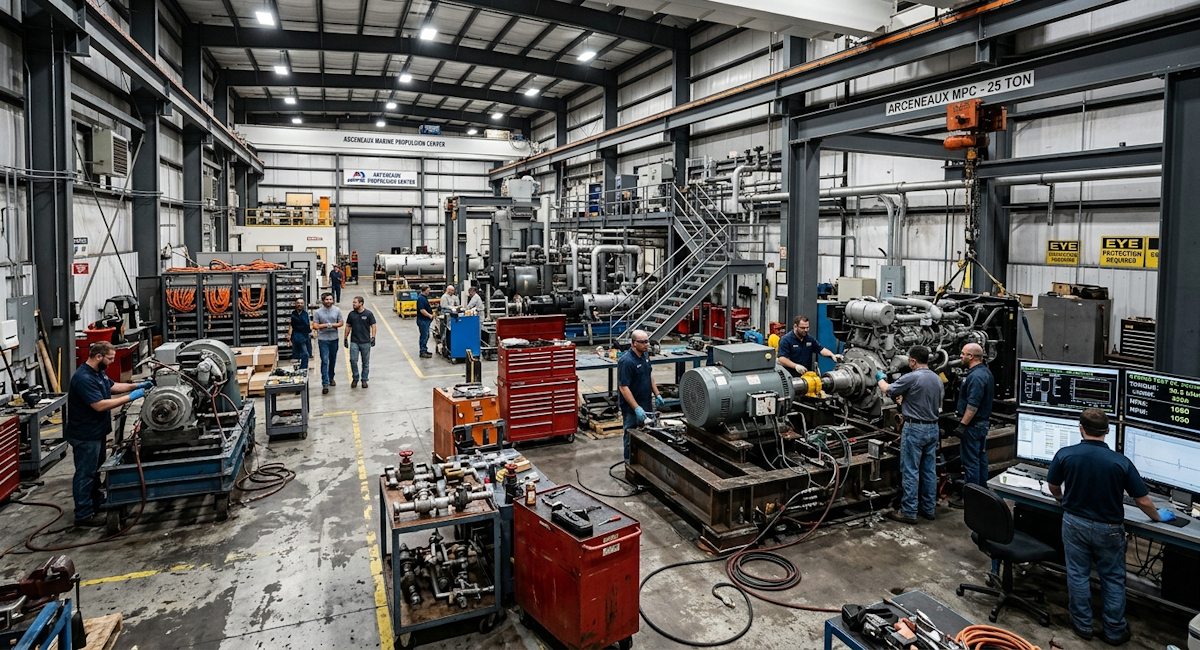
Situated within the Analex Laboratories research consortium along the vibrant Gulf Coast of Louisiana, the Arceneaux Marine Propulsion Center represents a premier research and development environment dedicated to advancing the next generation of marine power systems and propulsion technologies. Arceneaux occupies a purpose-built complex spanning approximately 95,000 square feet, strategically positioned to leverage Louisiana's deep maritime heritage and robust offshore energy infrastructure. The facility serves as a comprehensive front-end development hub where innovative propulsion concepts evolve from theoretical frameworks through rigorous engineering validation to functional prototype demonstration.
The physical architecture of Arceneaux integrates multiple specialized zones designed to support the complete development lifecycle of marine power systems. The powertrain integration wing features climate-controlled assembly bays equipped with overhead crane systems and precision alignment platforms for configuring propulsion machinery at various scales. Adjacent to this, the energy systems laboratory houses specialized containment facilities for investigating alternative fuel technologies, including cryogenic storage systems for liquid hydrogen, pressurized vessels for ammonia handling, and methanol fuel conditioning apparatus. The facility maintains comprehensive fuel supply installations with advanced conditioning and consumption measurement capabilities, enabling multi-fuel research operations within controlled environments.
The testing and validation complex at Arceneaux centers around a sophisticated dynamometer facility capable of evaluating propulsion systems ranging from compact auxiliary units to high-capacity main propulsion machinery. The test beds incorporate hydraulic and electric load absorption systems, enabling precise measurement of torque, rotational speed, and power output across variable load conditions. Battery emulation systems integrated into the testing infrastructure allow researchers to simulate realistic energy storage behavior, facilitating the development of hybrid configurations that combine conventional combustion systems with electric motor drives. Environmental simulation capabilities within the testing complex replicate marine operating conditions, including salt air exposure, temperature extremes, and humidity variations that propulsion systems encounter during maritime service.
The facility's prototyping division bridges computational design and physical implementation through advanced manufacturing capabilities tailored for marine power components. This area houses precision machining centers for fabricating engine components, additive manufacturing systems for producing complex geometries in high-performance alloys, and composite fabrication stations for lightweight structural elements. The systems integration hall provides dedicated spaces for assembling complete propulsion packages, including shafting arrangements, coupling systems, and auxiliary machinery configurations. Comprehensive instrumentation throughout the facility captures performance data, thermal profiles, vibration characteristics, and emissions parameters, generating detailed datasets that inform iterative design improvements and optimization strategies.
Research personnel at Arceneaux comprise marine engineers, power systems specialists, fuel technologists, and control systems engineers working in collaborative interdisciplinary teams. The facility maintains active partnerships with commercial vessel operators, offshore energy companies, and environmental research organizations throughout the Gulf region, ensuring that development activities address practical operational requirements while advancing sustainable maritime practices. Through this integrated approach, Arceneaux contributes to the evolution of cleaner, more efficient marine transportation and offshore operations.
Cutting-Edge Specialties
- Integrated Hybrid-Electric Propulsion Architecture
Arceneaux specializes in the development of hybrid power systems that optimize the interaction between conventional combustion engines, electric motor drives, and energy storage components. Researchers investigate supervisory control strategies that dynamically allocate power generation between sources based on operational demands, maximizing efficiency while maintaining system reliability. This specialty encompasses the design of power distribution networks, variable frequency drive systems, and regenerative braking configurations that capture energy during vessel deceleration. The facility supports the creation of modular hybrid packages that can be adapted across diverse vessel types, from harbor support craft to offshore service vessels, enabling operators to reduce fuel consumption and emissions while maintaining operational flexibility.
- Alternative Fuel Propulsion Systems
The center maintains an active research program investigating ammonia, methanol, and hydrogen as viable marine fuels for reducing greenhouse gas emissions from maritime operations. Researchers evaluate combustion characteristics, fuel handling requirements, and storage system integration for each alternative fuel type, developing propulsion configurations that maintain performance parity with conventional systems while meeting evolving environmental regulations. This specialty includes the investigation of dual-fuel engine technologies that enable vessels to operate on conventional diesel while building infrastructure and operational experience with alternative fuels. The facility's specialized fuel handling and containment systems support safe investigation of these emerging fuel technologies under controlled laboratory conditions.
- Advanced Energy Storage and Power Management
Arceneaux conducts intensive research into battery systems, fuel cells, and hybrid energy storage configurations optimized for marine applications. Researchers investigate lithium-based battery chemistries, solid-state storage technologies, and hydrogen fuel cell systems that provide zero-emission power for vessel operations. This specialty addresses the unique challenges of marine energy storage, including vibration resistance, thermal management in confined spaces, and safety systems for hazardous material containment. The facility develops battery management systems, thermal regulation strategies, and integration architectures that maximize storage system longevity while ensuring reliable power delivery across variable operational profiles.
- Propulsion System Testing and Validation
The center specializes in comprehensive validation methodologies for marine propulsion components and integrated systems prior to deployment. Researchers employ dynamometer testing, endurance cycling protocols, and accelerated life testing to verify performance claims and identify potential failure modes under controlled conditions. This specialty encompasses the development of test procedures that replicate the unique loading characteristics of marine operations, including varying shaft speeds, fluctuating torque demands, and extended continuous operation periods. The facility's testing infrastructure supports witness validation events where stakeholders can verify performance specifications, ensuring that propulsion systems meet contractual requirements and operational expectations.
- Smart Propulsion Control and Optimization Systems
Arceneaux develops intelligent control architectures that optimize propulsion system performance through real-time monitoring, predictive analytics, and automated adjustment capabilities. Researchers investigate the integration of sensor networks, machine learning algorithms, and adaptive control strategies that respond to changing operational conditions, sea states, and vessel loading configurations. This specialty includes the development of digital twin frameworks that create virtual representations of propulsion systems, enabling operators to simulate performance scenarios, predict maintenance requirements, and optimize operational parameters for maximum efficiency. The facility supports the creation of human-machine interface systems that present complex propulsion data in accessible formats, enabling vessel operators to make informed decisions regarding power system management.