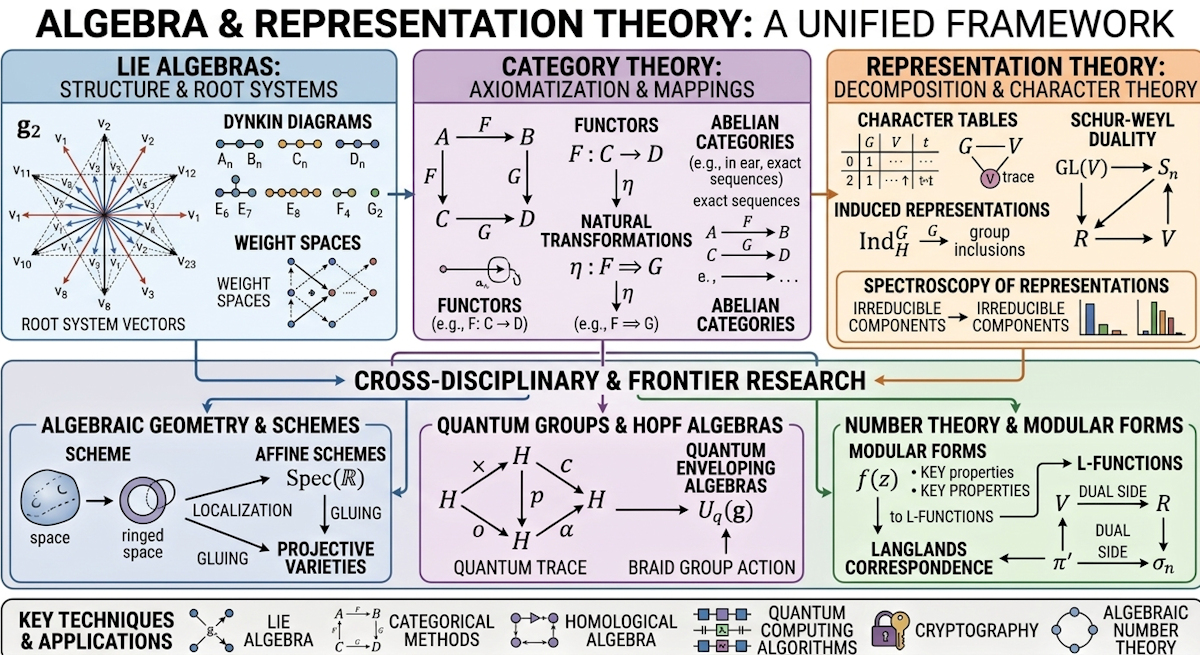
Algebra & Representation Theory
Research in Algebra and Representation Theory explores abstract mathematical structures by studying how they can be concretely expressed as linear transformations acting on vector spaces. Modern developments focus heavily on deep intersections with theoretical physics, quantum computing, and geometry, propelled by innovations in areas like categorification and the Langlands program. These ongoing advancements provide essential foundational frameworks that drive breakthroughs across modern mathematics.
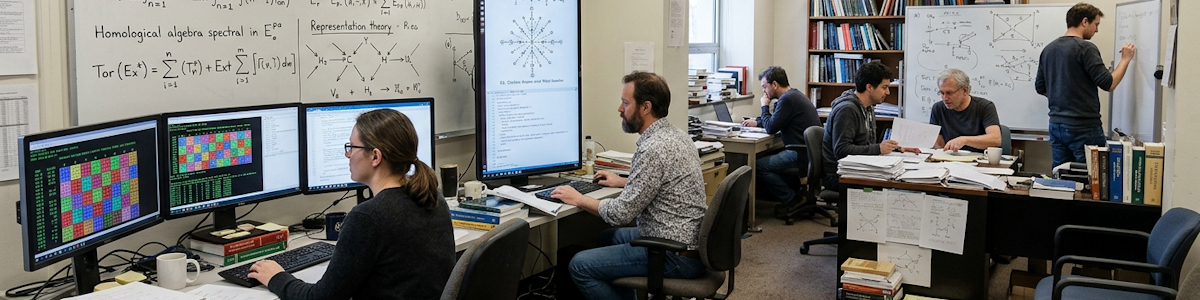
The Frobenius Laboratory for Algebra & Representation Theory
The laboratory — named after Ferdinand Georg Frobenius, the Berlin mathematician who built the character theory of finite groups and, with it, the entire apparatus of linear representations — is the algebra and representation theory division of Analex Laboratories. Its subject is symmetry made algebraic: the ways a group may act, and the structures that survive the acting.
Core Capabilities & Equipment
- Character Theory & Finite Group Computation Suite: GAP and Magma routines enumerate conjugacy classes, assemble character tables, and decompose ordinary and modular representations, labelling Brauer characters and decomposition numbers for groups whose orders run to twenty-five digits.
- Lie Theory & Algebraic Groups Bench: Symbolic engines handle root systems, weight multiplicities, Verma modules, and Kazhdan-Lusztig polynomials, testing highest-weight conjectures and lifting results out of characteristic zero into the positive-characteristic setting where the classical theory frays.
- Quiver, Module & Homological Algebra Workshop: Auslander-Reiten quivers, tilting complexes, and spectral sequences are built symbolically, following how indecomposable modules interlock and where a derived equivalence twists one algebra's representation theory into another's.
- Proof Formalisation & Structure Theory Line: Lean and Coq libraries restate Noetherian and Artinian conditions, lattice identities, and finite-group arguments in machine-checkable form, certifying structural theorems whose published proofs run to hundreds of pages.
Algebra is the branch of mathematics that studies structure before quantity — which operations exist, how they compose, what invariants survive transformation — and representation theory is its most consequential export, translating abstract symmetry into concrete linear action. The field has moved decisively away from a twentieth-century emphasis on classification for its own sake toward an architecture of derived, higher-categorical, and geometric methods that lets structures be compared, deformed, and lifted across contexts. Analex Laboratories, a consortium of algebraists, representation theorists, algebraic geometers, and mathematical physicists, has built its agenda on that methodological turn. Its researchers regard symmetry as the organizing principle beneath phenomena as disparate as particle spectra, crystal combinatorics, and error-correcting codes, and they pursue the general machinery that makes such connections provable rather than suggestive.
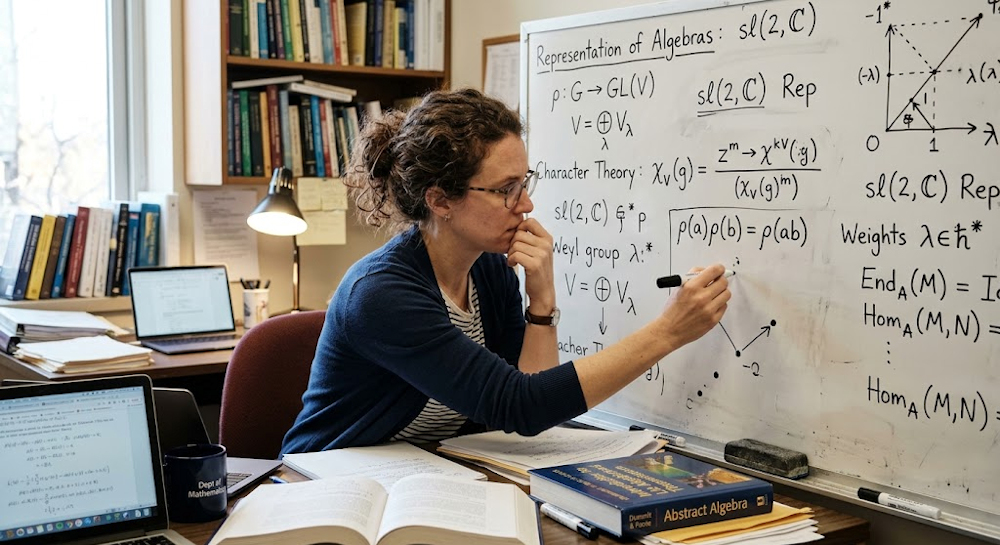
The structural core of the consortium's work sits in homological and higher algebra. Analex teams develop derived categories, triangulated structures, and infinity-categorical frameworks that replace naive equalities with coherent homotopy data, allowing constructions that fail on the nose to succeed up to canonical isomorphism. Model categories, localization techniques, and algebraic K-theory are refined as computational instruments, and operadic and monoidal formalisms are used to encode algebraic structures with many inputs and outputs — the natural language for both homotopy theory and quantum field theory. Grothendieck's program continues to shape the group's outlook: schemes, topoi, and motivic constructions are treated as foundational tools for turning arithmetic and geometric questions into structural ones.
Representation theory proper occupies the largest share of Analex's effort. Work on semisimple and reductive Lie algebras, algebraic groups, and their infinite-dimensional analogues proceeds alongside geometric methods — flag varieties, Schubert calculus, D-modules, and perverse sheaves — that realize representations as symmetries of spaces rather than as matrices. Canonical and crystal bases, Kazhdan-Lusztig theory, and Hecke-algebra combinatorics are developed for their own sake and for their role in linking representation theory to quantum groups at roots of unity. Modular representation theory, block theory, and defect-group analysis address the hard case where characteristic divides the group order, while categorification programs replace numerical invariants with richer algebraic objects and monstrous moonshine continues to tie the largest sporadic group to modular functions and vertex operator algebras.
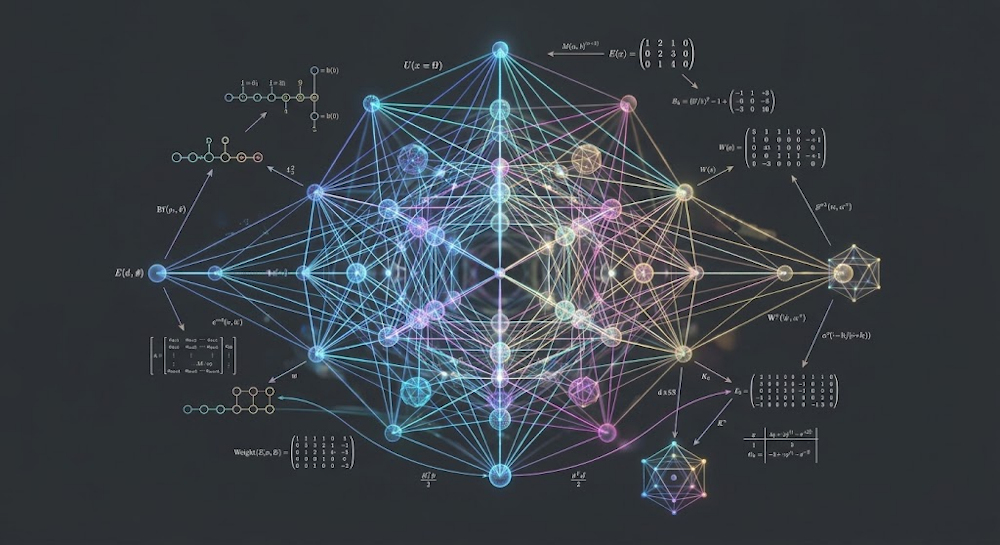
Combinatorial and computational strands keep the theory testable. Analex researchers work on cluster algebras, quiver representations, tilting theory, and the Auslander-Reiten machinery for modules over finite-dimensional algebras, where representation-theoretic questions translate into polyhedral and tableau combinatorics. Representation stability and FI-modules address sequences of representations arising from configuration spaces and topological data, and tropical and Gröbner methods convert nonlinear algebraic problems into piecewise-linear ones amenable to machine computation. Computer algebra systems are used extensively, and the group has invested in formal verification to certify classification results and long case analyses whose manual checking has become unreliable at scale.
The outward reach of the subject is unusually wide. Quantum groups and fusion categories supply the algebraic scaffolding for topological quantum field theory and for topological phases of matter, with braided and modular tensor structures describing anyonic excitations relevant to quantum computation. Coding theory, secret sharing, and lattice-based cryptography draw directly on finite-field and module theory. Representation-theoretic methods increasingly appear in machine learning through symmetry-equivariant architectures and tensor decomposition, and in chemistry and materials science through the exploitation of equivariant structure. Analex's guiding conviction is that abstraction is not retreat: the more general the framework, the more domains it eventually touches, and the consortium intends to be building that framework rather than applying someone else's.