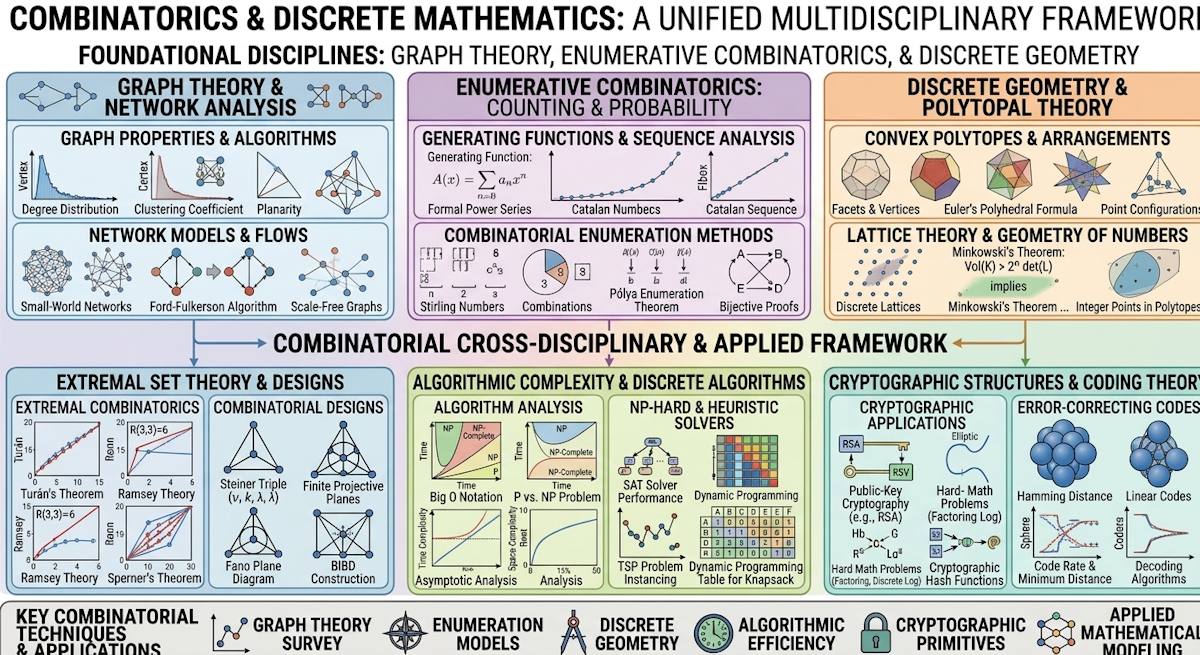
Combinatorics & Discrete Mathematics
Research in combinatorics and discrete mathematics focuses on exploring the structural properties, enumeration, and optimization of finite or discrete systems. Recent innovations in the field are deeply intertwined with theoretical computer science, driving breakthroughs in cryptography, network analysis, and randomized algorithms. Today, these developments provide essential foundational frameworks for solving complex computational problems across artificial intelligence, quantum computing, and large-scale data infrastructure.
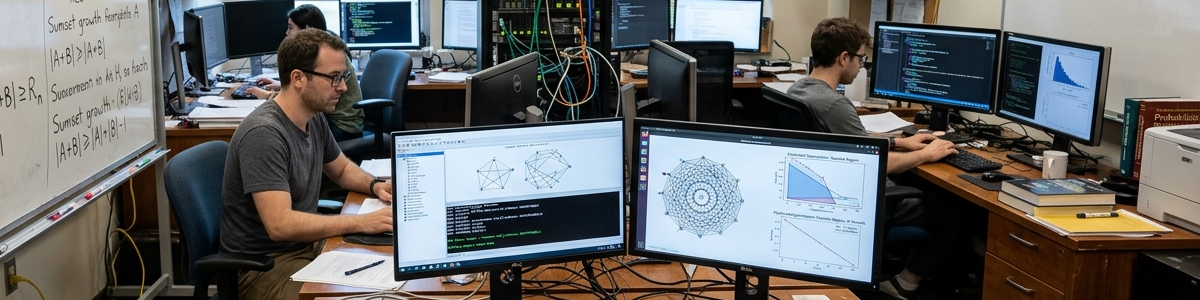
The Vera T. Sós Laboratory for Combinatorics & Discrete Mathematics
The laboratory remembers Vera T. Sós, the Hungarian mathematician who co-founded extremal graph theory, ran a legendary problem seminar for half a century, and treated the subject as a collective sport rather than a solitary one. It is the combinatorics and discrete mathematics division within Analex Laboratories — concerning finite structure: counting, arranging, and bounding.
Core Capabilities & Equipment
- Extremal Graph Theory & Enumeration Cluster: nauty, traces, and bespoke generators enumerate graphs up to symmetry, while SAT solvers and flag-algebra routines push Ramsey and Turán bounds upward, pruning search trees and certifying extremal configurations that stand as counterexamples.
- Combinatorial Optimisation & Integer Programming Bench: Mixed-integer solvers, cutting-plane generators, and polyhedral tools attack scheduling, packing, and routing instances lifted from real logistics, returning both the optimal value and a dual-side proof that nothing better exists.
- Design Theory & Finite Geometry Workshop: Block designs, Latin squares, difference sets, and finite projective planes are constructed and classified exhaustively, feeding straight into error-correcting codes whose minimum distances are verified by search rather than asserted.
- Additive Combinatorics & Discrete Probability Line: Sumset growth, discrepancy, and spectral gap are measured across large structured sets, while random-graph thresholds are located by simulation and then confirmed by second-moment and container arguments.
Combinatorics counts things, and for a long time that description was taken as a mild disparagement. The field's modern reality is otherwise: counting has become the mathematics of structure at finite scale, and the methods developed to count well — bijective, algebraic, probabilistic, spectral, and topological — have turned out to be among the most portable tools in all of mathematics. Analex Laboratories, a consortium of combinatorialists, discrete geometers, complexity theorists, and algorithm designers, has built its program on the recognition that discreteness is not a limitation but a setting where structure can be made explicit and where hardness and tractability are sharply separated. Its researchers approach finite objects the way analysts approach functions: by finding the right invariant, the right inequality, and the right limit.
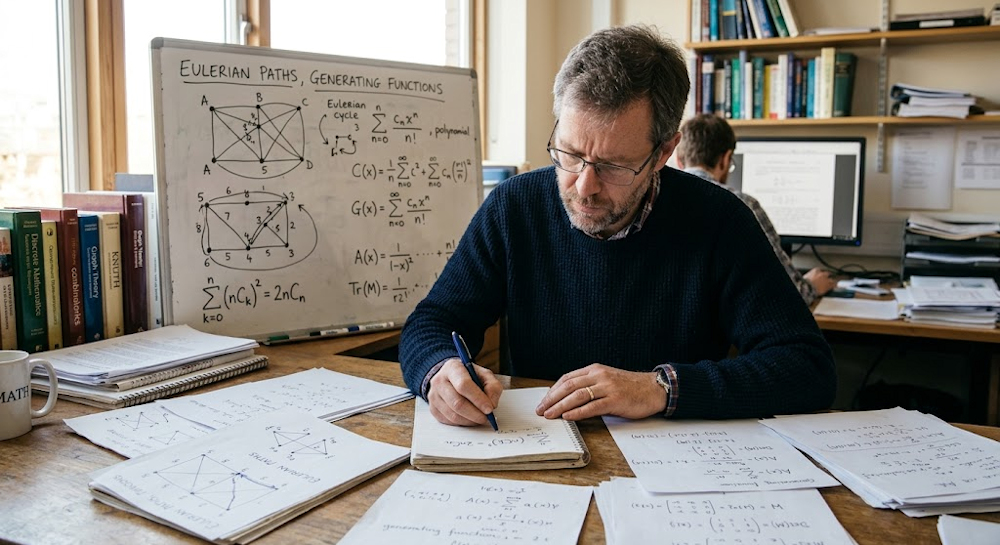
Extremal and probabilistic combinatorics form the largest bloc. Analex teams work on Ramsey-type phenomena, extremal set theory, and forbidden-substructure results, sharpening the quantitative bounds that separate unavoidable structure from constructed chaos. The regularity method, hypergraph removal lemmas, and flag-algebra techniques are refined as general transfer principles that convert dense discrete problems into analytic ones, while graph limit theory formalizes the passage from finite graphs to measurable objects. The probabilistic method and its refinements — concentration inequalities, the Lovász Local Lemma, entropy and container methods — supply existence proofs where explicit construction fails, and random graph and percolation theory are studied for their own thresholds and scaling windows.
Algebraic and additive strands carry equal weight. Analex researchers pursue sum-product phenomena, Freiman-type structure theorems, and Gowers-norm approaches to patterns in dense sets, using polynomial and spectral methods to extract algebraic rigidity from combinatorial hypotheses. Expander families, Cayley graphs, and spectral gap arguments link discrete structure to linear algebra and group theory, while association schemes, design theory, and coding theory exploit algebraic symmetry to construct objects with extremal parameters — and list decoding and expander codes bring those constructions into contact with information theory. Discrete geometry contributes incidence bounds, arrangement complexity, and the polynomial partitioning technique, and topological combinatorics applies Borsuk-Ulam and Kneser-type arguments to settle combinatorial questions by topological means.
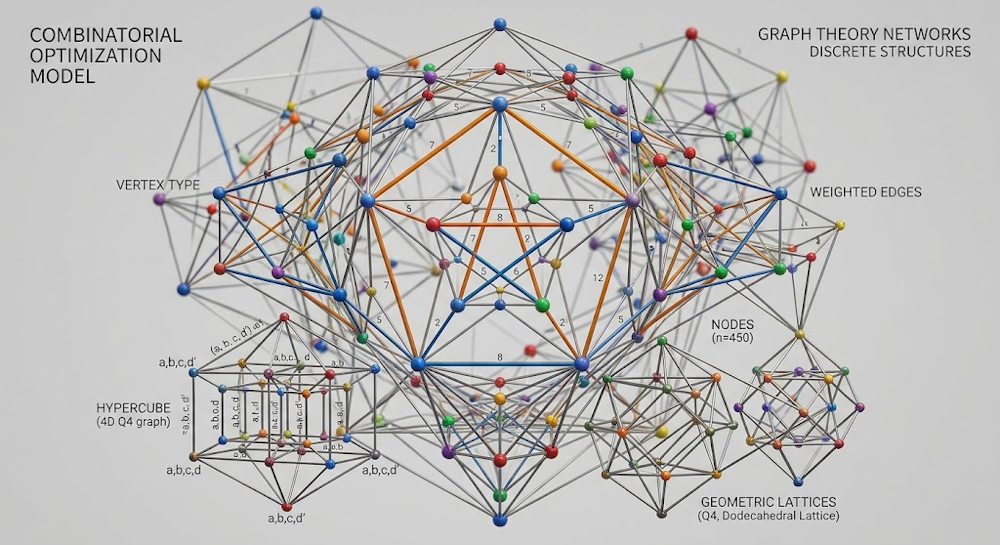
Structural and algorithmic work addresses what can actually be decided and computed. The graph minors program and its descendants give decomposition theorems — treewidth, rankwidth, clique-width — that make whole classes of problems tractable, and matroid theory extends the same structural spirit to independence systems with polyhedral and optimization consequences. Polyhedral combinatorics, matching, flow, and submodular optimization are pursued alongside approximation algorithms and hardness-of-approximation results, with the PCP theorem and its refinements fixing the boundary between the approximable and the intractable. Communication and circuit complexity, pseudorandomness, and derandomization round out a program that treats computational limits as mathematical objects rather than engineering frustrations.
Discreteness makes the applications immediate. Analex's algorithms group supplies scheduling, routing, network design, and resource allocation methods to logistics, telecommunications, and energy systems; coding and cryptography benefit directly from combinatorial constructions; statistical physics borrows and returns ideas through spin models, percolation, and the combinatorics of phase transitions. Machine learning increasingly consumes combinatorial machinery in submodular selection, tensor methods, and generalization theory. Biology, from phylogenetics to regulatory networks, presents inherently discrete problems with combinatorial structure. Analex's judgment is that combinatorics has graduated from supplying counterexamples to supplying foundations, and that its continued growth will come from pushing general principles — regularity, decomposition, spectral control, algebraic rigidity — into domains still treated case by case.