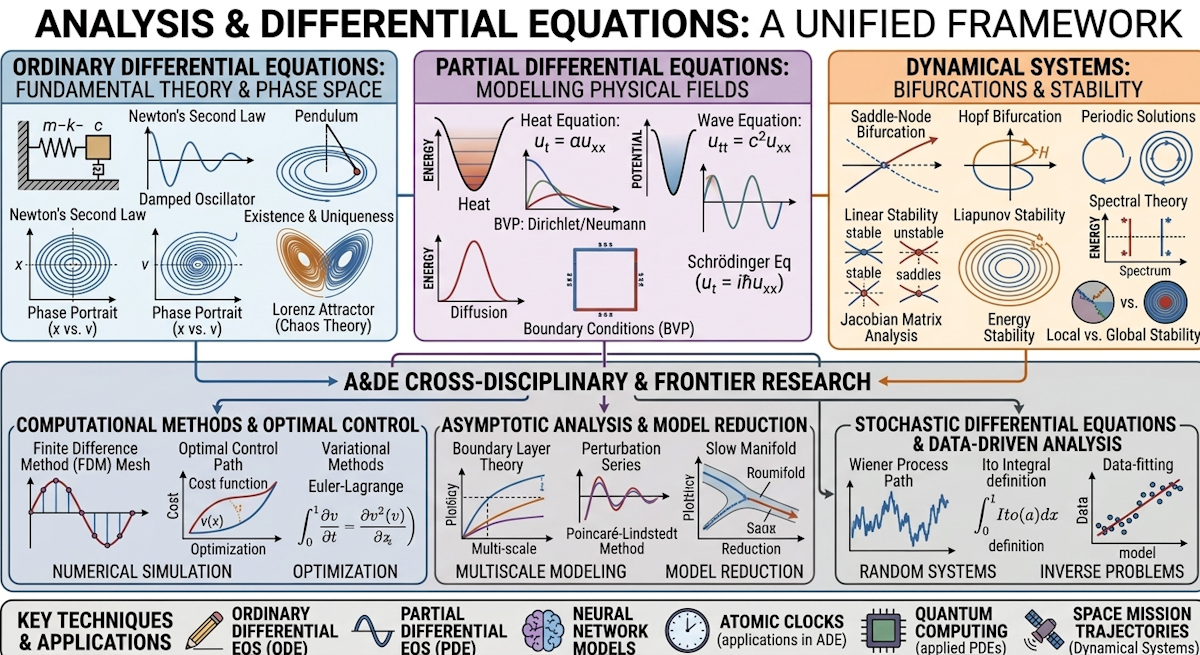
Analysis & Differential Equations
Research and development in Analysis and Differential Equations focuses on advancing foundational mathematical theory to rigorously model complex physical, biological, and economic systems. Modern innovation heavily integrates high-performance scientific computing and machine learning to analyze nonlinear phenomena, high-dimensional partial differential equations, and data-driven dynamical systems. These efforts bridge abstract functional analysis with real-world applications, creating robust numerical and analytical tools to solve intricate challenges in science and engineering.
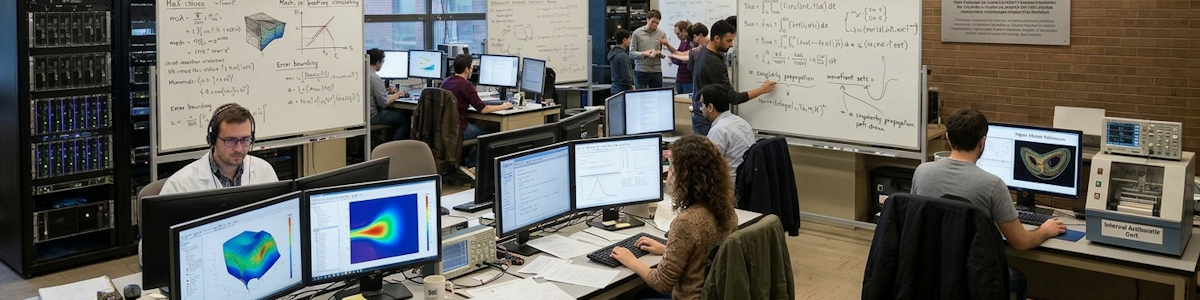
The Hadamard Laboratory for Analysis & Differential Equations
The laboratory — honoring Jacques Hadamard, the French analyst who fixed what it means for a problem to be well-posed, gave the wave equation its method of descent, and proved the prime number theorem by a route nobody had anticipated — forms the analysis and differential equations division of Analex Laboratories. Its concern is the behaviour of functions, of limits, and of the equations that govern change.
Core Capabilities & Equipment
- Numerical PDE & Spectral Solver Cluster: Adaptive finite-element, finite-difference, and spectral codes march parabolic, hyperbolic, and elliptic systems across thousands of cores, refining meshes where gradients steepen and bounding solver error against manufactured and exact solutions.
- Functional Analysis & Operator Theory Bench: Computer algebra and interval routines handle special functions, asymptotic expansions, and integral transforms, while operator semigroups and spectral measures are built symbolically to probe well-posedness before any discretisation is attempted.
- Validated Computation & Computer-Assisted Proof Suite: Taylor models and interval arithmetic enclose trajectories of nonlinear systems inside rigorously bounded tubes, letting chaotic attractors, blow-up criteria, and existence results be settled by machine rather than by eye.
- Harmonic Analysis & Microlocal Workshop: Wavefront sets, pseudodifferential and Fourier integral operators are computed symbolically to follow where singularities propagate, sweeping semiclassical limits and scattering data into regimes where classical energy estimates give out.
Analysis is the mathematics of estimation — of limits, inequalities, and the behavior of objects under scaling — and differential equations are its principal application, the language in which change in continuous systems is written. The discipline's center of activity has migrated from case-by-case solution techniques toward unified frameworks in which geometric, measure-theoretic, and probabilistic ideas reinforce one another, allowing questions about existence, regularity, and stability to be posed in settings where classical methods collapse. Analex Laboratories, a consortium of analysts, PDE theorists, geometers, and numerical mathematicians, works squarely inside that consolidation. Its researchers operate on the premise that the true medium of the subject is control: control over size, over oscillation, over the growth of norms — and that a theorem's value is measured by how much of that control it delivers under how weak an assumption.
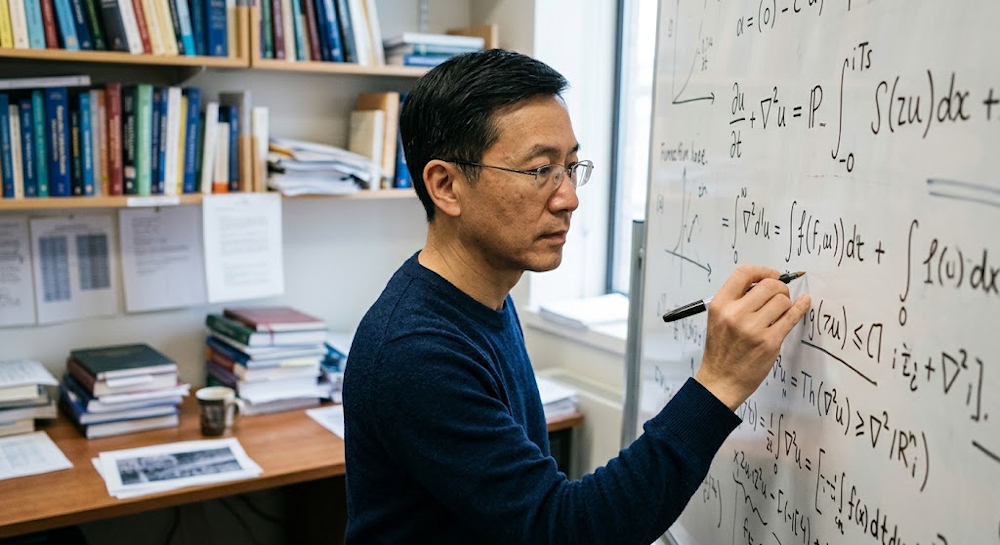
The technical engine room is harmonic and microlocal analysis. Analex teams sharpen singular-integral theory, Littlewood-Paley decompositions, and square-function estimates, then push them into variable-coefficient and rough-background settings where the classical Calderón-Zygmund machinery no longer applies directly. Pseudodifferential and paradifferential calculi are used to linearize nonlinear problems locally in phase space, separating the elliptic, hyperbolic, and dispersive regimes that demand entirely different tools. Function-space technology — Sobolev, Besov, Triebel-Lizorkin, and their fractional and weighted variants — is refined because the choice of space often decides whether a problem is tractable at all. Geometric measure theory and optimal transport provide the complementary geometric arm, supplying rectifiability, isoperimetric, and Monge-Ampère tools for problems where curvature and transport cost, not oscillation, are the governing features.
Partial differential equations are where these instruments meet their hardest tests. The consortium maintains programs on elliptic regularity and free-boundary problems, on parabolic equations and their smoothing and blow-up behavior, and on hyperbolic conservation laws where weak solutions, entropy conditions, and shock formation must be handled with care rather than wished away. Dispersive equations — Schrödinger, wave, KdV-type — are studied through Strang splitting, profile decompositions, and concentration-compactness arguments that distinguish scattering from collapse. Incompressible fluid equations, both Euler and Navier-Stokes, receive sustained scrutiny, with attention to vorticity dynamics, partial regularity criteria, and the mechanisms that might or might not produce finite-time singularity in three dimensions.
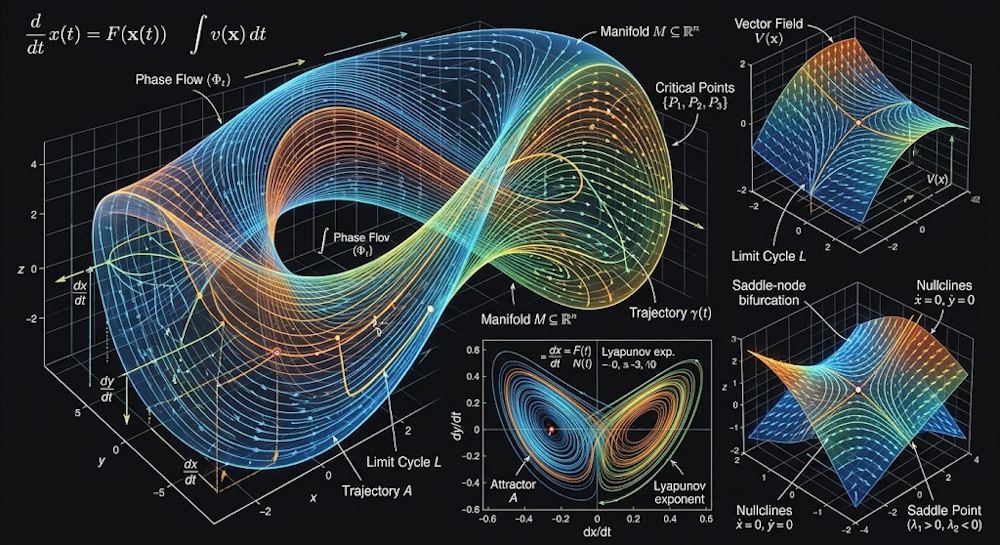
Variational and geometric analysis forms the second pillar. Analex works on the calculus of variations, minimal and constant-mean-curvature surfaces, and geometric flows including Ricci and mean curvature flow, where the analytic difficulty is inseparable from the geometric question being asked. Spectral theory for Schrödinger and Dirac operators, scattering theory, and inverse problems — recovering coefficients or geometry from boundary or far-field data — sit alongside these efforts, as do stochastic partial differential equations, where rough-path theory and regularity structures have finally given meaning to equations that physicists had written down decades earlier without rigorous footing. Dynamical systems research, including KAM-type stability and ergodic questions, connects the deterministic and statistical pictures.
Application and computation keep the enterprise grounded. Fluid and plasma models, phase-field and materials models, reaction-diffusion systems in biology, and imaging and tomography inverse problems all supply concrete targets, and the consortium's numerical analysts develop finite-element, spectral, and multiscale schemes with provable convergence and error control, treating discretization as a mathematical problem rather than an engineering afterthought. Machine learning enters both as an object of analysis and as a heuristic tool for high-dimensional PDE and inverse problems, with the group insisting on certified guarantees where possible. Analex's long view is that analysis advances by weakening hypotheses one at a time, and that the frameworks capable of surviving the roughest settings are the ones that will eventually explain the smoothest phenomena.