Mathematical Logic & Foundations
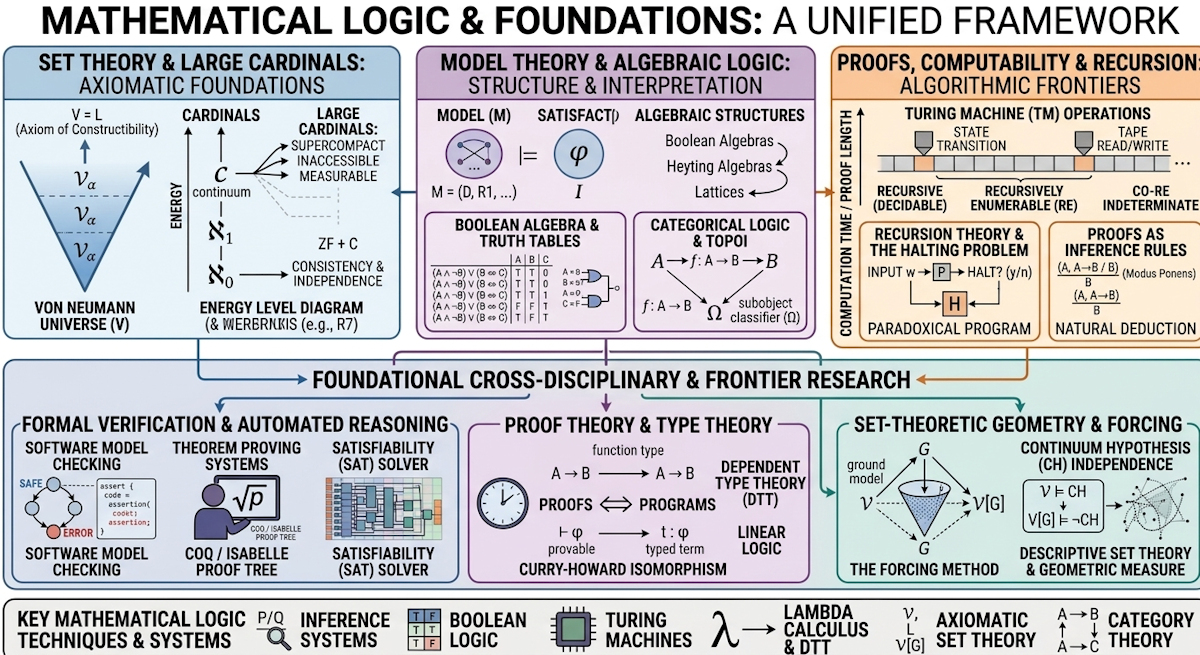
Research in mathematical logic and foundations investigates the formal architecture of mathematical reasoning, exploring the structural power, consistency, and limitations of formal systems. Modern innovations span core subfields like set theory, model theory, and proof theory, frequently intersecting with theoretical computer science to formalize automated reasoning, verify complex software, and analyze the computational complexity of mathematical truths.
The Robinson Mathematical Logic & Foundations Laboratory
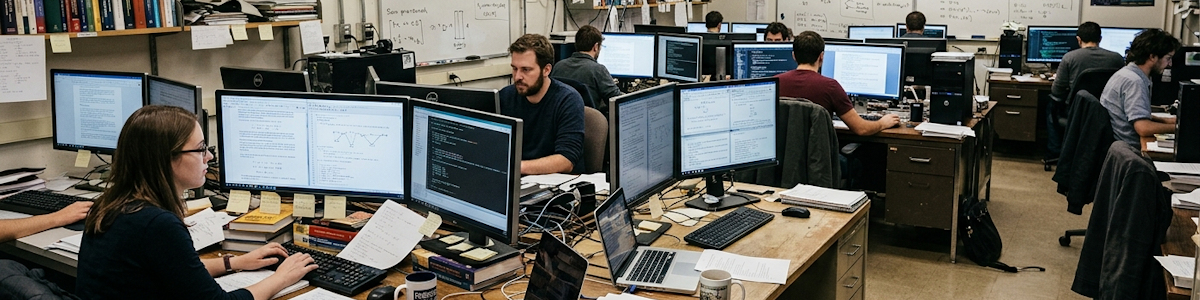
Bearing the name of Julia Robinson — the Berkeley logician who broke Hilbert's tenth problem alongside three colleagues, and who agreed to join the National Academy only once its rules on women were rewritten — the lab forms the mathematical logic and foundations department of Analex Laboratories. Its focus is proof, computability, and the outer limits of each.
Core Capabilities & Equipment
- Automated Theorem Proving & Proof Mining Cluster: SMT and superposition provers discharge first-order obligations in seconds, while Lean, Coq, and Isabelle libraries hold formalised mathematics at scale and proof-mining tools extract the arithmetic content buried inside classical arguments.
- Computability & Reverse Mathematics Bench: Turing degrees, oracle hierarchies, and reducibility relations are computed and compared, sorting theorems by the exact set-existence axioms required to prove them and pinning the Diophantine complexity of decision problems.
- Model Theory & Set Theory Workshop: Forcing constructions, large-cardinal hierarchies, and countable model building are worked symbolically, testing which statements survive the removal of choice and where an independence proof can be driven through.
- Constructive & Type-Theoretic Foundations Line: Dependent type theories, homotopy type theory, and realizability models are developed and machine-checked, calibrating precisely how much of classical analysis survives once excluded middle is set aside.
Logic studies consequence itself: what follows from what, what a formal system can prove, define, or compute, and where those capacities reach their limits. The discipline long carried a reputation as custodial work — patching foundations after paradoxes and policing rigor — but its modern identity is far more constructive, functioning as an independent mathematical subject with deep links to combinatorics, algebra, computer science, and philosophy. Analex Laboratories, a consortium of set theorists, proof theorists, model theorists, computability researchers, and type theorists, pursues logic as a positive science of formal structure. Its members treat independence, definability, and complexity as phenomena worth mapping for their own sake, and they assume that the sharpest foundational insight comes from precise technical work rather than sweeping pronouncement.

Set theory forms the consortium's most expansive program. Analex researchers use forcing, iterated forcing, and class-forcing techniques to calibrate exactly which statements are independent of the standard axioms, and they study large-cardinal hierarchies as measures of consistency strength that rank the known independence phenomena into a coherent scale. Inner model theory constructs canonical models realizing high consistency strength, while descriptive set theory — the Borel and projective hierarchies, determinacy, and Ramsey-type partition results on cardinals — supplies a fine-grained classification of definable sets of reals. The resulting picture is plural rather than monolithic: multiple legitimate universes of sets, distinguished by combinatorial and large-cardinal properties, and a research effort to determine which mathematical questions are settled within which.
Proof theory works from the other end, extracting information from proofs rather than from models. Analex teams develop ordinal analysis, cut-elimination, and normalization results that assign constructive content to classical arguments, and proof-mining techniques that convert non-effective theorems into explicit bounds and algorithms. Reverse mathematics calibrates which axioms a given theorem genuinely requires, producing a fine classification of mathematical strength, while proof complexity and bounded arithmetic attack the lengths of proofs themselves — a program with direct bearing on the separation of complexity classes and on the limits of automated reasoning. Substructural and non-classical calculi, including linear and modal systems, are studied for their expressive precision rather than as curiosities.
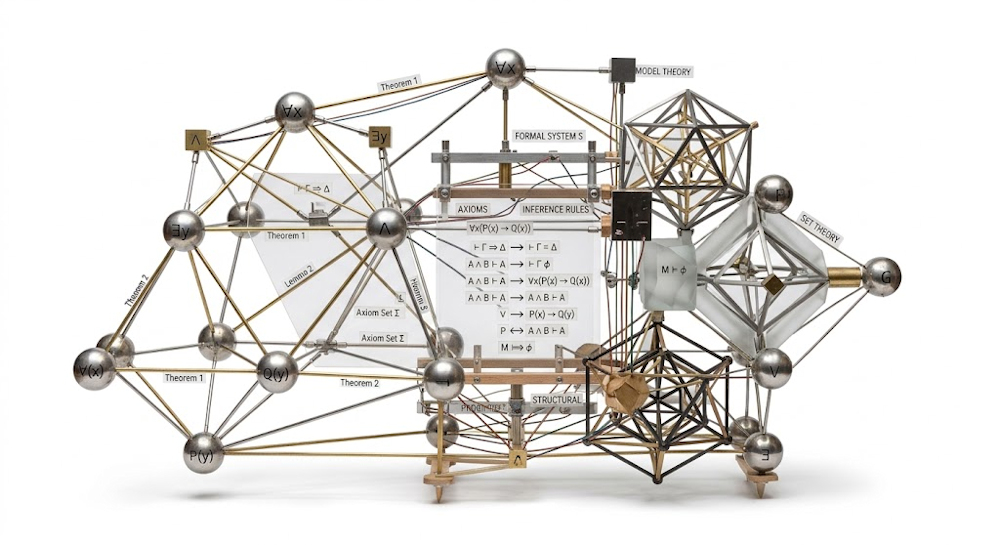
Model theory contributes classification and transfer. Analex researchers work in stability theory, simplicity, and their neo-stable refinements, seeking dividing lines that determine when a theory's models admit a well-behaved dimension theory, and in o-minimality and its variants, where definable sets in ordered structures inherit tame geometric behavior that feeds back into real algebraic and analytic geometry. Finite model theory and descriptive complexity characterize complexity classes by the logics needed to express them, computable structure theory and effective descriptive set theory make definability sensitive to computability, and algorithmic information theory supplies Kolmogorov-complexity measures of randomness that connect logic to probability.
Type theory and categorical logic have become the consortium's most rapidly growing area. Dependent type theory, homotopy type theory, and univalent foundations reconceive proofs as objects with their own structure, and topos-theoretic and realizability semantics provide a general framework in which constructive, intuitionistic, and higher-order logics are modeled uniformly. Practically, these ideas underpin proof assistants now used to certify substantial mathematics and verified software, while SAT and SMT solvers, database query languages, and knowledge representation systems all rest on decidability and expressiveness results established by logicians. Analex's position is that foundations are not a basement to be finished and abandoned but a live construction site, and that the most consequential work lies in mapping the boundaries of formal systems rather than pretending those boundaries do not exist.