Number Theory
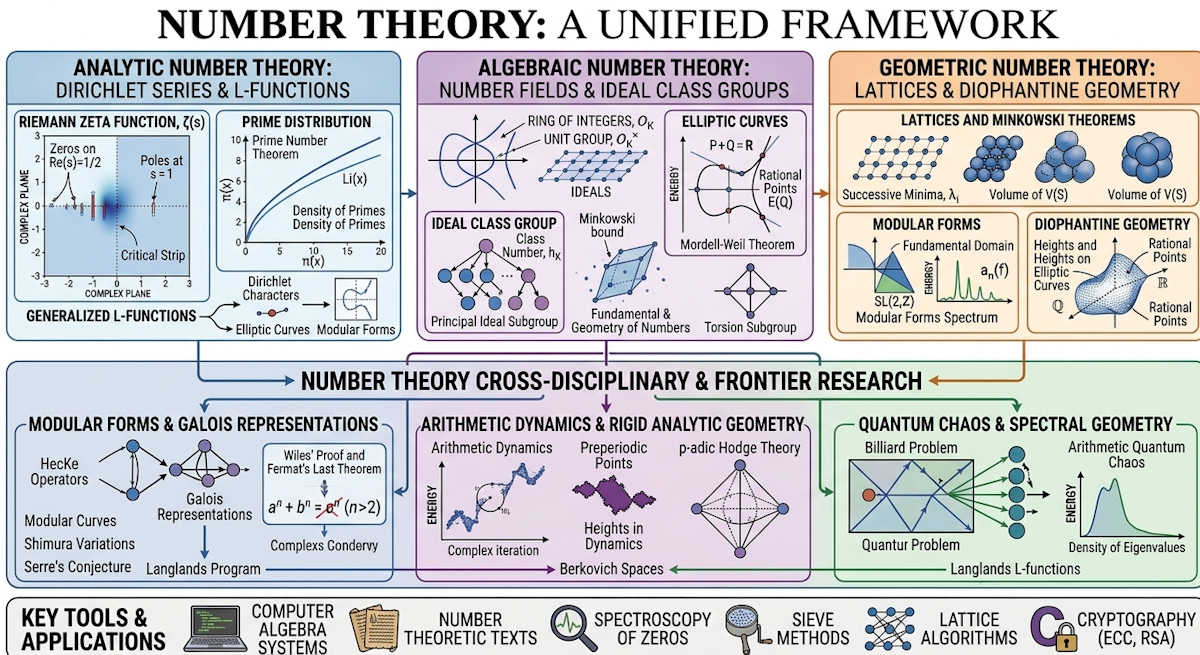
Modern research in number theory explores the deep structures of integers and prime numbers, expanding far beyond classical boundaries through bridges to algebraic geometry and computer science. Recent innovations drive critical breakthroughs in cryptography and cybersecurity, while ambitious frameworks like the Langlands program seek to unify vast areas of mathematics. Contemporary developments also increasingly leverage artificial intelligence and machine learning to help mathematicians discover subtle patterns and formulate new conjectures.
The Gauss Arithmetic Laboratory
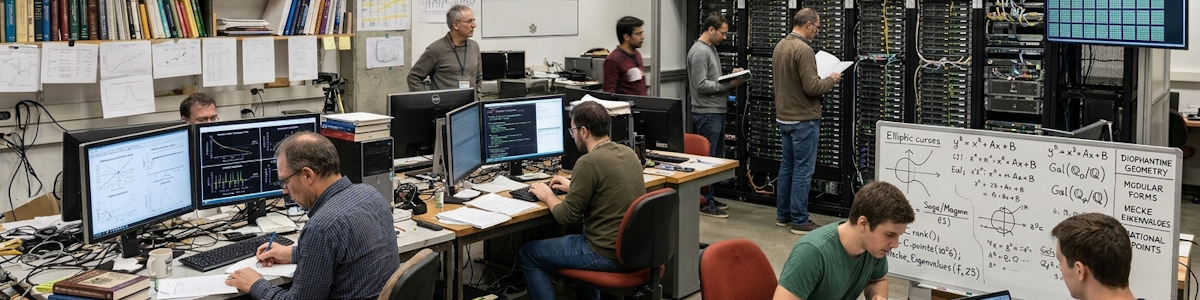
The laboratory takes as its name from Carl Friedrich Gauss, the German mathematician whose Disquisitiones Arithmeticae recast arithmetic from a bag of tricks into a rigorous science, and who filed away whole discoveries because the working-out bored him — it serves as the number theory division of Analex Laboratories. Its business is the integers: their divisibility, their distribution, and the structures concealed inside them.
Core Capabilities & Equipment
- Computational Arithmetic & Sieving Cluster: Several thousand cores grind through quadratic and number-field sieves, factorisation, and elliptic-curve search routines, tabulating ranks, class numbers, and point counts over ranges far too wide for hand computation, with every result checked against an independent run.
- High-Precision Analytic Number Theory Bench: Arbitrary-precision libraries evaluate the Riemann zeta function and its relatives far up the critical line, harvesting zero spacings, moment statistics, and explicit-formula terms that hold conjectures about prime distribution up against numerical reality.
- Formal Verification & Proof Assistant Suite: Lean, Coq, and Isabelle environments restate published arguments in machine-checkable form, certifying results line by line and exposing the exact step where a human proof waved its hands.
- Symbolic Algebra & Diophantine Geometry Workshop: Magma and Sage sessions manipulate modular forms, Galois representations, and algebraic curves symbolically, exhausting rational point sets, computing Hecke eigenvalues, and weighing candidate counterexamples before any conjecture gets declared settled.
Number theory once earned its reputation as the purest of the pure — a field of isolated, famously hard problems pursued for their own sake. That characterization no longer fits. The discipline's center of gravity has shifted toward something more architectural: the construction of vast conjectural frameworks that predict how primes, rational points, and Galois groups ought to behave, and the assembly of techniques from geometry, representation theory, harmonic analysis, and mathematical physics needed to attack those predictions. Analex Laboratories, a consortium of analytic number theorists, arithmetic geometers, representation theorists, and algorithmic mathematicians, has positioned its research program inside that unification. Its mathematicians treat arithmetic not as a collection of puzzles but as a structured landscape with hidden ridgelines, and they work on the assumption that the right general theory dissolves problems that resisted centuries of isolated assault.
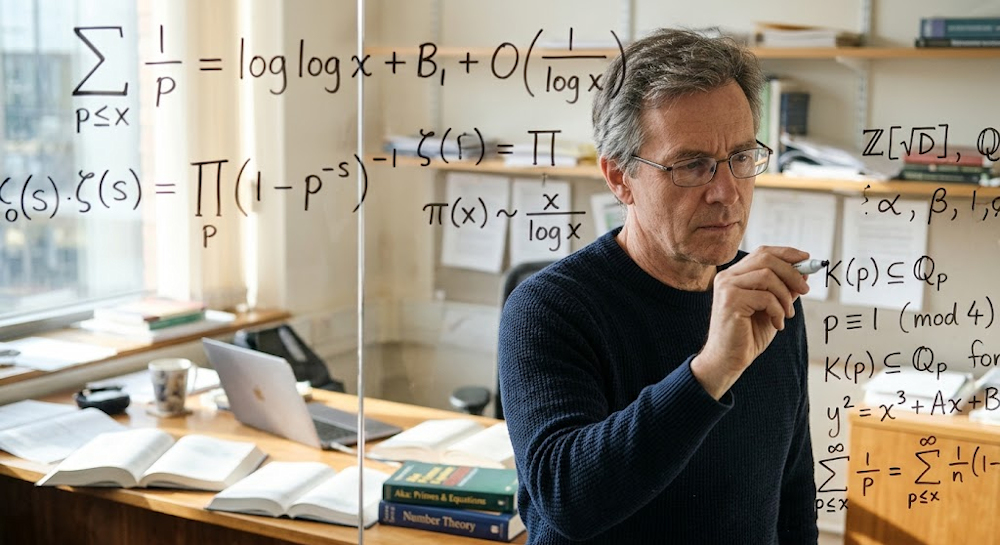
Analytic number theory remains the consortium's most visible front. Analex teams push sieve methods and the circle method to their limits, refining exponential-sum estimates and large-sieve inequalities that control how primes distribute in short intervals and arithmetic progressions. The group's work on bounded prime gaps and on patterns in the primes exploits the Maynard-Tao variational approach together with Gowers-norm technology from additive combinatorics, importing transference principles, sum-product results, and polynomial-method bounds developed elsewhere. A parallel effort applies homogeneous dynamics and ergodic theory to arithmetic counting problems, and another exploits the striking empirical agreement between the statistics of zeta zeros and the eigenvalue distributions of random matrices — a correspondence the consortium studies both as a tool and as a phenomenon demanding explanation.
Arithmetic geometry supplies the deepest structural advances. Analex researchers study elliptic curves, abelian varieties, and higher-dimensional varieties over number fields, using Galois representations, deformation theory, and automorphic forms to link arithmetic invariants to analytic ones. The Langlands program provides the connective tissue: functoriality, the trace formula, and local-global principles are pursued not only in the classical setting but in the p-adic and rigid-analytic worlds, where perfectoid and condensed techniques have reorganized what counts as a tractable theorem. Height theory, Arakelov geometry, and Diophantine approximation are deployed to bound rational and integral points, while the ABC conjecture, Szpiro's inequality, and effective versions of Faltings' theorem drive work on gaps between what is provable and what is conjectured.
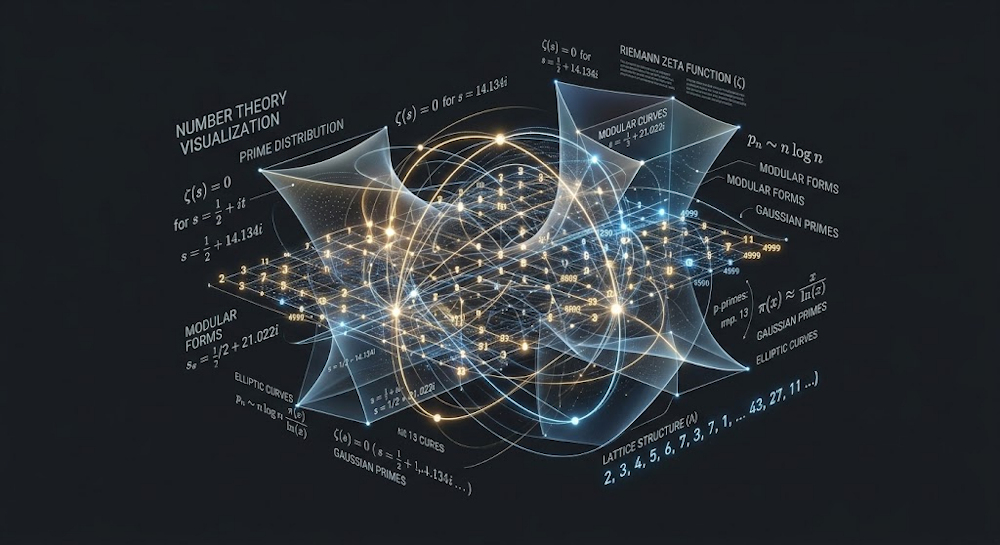
Computation is not a sideline. Analex maintains and mines large curated databases of L-functions, elliptic curves, modular forms, and number fields, runs distributed searches for high-rank curves and record prime gaps, and verifies zeta zeros at extreme heights to test statistical predictions. Algorithmic research on factoring, discrete logarithms, lattice reduction, and primality certification keeps the group's complexity theory sharp, and formal proof assistants are used to certify long computational lemmas whose hand-checking exceeds human patience. Machine learning has begun to earn its place as a conjecture generator, surfacing numerical patterns in arithmetic data that human inspection missed — with the consortium's culture insisting that every such pattern then be proved or falsified by classical means.
The applied reach is genuinely load-bearing. Public-key cryptography rests on the presumed hardness of factoring and discrete logarithms; Analex contributes to elliptic-curve and pairing-based protocol analysis and to the lattice-based and isogeny-based schemes intended to survive quantum attack. Coding theory, pseudorandom generation, and hash design draw on the same arithmetic. Off-mathematics, the group's techniques have been borrowed by theoretical computer science, signal processing, and even quantum information. The consortium's wager is that arithmetic's future lies in breadth of connection: the theorem that unlocks a stubborn problem is increasingly likely to arrive from representation theory, dynamics, or geometry than from the problem's own neighborhood.