Numerical Analysis & Computational Mathematics
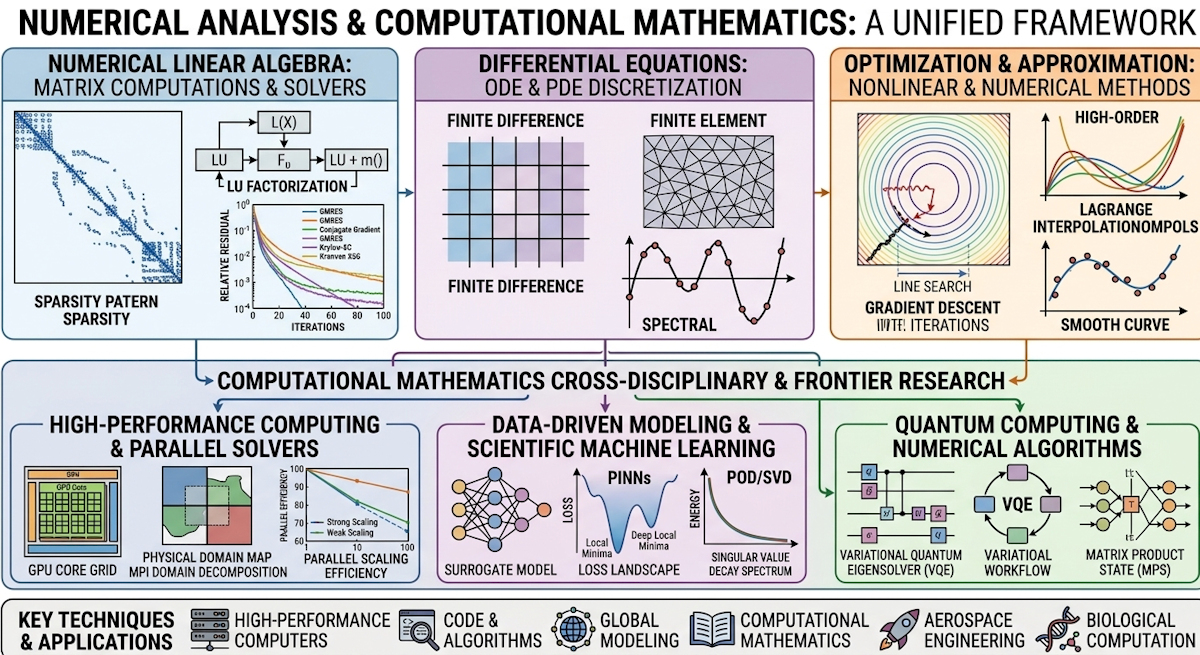
Advances in computational mathematics and numerical analysis center on crafting efficient, reliable algorithms that approximate solutions to intricate equations modeling natural and technological phenomena. Recent progress relies on combining data-driven paradigms, scientific machine learning, and scalable algorithms tailored for high-performance supercomputing environments. These breakthroughs connect theoretical mathematics with practical problem-solving, driving quicker and more precise simulations in science and industry.
The J.H. Wilkinson Laboratory for Computational Mathematics
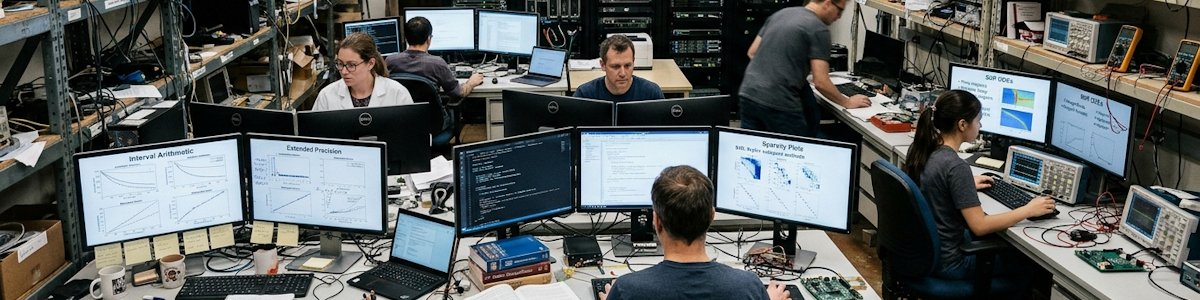
Named for James Hardy Wilkinson, the British numerical analyst who taught the field to measure the error it was truly making rather than the error it merely feared, the laboratory serves as the numerical analysis and computational mathematics division of Analex Laboratories. Its work is arithmetic at scale: making finite machines answer questions that were posed in the infinite.
Core Capabilities & Equipment
- Floating-Point Error & Backward Stability Laboratory: Interval arithmetic, extended precision, and ULP-level test harnesses measure how far a computed result genuinely drifts, reporting condition numbers and backward errors so that every routine's output arrives with an honest bound attached.
- Numerical Linear Algebra & Eigenvalue Suite: SVD, QR, Krylov subspace, and randomised factorisation codes handle matrices that overflow memory and matrices that barely fill a page, exploiting sparsity and structure to bring eigenproblems and least-squares fits within reach.
- Stiff Systems & Time-Stepping Bench: Implicit multistep and Runge-Kutta integrators, adjusting order and step size on their own, march differential-algebraic systems across their stability regions and up against the order barriers that cap explicit schemes.
- Parallel Algorithms & Performance Group: GPU kernels, communication-avoiding factorisations, and mixed-precision schemes are profiled on the consortium's largest machines, with scaling studies and roofline models exposing exactly where arithmetic sits waiting on memory instead of running.
Numerical analysis is the mathematics of being approximately right on purpose. Its object of study is error — where it comes from, how it accumulates, and how it can be bounded, distributed, or canceled — and its practitioners are unusual among mathematicians in treating approximation as a design decision rather than a concession. Analex Laboratories, a consortium of numerical analysts, scientific computing specialists, optimization theorists, and applied mathematicians, has built its agenda around the conviction that computable mathematics is a discipline in its own right. Its researchers pursue algorithms with provable stability, structure-preserving discretizations, and quantified uncertainty, holding that a method is not understood until its failure modes are characterized as carefully as its successes.

The foundational stratum is numerical linear algebra and approximation theory. Analex teams analyze conditioning, backward stability, and rounding behavior at the level of floating-point arithmetic, work that determines whether an algorithm's output is meaningful or merely reproducible. Sparse direct solvers, Krylov subspace methods, preconditioning strategies, multigrid and domain-decomposition schemes are developed with sharp convergence theory, while rank-structured and hierarchical representations — fast multipole methods, H-matrices, tensor decompositions — compress operators that would otherwise be computationally unreachable. Randomized numerical linear algebra and sketching have emerged as a major thread, trading exactness for dramatic cost reductions with probabilistic guarantees attached. Fast transforms, low-rank approximation, and eigenvalue algorithms round out a toolkit on which nearly every other computational science depends.
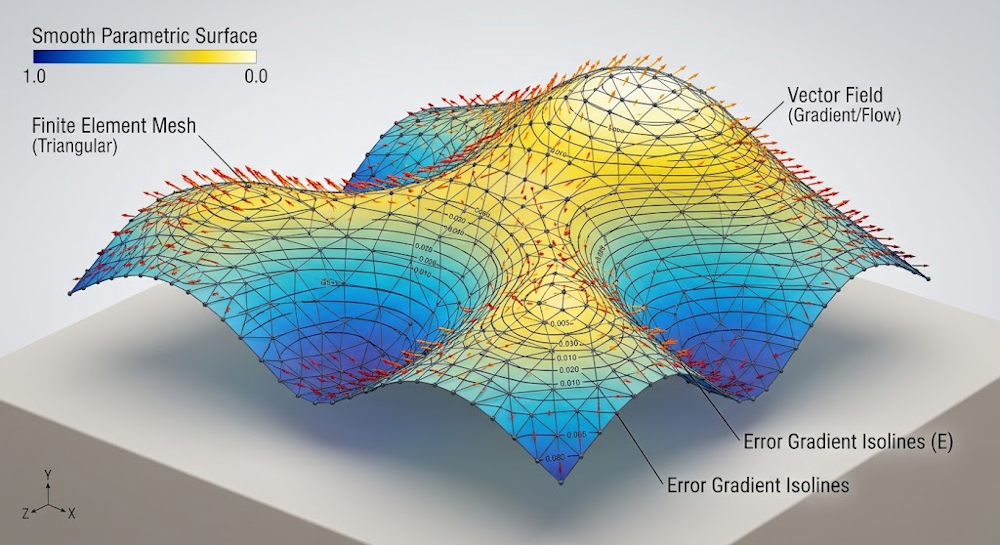
Discretization of differential equations constitutes the central applied program. Analex develops finite element, discontinuous Galerkin, finite volume, and spectral methods with rigorous a priori and a posteriori error estimates, enabling adaptive refinement that concentrates resolution where it is needed. Structure preservation receives particular emphasis: symplectic and geometric integrators for Hamiltonian systems, conservative schemes for hyperbolic conservation laws with careful shock capturing, and level-set and immersed-boundary techniques for evolving interfaces. Stiff systems, long-time integration, and multiscale coupling each demand dedicated analysis, because in these regimes naive schemes fail qualitatively rather than merely losing digits. Mesh generation, high-order accuracy, and dispersion and dissipation control are treated as mathematical problems rather than implementation details.
Optimization, inversion, and uncertainty quantification form the decision-facing arm. Analex researchers work on convex and nonsmooth optimization, interior-point and proximal methods, stochastic and accelerated gradient schemes, and semidefinite and conic programming, with convergence rates and complexity bounds as the deliverable. Inverse problems are handled through regularization theory, compressed sensing and sparse recovery, and Bayesian formulations where the posterior itself must be approximated. Uncertainty quantification — polynomial chaos, multilevel and quasi-Monte Carlo, variance reduction, surrogate construction, and reduced-order modeling — allows expensive simulations to be embedded in design loops and risk assessments. More recently, operator learning, physics-informed networks, and scientific machine learning have entered the program, with the consortium insisting that these approaches be analyzed rather than merely benchmarked.
Performance and trustworthiness sit at the top of the stack. Analex engineers for parallel scalability, accelerator architectures, mixed-precision arithmetic, and communication-avoiding formulations, and treats reproducibility, deterministic reduction, and performance portability as first-class research topics. Verified computing through interval and ball arithmetic, alongside automated differentiation and error-controlled pipelines, extends guarantees from the abstract algorithm to the running code. Applications span fluid and structural simulation, climate and weather modeling, materials and molecular dynamics, medical imaging, power systems, and computational finance. Analex's thesis is that computation has become a third mode of science alongside theory and experiment, and that its credibility depends entirely on how rigorously its errors are understood.