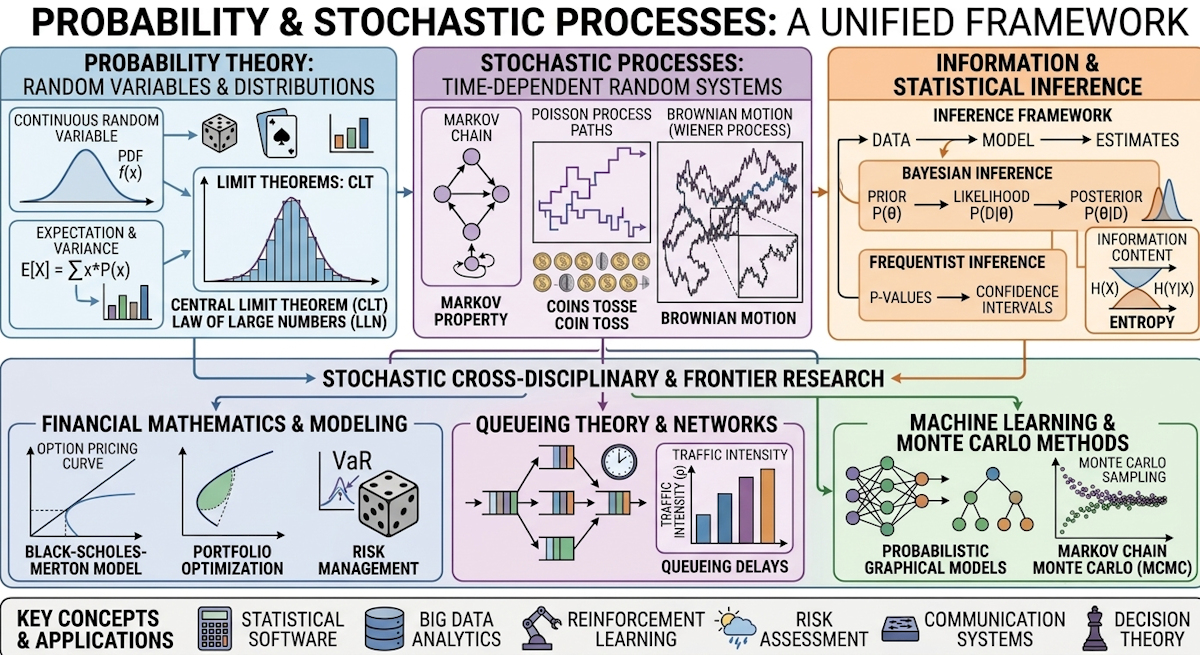
Probability & Stochastic Processes
Probability and stochastic processes focus on modeling complex, time-dependent random systems, blending rigorous measure-theoretic foundations with modern computational methods. Recent developments are advancing fields such as high-dimensional random matrices, interacting particle systems, and rough paths, driving breakthroughs in machine learning, quantitative finance, and statistical physics. These advancements enable scientists and engineers to rigorously quantify uncertainty and analyze dynamic, data-rich networks.

The Kolmogorov Probability & Stochastic Processes Laboratory
Named in honor of Andrey Kolmogorov, the Russian mathematician who handed probability its axiomatic foundation in 1933 and then spent the following decades proving the theory could carry real weight, the laboratory forms the probability and stochastic processes division of Analex Laboratories. Its subject is chance: the laws that govern randomness once it accumulates.
Core Capabilities & Equipment
- Monte Carlo & Simulation Cluster: Millions of independent paths run across GPU arrays with quasi-random sequences and variance-reduction schemes, sampling rare events whose probabilities sit below one in a billion and reporting confidence intervals beside every estimate.
- Stochastic Analysis & SDE Bench: Symbolic and numerical Itô calculus, Malliavin derivatives, and Feynman-Kac solvers discretise diffusions with controlled strong and weak error, coupling schemes so two neighbouring paths stay together until the instant they must part.
- Limit Theorem & Large Deviation Line: Stein's method, concentration inequalities, and exact asymptotic expansions tighten convergence rates in the central limit theorem, mapping the exponential cost of a large deviation far out along the tail.
- Random Media & Interacting Particle Workshop: Percolation thresholds, random walks in random environment, stochastic Loewner evolutions, and random matrix spectra are simulated first and steered analytically second, following critical exponents and scaling limits as system size grows.
Probability is measure theory with a purpose, and the purpose has always been to explain why randomness produces regularities. The field's frontier has moved from establishing that such regularities exist toward characterizing them precisely — identifying the universality classes, critical exponents, and scaling limits into which vast families of unrelated random systems collapse. Analex Laboratories, a consortium of probabilists, stochastic analysts, statistical physicists, and computational statisticians, has organized its research around that ambition. Its members regard chance not as the absence of structure but as a finer-grained structure, and they work on the assumption that a random model is understood only when its limit laws, fluctuation exponents, and phase boundaries are known.
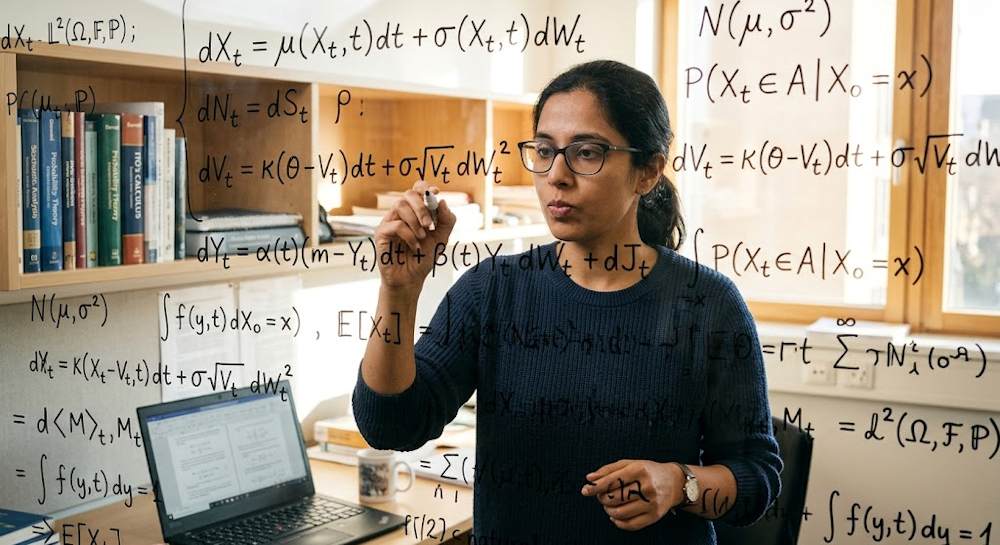
Limit theory supplies the first layer. Analex researchers refine central-limit results and their non-classical counterparts, using Stein's method, exchangeable-pair constructions, and coupling arguments to bound distributional distance in settings where characteristic functions fail. Large-deviation theory — Cramér, Sanov, and Freidlin-Wentzell-type results, including path-space asymptotics — quantifies how improbable events occur and by which cheapest route, while concentration-of-measure phenomena, log-Sobolev and Poincaré inequalities, transportation-cost methods, and Talagrand-type bounds provide the quantitative stability that makes high-dimensional statements meaningful. Mixing times, cutoff phenomena, and spectral-gap estimates for Markov chains are developed both as abstract theory and as practical diagnostics.
Process-level research constitutes the technical heart. Analex teams work on martingale theory, optimal stopping, and stochastic control, on Brownian motion and its generalizations through Itô calculus, on diffusions and jump processes, and on the boundary between continuous and discrete models. Conformal invariance and the Schramm-Loewner evolution have converted two-dimensional critical phenomena from heuristics into a rigorous classification scheme, while the Gaussian free field and Liouville-type constructions extend the same geometric-probabilistic reasoning to random surfaces. Random matrix theory supplies universality results and edge statistics of Tracy-Widom type, branching and coalescent processes organize genealogies and population dynamics, and stochastic partial differential equations — the KPZ equation, stochastic Navier-Stokes, and their relatives — are now tractable thanks to rough-path and regularity-structure technologies.
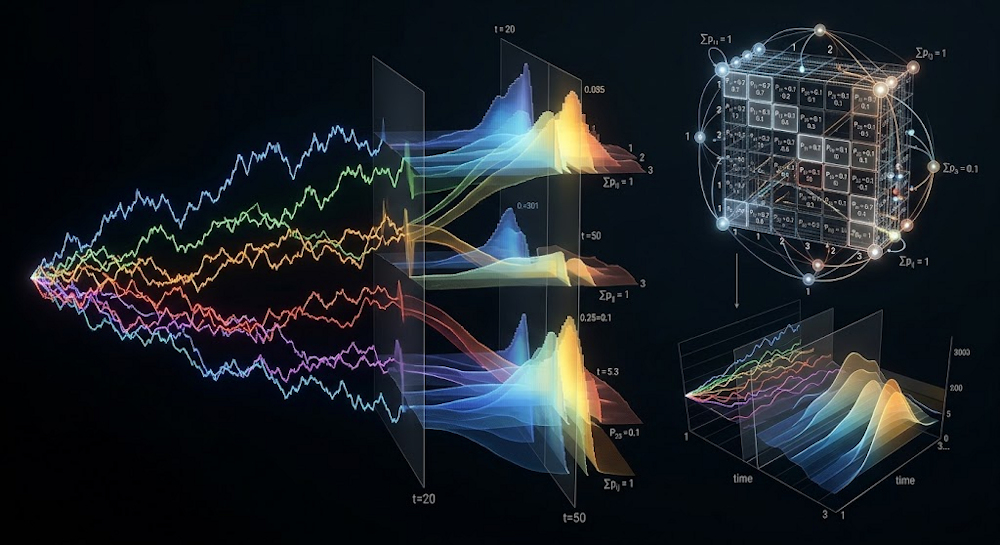
Random media and interacting systems receive sustained attention because they generate the field's richest phase structure. Percolation, first-passage percolation, and stochastic geometry probe the geometry of connectivity and its critical thresholds; spin glasses, metastability, and simulated annealing address rugged energy landscapes; and interacting particle systems, exclusion processes, and hydrodynamic limits connect microscopic stochastic rules to macroscopic deterministic laws. Ergodicity, stationarity, and long-range dependence are studied across statistical mechanics, queuing, and time-series settings, with the recurring theme that universality — insensitivity of scaling behavior to microscopic detail — is a theorem to be proved rather than an assumption to be invoked.
Applications are pervasive and analytically demanding. Analex's quantitative finance group handles volatility modeling, portfolio optimization, and risk under jump-diffusion dynamics; computational statisticians develop Markov chain Monte Carlo, Langevin, and variational methods with provable convergence; and machine learning has absorbed stochastic analysis wholesale, with diffusion and score-based generative models now described by stochastic differential equations whose sampling guarantees the consortium studies directly. Randomized algorithms, load balancing, and network analysis consume concentration theory; biology draws on branching, coalescent, and epidemic models; and reliability engineering, climate attribution, and insurance rely on extreme-value and large-deviation tools. Analex's contention is that probability advances by widening the class of systems whose fluctuations can be classified, and that the mathematics of the next decade will be shaped by whoever establishes those classifications first.