Topology & Geometry
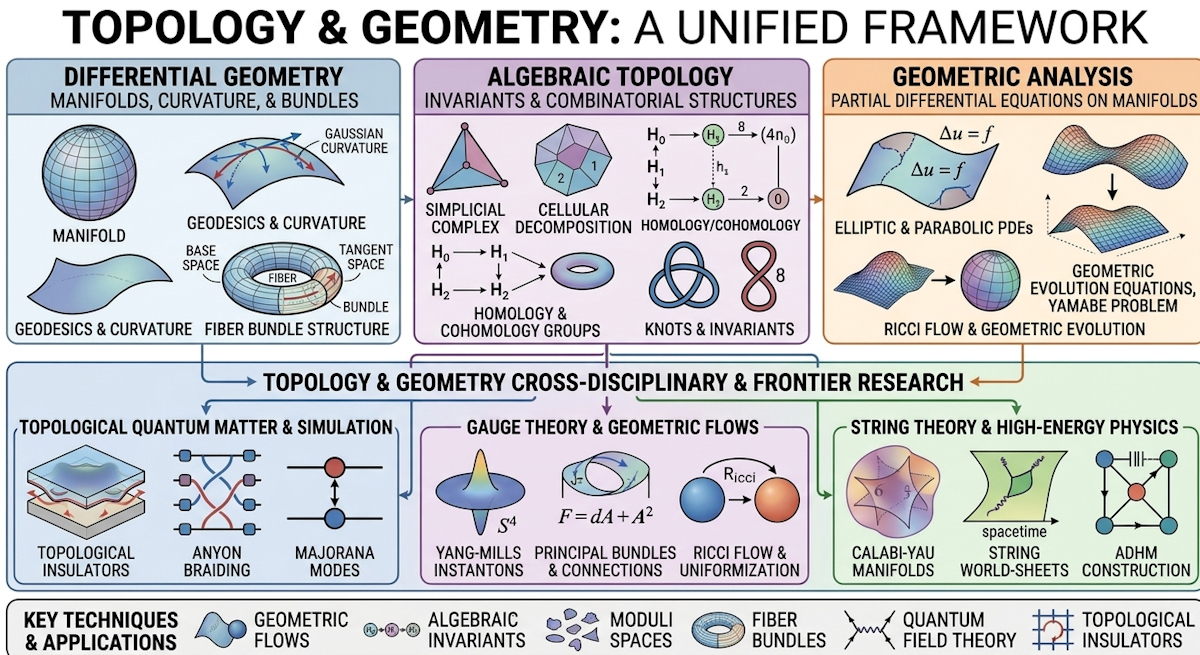
Topology and geometry explore the fundamental properties of space, shape, and structure, bridging abstract pure mathematics with physical reality. Innovation in this field drives breakthroughs across diverse domains, including quantum field theory, materials science, and topological data analysis for complex biological systems.
The Poincaré Laboratory for Topology & Geometry
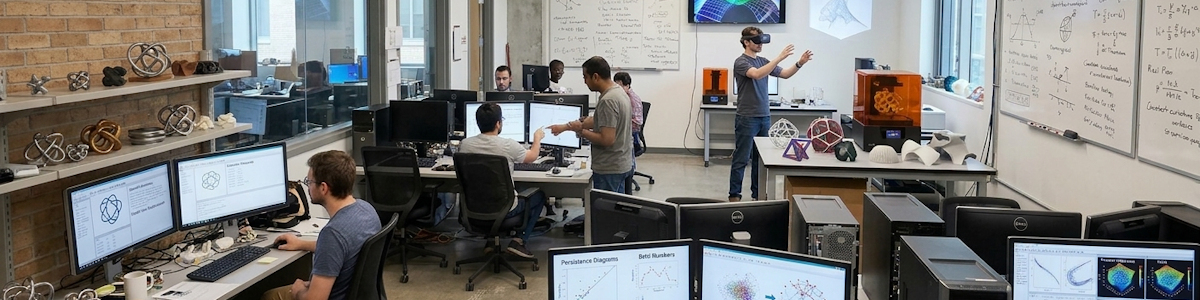
Named after Henri Poincaré, the French mathematician who invented analysis situs — the study of shape that survives stretching and who saw the geometry of hyperbolic space more clearly than anyone else of his century — the laboratory serves as the topology and geometry department of Analex Laboratories. Its concern is shape, and the invariants that refuse to change.
Core Capabilities & Equipment
- Computational Topology & Persistent Homology Cluster: Simplicial complexes are built from point clouds and filtered across scales, extracting Betti numbers, barcodes, and persistence diagrams, while triangulation enumeration and normal-surface algorithms settle questions about surfaces too large to draw.
- Low-Dimensional Topology & Knot Theory Workshop: Knot polynomials, braid groups, and Dehn surgery coefficients are computed symbolically, with hyperbolic volumes of knot and link complements sampled by SnapPea routines to separate manifolds that agree on every classical invariant.
- Riemannian Geometry & Curvature Computation Bench: Tensor algebra packages assemble metric, connection, and curvature quantities in arbitrary dimension, while Ricci flow and geodesic codes register how metrics deform, collapse, or pinch under the weight of their own curvature.
- Manifold Visualisation & Fabrication Studio: Ray-tracing, headset-based hyperbolic navigation, and resin 3D printing render four-dimensional polytopes, constant-curvature surfaces, and embedded knots as objects a researcher can walk through or hold.
Topology asks which properties survive continuous deformation; geometry asks what shape costs in curvature, distance, and volume. For a century these were neighboring but distinct enterprises. They are now effectively one subject, and much of the most significant work in mathematics happens in the seam between them — where a rigidity theorem constrains the topologies a manifold can carry, or a topological invariant obstructs a geometric structure. Analex Laboratories, a consortium of topologists, differential geometers, symplectic and algebraic geometers, and mathematical physicists, has made that seam its home. Its researchers proceed on the understanding that the sharpest results arise when algebraic invariants are forced to interact with analytic and geometric constraints, and that the productive direction of travel is toward more structured, more categorical, and more equivariant frameworks rather than looser ones.
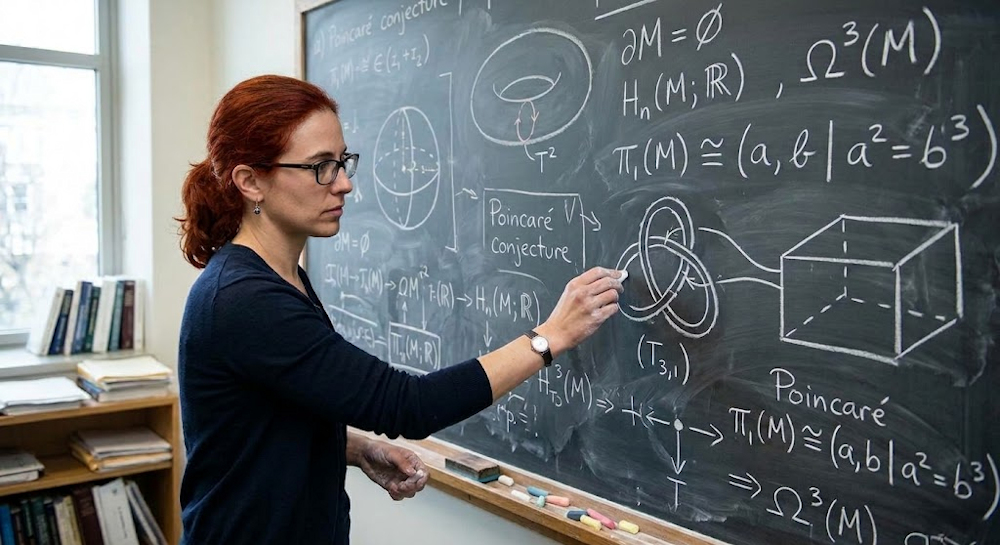
Homotopy theory provides the algebraic spine. Analex teams work in stable homotopy theory, manipulating spectra, chromatic localizations, and the machinery of higher algebra to organize the enormously complicated invariants that arise when spaces are probed by cohomology theories. Algebraic K-theory, cobordism, and characteristic-class computations supply computable shadows of these structures, and infinity-categorical and operadic formalisms — including the cobordism hypothesis and its descendants — have turned the construction of topological quantum field theories into a well-posed problem about symmetric monoidal structures. Motivic and equivariant refinements extend the same machinery into arithmetic and representation-theoretic territory, blurring boundaries the previous generation maintained.
Low-dimensional topology remains a proving ground where algebraic and analytic techniques must actually deliver. Analex researchers study three- and four-manifolds through Heegaard Floer and Khovanov-type homologies, knot concordance, and the gauge-theoretic invariants descending from instanton and Seiberg-Witten equations, alongside surgery theory and the classification of smooth structures on manifolds of dimension four and above. Geometric group theory contributes the complementary viewpoint: hyperbolic groups, cube complexes, mapping class groups, and Teichmüller-theoretic moduli are analyzed through curvature and coarse-geometric analogues that convert algebraic properties into statements about space. The resolution of the geometrization conjecture stands as the consortium's inherited template — an analytic flow argument settling a purely topological question.
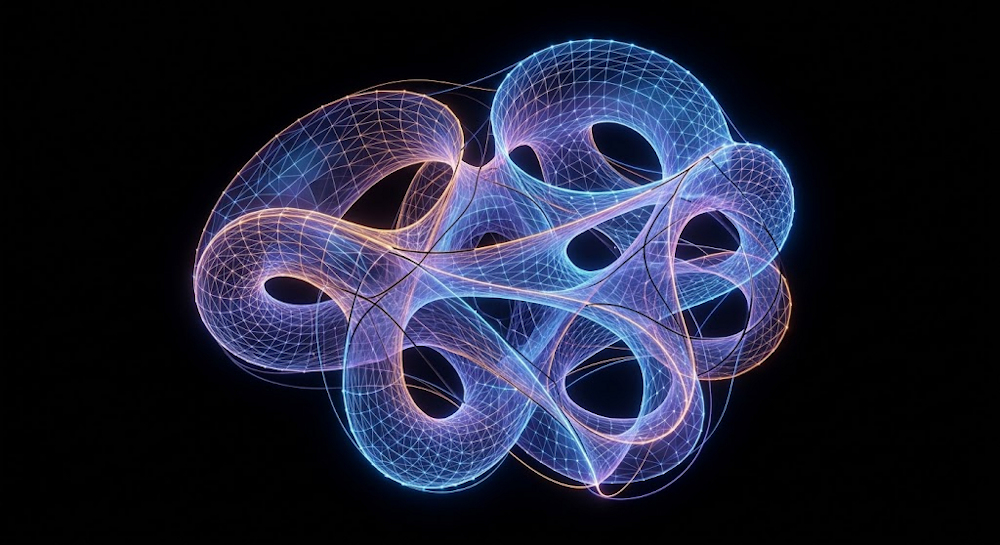
Geometry itself has become increasingly flow- and curvature-driven. Analex programs on Ricci flow, mean curvature flow, and minimal-surface methods address singularity formation and canonical metrics, while scalar-curvature and positive-mass questions connect local curvature inequalities to global topology. Kähler and Calabi-Yau geometry, special holonomy, and Einstein metrics are pursued in close dialogue with mirror symmetry and enumerative predictions from symplectic geometry, where Gromov-Witten and Floer-theoretic invariants are computed via derived and stack-theoretic moduli constructions. Tropical and non-Archimedean methods provide combinatorial approximations that frequently turn intractable degeneration problems into finite data.
The surrounding sciences are unusually receptive. String theory and quantum field theory have supplied both motivation and technique — anomaly cancellation, mirror symmetry, and the categorification of invariants all originated at that interface — while topological phases of matter and topological quantum computation depend on braided and modular structures that topologists classify. Materials science, robotics, and configuration-space problems draw on geometric and topological constraints, and topological data analysis exports persistent homology into applied settings where shape is inferred from noisy point clouds. Analex's assessment is that the subject's future lies in structured invariants: the more refined the algebraic object attached to a space, the more geometry it can be made to remember, and the consortium intends to keep pushing refinement rather than settling for coarse classification.