Paleontology & Stratigraphy
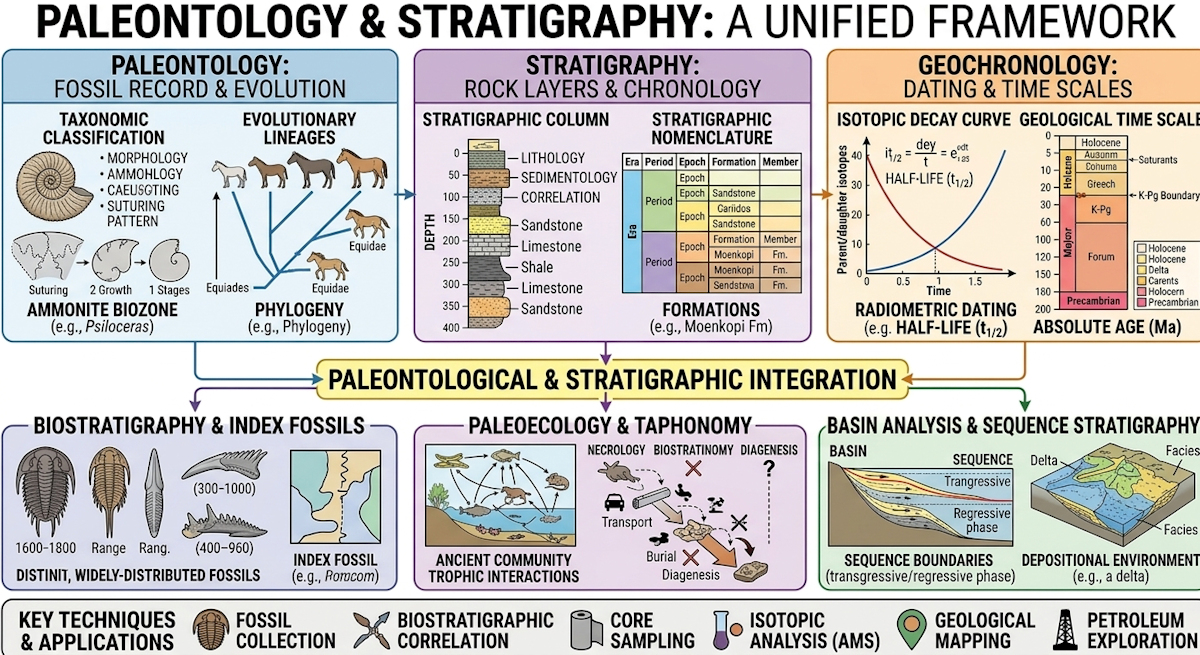
Paleontology and stratigraphy are increasingly driven by advanced technologies such as high-resolution CT scanning, chemical isotope analysis, and machine learning. These cutting-edge tools enable scientists to examine microscopic fossil details and refine the geological timescale with unprecedented precision. As a result, researchers can reconstruct ancient ecosystems and climate dynamics more accurately, offering deeper insights into evolutionary history and Earth's past mass extinction events.
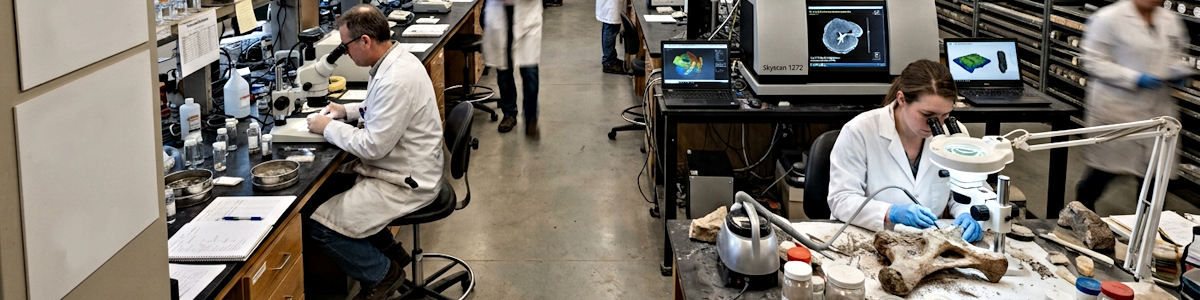
The W. Smith Stratigraphy & Fossil Record Laboratory
Carrying the name of William Smith, the canal surveyor who noticed that fossil assemblages succeed one another in a fixed and predictable order, then turned that observation into the first geological map of a nation — this lab handles palaeontology and stratigraphy at Analex Laboratories. Its charge is twofold: putting rock in sequence, and reading the organisms buried inside it.
Core Capabilities & Equipment
- Fossil Preparation & Micro-CT Laboratory: Air scribes, buffered acid baths, and epoxy consolidation free specimens from matrix, while micro-focus CT scanning and photogrammetry render internal anatomy and concealed sutures as manipulable digital models before a blade ever touches the original bone.
- Microfossil Biostratigraphy Suite: Conodonts, foraminifera, ostracods, and palynomorphs are liberated by disaggregation and heavy-liquid separation, then assigned to published zonal schemes that bracket a bed's age to a fraction of a stage.
- Chemostratigraphy & Radioisotopic Dating Line: Carbon, oxygen, and strontium isotope curves measured from carbonate and organic fractions are correlated bed-for-bed, while CA-ID-TIMS uranium-lead work on interbedded ash pins those curves onto an absolute numerical timescale.
- Sediment Core Repository & Cyclostratigraphy Bench: A refrigerated core archive backs continuous XRF scanning, gamma densitometry, and magnetic susceptibility logging, teasing orbital cyclicity out of laminated successions and anchoring correlations between sections hundreds of kilometres apart.
Paleontology's oldest tension — the romance of discovery versus the rigor of measurement — has been resolved in favor of the latter, and the field is far better for it. Fossils are no longer endpoints; they are data points in quantitative models of diversification, extinction, and environmental change, and their value depends entirely on knowing precisely when they lived. Analex Laboratories, a consortium of paleobiologists, stratigraphers, geochronologists, and evolutionary modelers, has built its identity on that premise. Its researchers operate under an uncomfortable but productive constraint: the fossil record is an incomplete and structurally biased sample of past life, and any honest inference must model the bias explicitly rather than pretend it away.
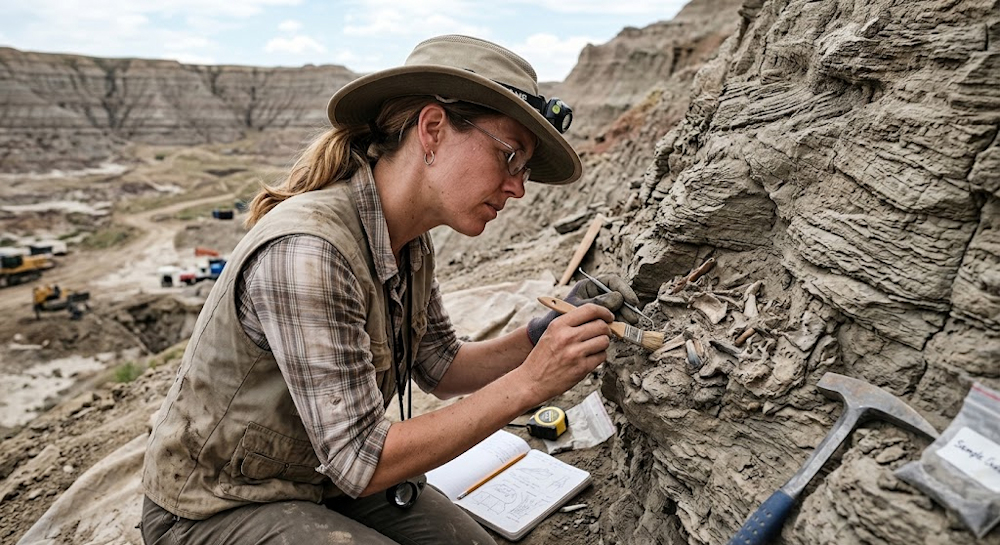
Time is the consortium's currency, and its stratigraphy group treats calibration as a discipline in its own right. Analex runs high-precision uranium-lead and argon-argon geochronology alongside astrochronology, cyclostratigraphy, magnetostratigraphy, and carbon and strontium isotope chemostratigraphy, layering independent clocks until basin histories are resolved to tens of thousands of years — occasionally finer. Sequence stratigraphic analysis maps accommodation space, flooding surfaces, and depositional architecture across shelf-to-basin transects, providing the geometric framework into which fossil ranges and geochemical signals are fitted. Continuous coring campaigns supply unweathered, stratigraphically ordered material that outcrop work alone cannot deliver.
Specimen-level science has been transformed by imaging. Synchrotron microtomography, propagation-phase contrast scanning, and neutron tomography let Analex researchers peer inside unprepared blocks, extracting cranial anatomy, gut contents, and embryonic remains from matrix without a single chisel stroke, while photogrammetric surface scanning produces open, three-dimensional digital vouchers that anyone can re-measure. Taphonomy is studied experimentally — decay, scavenging, transport, and mineralization replicated under controlled conditions — to establish which biological signals survive fossilization and which are artifacts. Exceptional preservation receives particular attention: Konservat-Lagerstätten, amber inclusions, and organic-walled microfossils are mined for original biomolecules, pigment residues, and, where conditions permit, degraded genetic material, with environmental DNA from sediments extending the record of recent faunas beyond macrofossils.
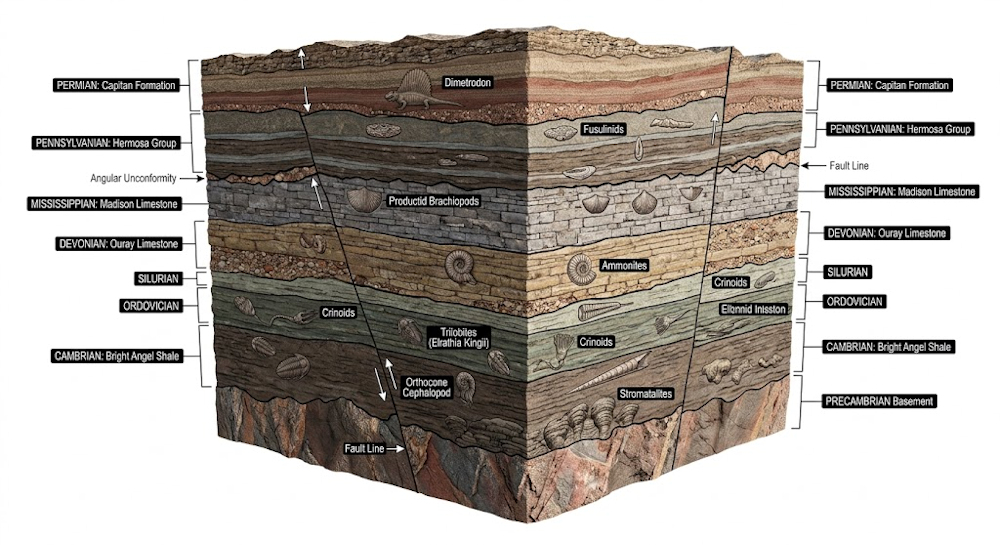
On that foundation, the consortium's evolutionary program asks large questions with explicit statistics. Bayesian tip-dating and total-evidence phylogenetics place extinct taxa in time-scaled trees, geometric morphometrics quantifies shape disparity and convergence, and occupancy and capture-recapture models correct raw diversity curves for uneven sampling across rock volume, geography, and collector effort. Analex has concentrated on extinction dynamics — selectivity by body size, physiology, geographic range, and ecology — and on the structure of recovery intervals, using end-Permian, end-Triassic, and Cretaceous-Paleogene boundaries as natural laboratories for how ecosystems reassemble. Volcanic, bolide, and hyperthermal drivers are evaluated comparatively rather than case-by-case, and paleoclimate proxies extracted from fossils and their host sediments are converted into quantitative temperature, pCO₂, and productivity estimates.
The applied dimension is substantial and growing. Biostratigraphic zonation built from foraminifera, nannofossils, conodonts, and palynomorphs remains the cheapest high-resolution correlation tool available to subsurface geologists, and Analex supplies that expertise to hydrocarbon, geothermal, helium, and CO₂-storage programs, where reservoir connectivity and seal integrity hinge on stratigraphic geometry. Ichnology and facies analysis inform aquifer characterization; paleosol and isotope work informs paleogeographic reconstruction. Off-world, the consortium advises on sample-return priorities and astrobiology strategy, since the criteria for recognizing ancient life are drawn directly from Earth's taphonomic and geochemical experience. Analex's underlying position is unromantic and firm: the past can only be read through its biases, and the groups that model those biases best will write the history.