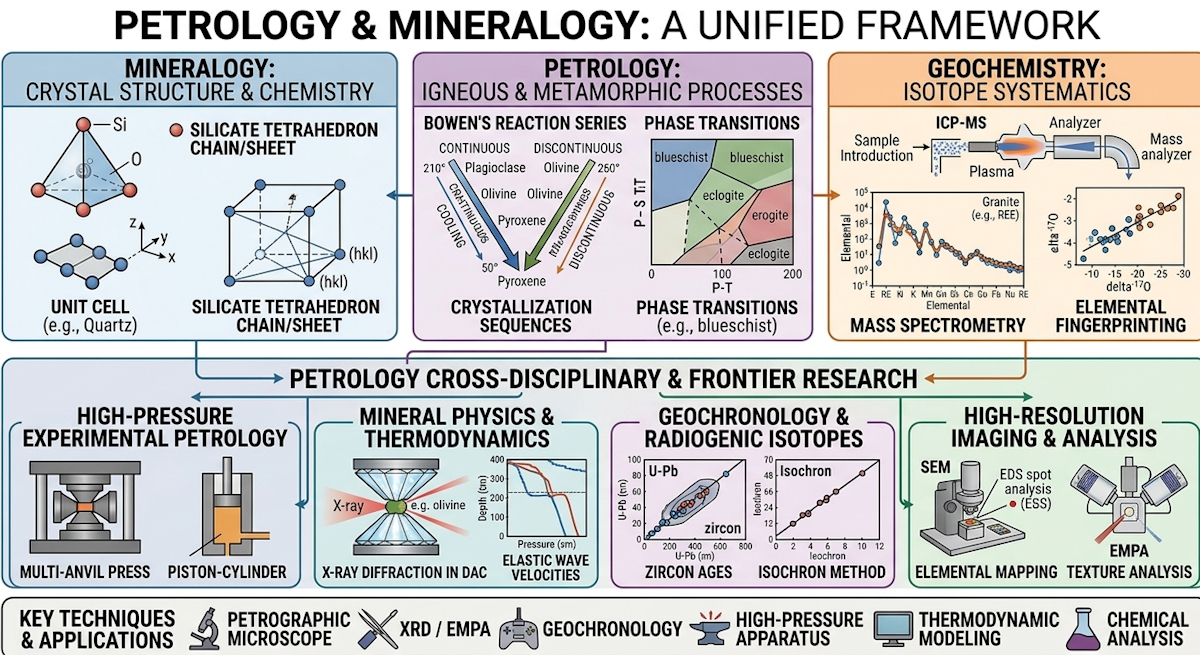
Petrology & Mineralogy
Contemporary research in petrology and mineralogy integrates cutting-edge micro-analytical tools — such as high-resolution mass spectrometry and synchrotron imaging — to decode the thermal and chemical evolution of Earth's crust and mantle. Recent innovations heavily emphasize sustainable resource exploration, focusing on identifying critical minerals essential for green energy technologies and applying machine learning to advanced mineral identification.
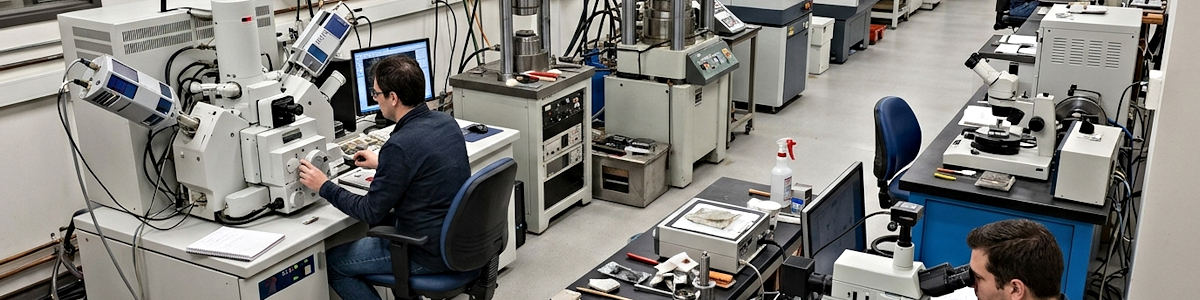
The Sorby Petrographic Laboratory
Named in honor of Henry Clifton Sorby, the Sheffield naturalist who first ground stone to translucent thinness and taught petrology to read the rock at the scale of the crystal — the lab serves as the high-precision petrological and mineralogical core for Analex Laboratories. The center pairs micro-analytical chemistry with high-pressure experimentation, specialized in reconstructing the thermal, fluid, and tectonic history of the crust from a single grain.
Core Capabilities & Equipment
- Petrographic Thin-Section & Microtexture Suite: Diamond sawing, vacuum resin impregnation, and precision grinding to thirty microns yield polished thin sections imaged under transmitted and reflected polarized light, exposing growth textures, reaction rims, and deformation microfabrics at crystal scale.
- Electron Probe Micro-Analysis (EPMA): Five-spectrometer wavelength-dispersive analysis maps major and trace element zoning across individual grains at micron resolution, resolving oscillatory banding, exsolution lamellae, and diffusion profiles that record shifting pressure, temperature, and melt composition.
- Fluid & Melt Inclusion Microthermometry: Coupled heating-freezing stages and Raman spectroscopy on entrapped inclusions recover the pressure, temperature, salinity, and volatile load of fluids that once migrated through a rock, reconstructing ancient hydrothermal cells and the volatile budgets of magmas.
- High-Pressure Experimental Petrology Bay: Piston-cylinder and multi-anvil presses reproduce lower-crustal and upper-mantle conditions past twenty-five gigapascals, testing phase equilibria against natural assemblages and constraining the depths from which xenoliths and orogenic massifs were exhumed.
Petrology and mineralogy, once largely descriptive disciplines built on hand-lens identification and thin-section microscopy, have undergone a decisive transformation into a quantitative, predictive, and computationally driven branch of Earth science. Analex Laboratories, a multinational consortium of geoscientists, mineral physicists, and materials researchers, sits at the leading edge of that transformation. Its central thesis is that rocks and minerals are not merely archives to be catalogued but dynamic systems whose formation, deformation, and decomposition can be modeled, predicted, and interrogated at the scale of individual atoms and the timescale of nanoseconds. The consortium's program spans the full range of the field — from deep-mantle phase equilibria to ore-forming hydrothermal systems to extraterrestrial mineralogy — unified by a shared methodology that fuses high-pressure experiment, ultra-high-resolution spectroscopy, thermodynamic computation, and machine learning.
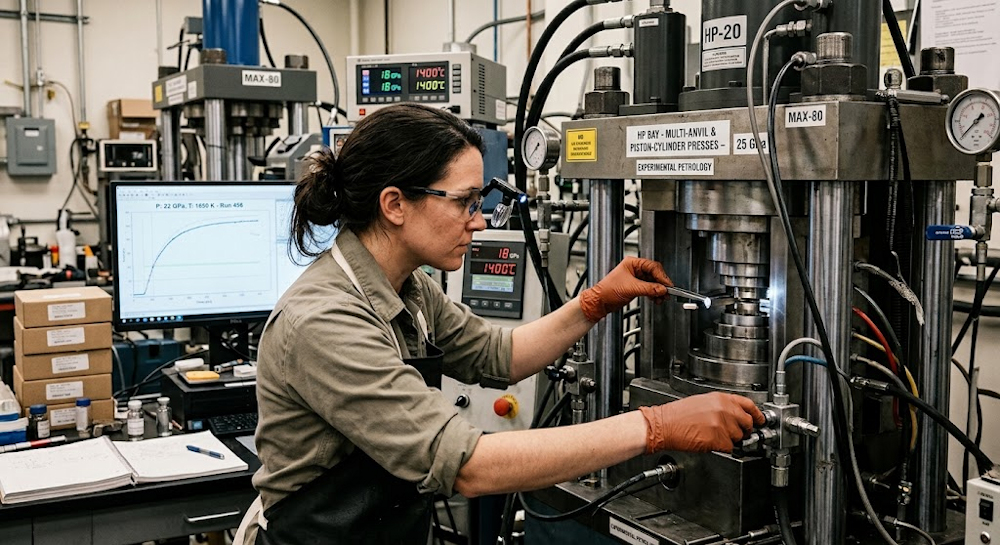
The analytical backbone of this work is instrumentation that would have been unimaginable two decades ago. Analex beamline teams routinely deploy synchrotron micro-X-ray diffraction and fluorescence to map phase assemblages and trace-element zoning at sub-micron resolution without destroying the sample, while atom probe tomography reconstructs the three-dimensional atomic arrangement of nanoscale clusters — the first direct window into how trace elements and volatiles actually distribute within nominally "pure" mineral lattices. In parallel, the consortium operates laser-heated diamond anvil cells and multi-anvil presses that reach the pressures of Earth's core–mantle boundary, paired with time-resolved detectors that capture polymorphic transitions as they happen. Coupled with focused-ion-beam sample preparation and aberration-corrected electron microscopy, these tools allow Analex to watch mineral reactions in situ rather than infer them from quenched run products.
This experimental capability feeds directly into the consortium's flagship deep-Earth program. Analex researchers have concentrated on the stability fields of bridgmanite, post-perovskite, and the hydrous and carbon-bearing phases that shuttle volatiles between surface and interior — work that has reframed the deep water and deep carbon cycles as coupled, redox-sensitive processes rather than one-way fluxes. Melt and fluid inclusions trapped inside sublithospheric diamonds serve as natural high-pressure capsules, and Analex's inclusion characterization pipeline has turned them into direct samples of otherwise inaccessible mantle domains. Alongside the benchwork, the consortium's computational group has built machine-learned interatomic potentials and thermodynamic databases that reproduce measured phase boundaries to within experimental uncertainty, enabling forward modeling of mantle convection, magma generation, and seismic discontinuities at a fidelity that ties petrology directly to geophysics.
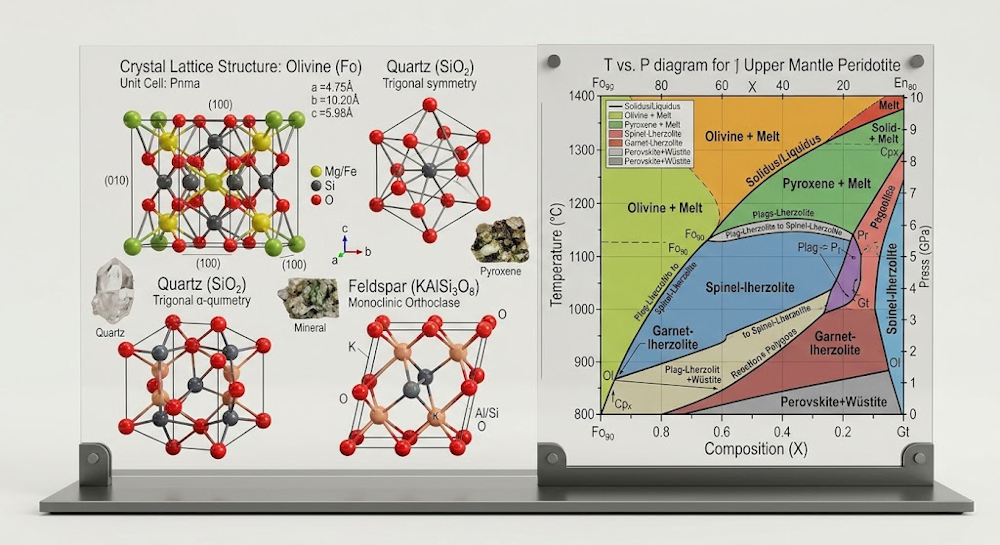
The applied side of the research is equally aggressive, and increasingly shaped by the energy transition. Analex's ore-genesis group treats magmatic-hydrothermal and basin-brine systems as mineralogically self-organizing, using coupled reactive-transport models to predict where lithium, rare-earth elements, cobalt, and platinum-group metals concentrate — and why. A parallel effort in mineral carbonation has demonstrated that tailored ultramafic and basaltic feedstock can fix CO₂ into stable carbonate phases at industrially relevant rates, converting mine tailings and serpentinite bodies from waste liabilities into sequestration assets. Geothermal reservoir petrology, acid-rock drainage prediction, and cement-phase durability all draw on the same core competencies.
Finally, Analex has pushed mineralogy beyond Earth. Consortium teams characterize presolar grains, chondritic meteorites, and returned asteroid and lunar samples to reconstruct the condensation sequence of the early solar nebula, and they apply the framework of mineral evolution — the co-evolution of the mineral kingdom with planetary differentiation and, later, with life — to assess habitability on other worlds. Biomineralization studies probe how organisms template aragonite, magnetite, and silica with nanoscale precision, offering blueprints for synthetic materials. The through-line across all of it is a commitment to open, machine-readable data and reproducible experiment, on the conviction that the next decade of petrology and mineralogy will belong not to whoever holds the best single sample, but to whoever can integrate the most observations into models that actually predict what the Earth will do next.