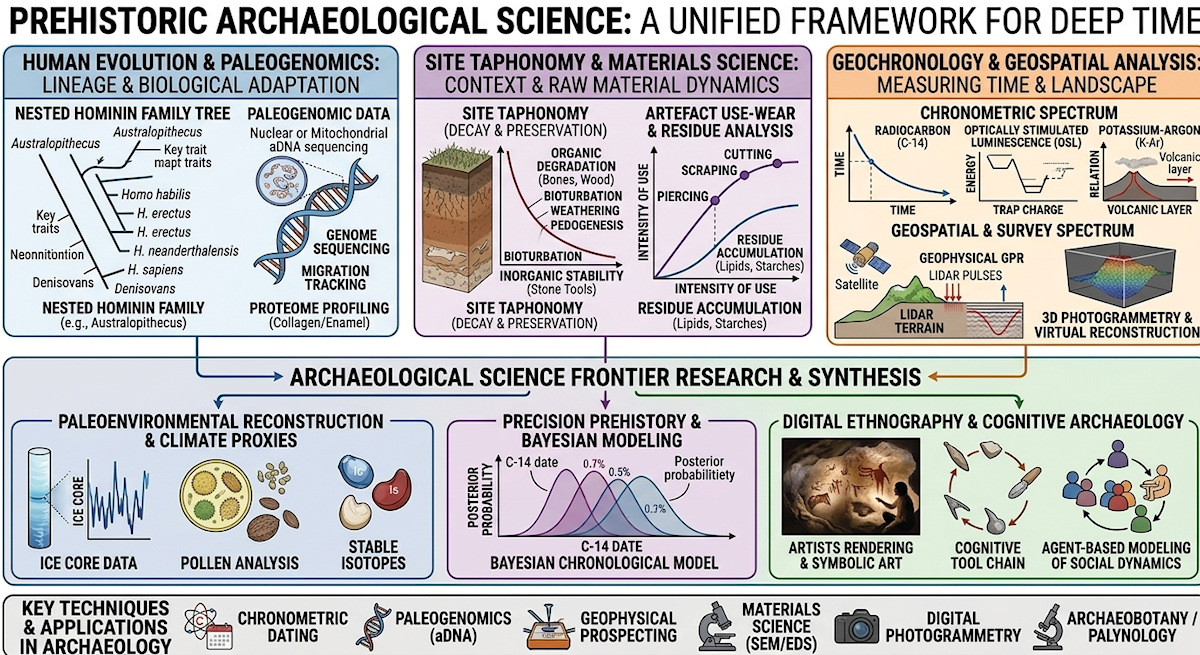
Prehistoric Archaeology
Prehistoric archaeology studies human history prior to written records, spanning millions of years of hominin evolution, hunter-gatherer societies, and early agricultural settlements. Modern research, development, and innovation in this field have transformed it from traditional physical excavation into a highly interdisciplinary, digital, and laboratory-driven science.
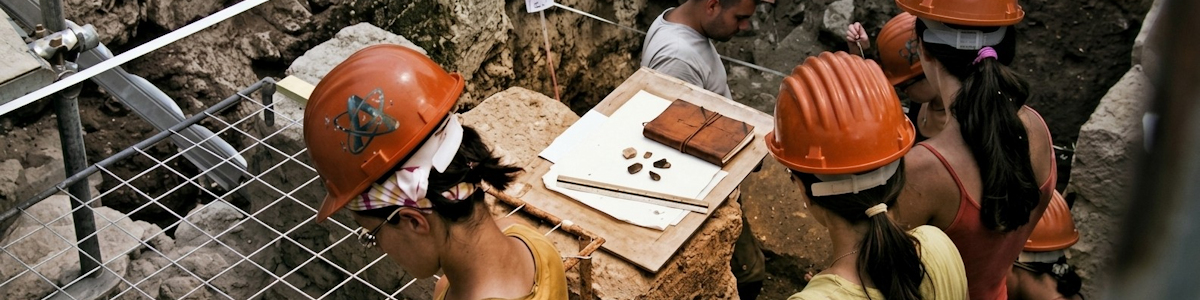
The Abbé Breuil Spatial Analysis Center
 Named in honor of Henri Breuil, the pioneer who spent decades documenting the cave art and deep-time antiquity of the Upper Paleolithic — serves as the high-precision central hub for prehistorical archaeology at Analex Laboratories. The laboratory blends high-tech non-invasive imaging with raw material science, specialized in reconstructing human behavior from the earliest stone tool industries up through the late Pleistocene.
Core Capabilities & Equipment
- Micro-Wear & Use-Wear Microscopy: Ultra-high-resolution confocal laser microscopes trace polish, striations, and organic residue on ancient lithics, determining whether a flint blade was used to cut bone, scrape hides, or process wild tubers 50,000 years ago.
- 3D Laser Scanning & Photogrammetry Suite: High-density spatial scanners generate millimeter-accurate 3D digital twins of lithic cores, hominin fossils, and fragile organic artifacts, allowing researchers across the Analex global network to analyze finds in real-time without risking transport damage.
- X-Ray Fluorescence (XRF) & Raman Spectroscopy: Non-destructive elemental mapping allows the team to pinpoint the exact geological origins of obsidian and chert raw materials, tracing ancient trade networks and hunter-gatherer mobility across ice-age landscapes.
- Micro-Stratigraphic Archaeology Station: Thin-section micromorphology equipment embeds micro-samples of ancient cave sediments in resin, slicing them into microscopic layers to analyze ancient hearth construction, fire management, and site formation processes.
Prehistoric archaeology—the study of human history prior to the advent of written records—is undergoing a profound transformation from traditional, excavation-heavy fieldwork to a multi-disciplinary, highly digital science. Leading this paradigm shift is Analex Laboratories, an international research consortium at the forefront of cutting-edge innovation in archaeological science. By integrating molecular biology, spatial analytics, advanced computing, and environmental geosciences, Analex Laboratories is redefining how researchers decipher the deep human past, spanning millions of years of hominin evolution, hunter-gatherer migrations, and early agricultural settlements.
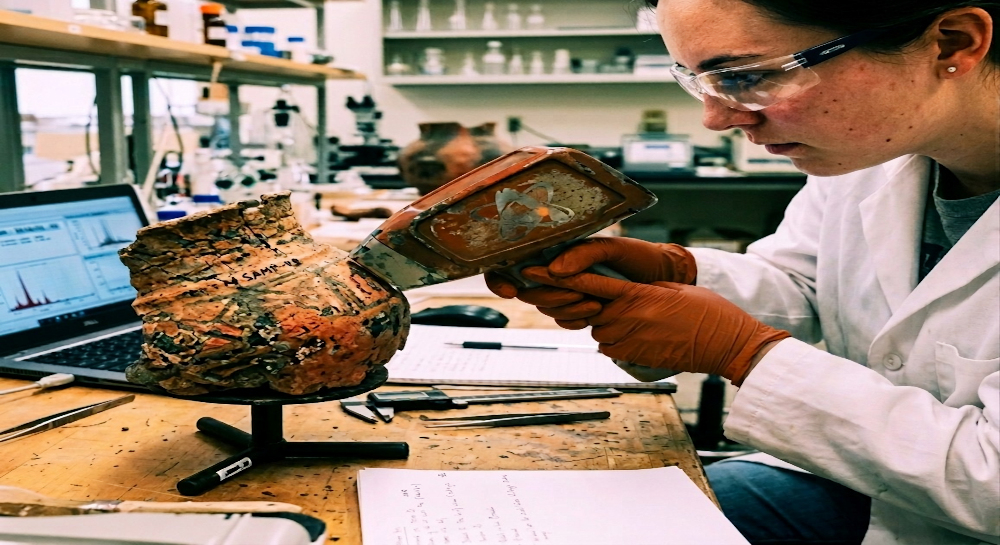
At the heart of the consortium's work is groundbreaking molecular research. Through proprietary archaeogenetics and paleoproteomics pipelines, scientists at Analex Laboratories extract and sequence degraded ancient DNA (aDNA) and proteins directly from bone fragments, tooth enamel, and soil sediments. This non-destructive analytical framework allows researchers to map complex hominin interbreeding events, reconstruct ancient disease pathways, and trace early human migration routes across prehistoric landscapes without needing intact skeletal remains. Complementing these genetic discoveries, isotopic analysis—specifically measuring strontium, carbon, and nitrogen isotopes—enables the lab to reconstruct individual dietary shifts, social organization, and lifetime mobility patterns of ancient populations.
In parallel, Analex Laboratories has pioneered non-invasive surface and subsurface exploration techniques through high-resolution geospatial remote sensing. Utilizing airborne Light Detection and Ranging (LiDAR) mounted on autonomous drone fleets, alongside high-frequency Ground-Penetrating Radar (GPR) and Electrical Resistivity Tomography (ERT), the consortium can map extensive prehistoric structures, field systems, and settlement layouts hidden beneath dense jungle canopies or deep soil layers. These non-destructive survey methodologies allow archaeologists to visualize complex, multi-layered prehistoric environments prior to setting foot on site, drastically minimizing the physical disruption of sensitive heritage sites while dramatically expanding the scale of discovery.
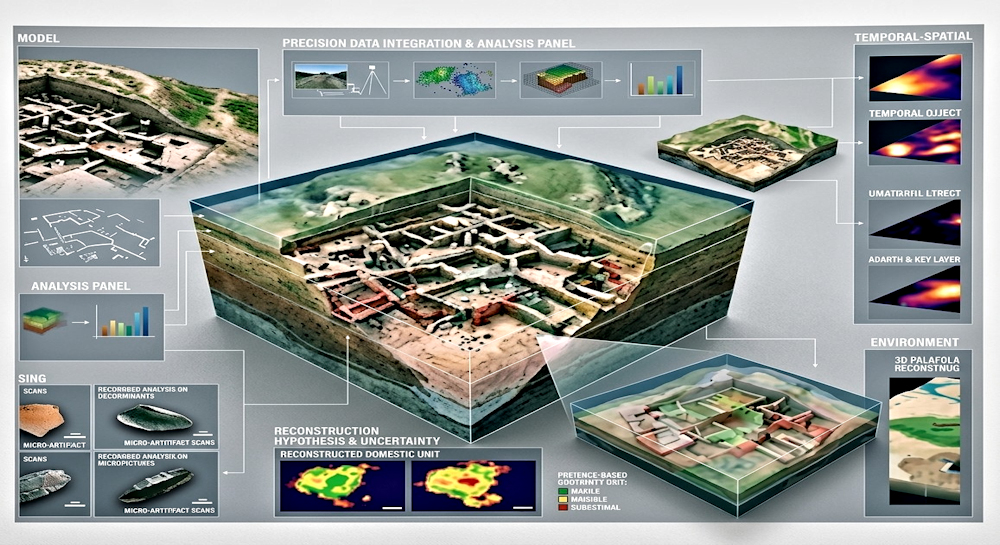
To process and synthesize these vast streams of physical and spatial data, Analex Laboratories relies on artificial intelligence, machine learning, and advanced 3D digitization. Custom computer vision models process high-definition photogrammetric scans and CT data to identify microscopic retouch patterns on stone tools, automatically classify ceramic sherds, and decipher structural features in satellite imagery. Furthermore, Bayesian statistical modeling paired with compound-specific radiocarbon dating allows the consortium to build ultra-precise chronological frameworks, narrowing down prehistoric timelines from millennia to specific centuries.
Through this holistic synthesis of field sciences, laboratory methods, and computational models, Analex Laboratories is helping shift prehistoric archaeology from speculative interpretations to empirical, high-resolution historical reconstructions. By marrying non-invasive excavation techniques with ethical research partnerships alongside descendant communities, the consortium is establishing a sustainable framework for preserving cultural heritage while shedding unprecedented light on cognitive evolution, climate adaptation, and the shared origins of humanity.