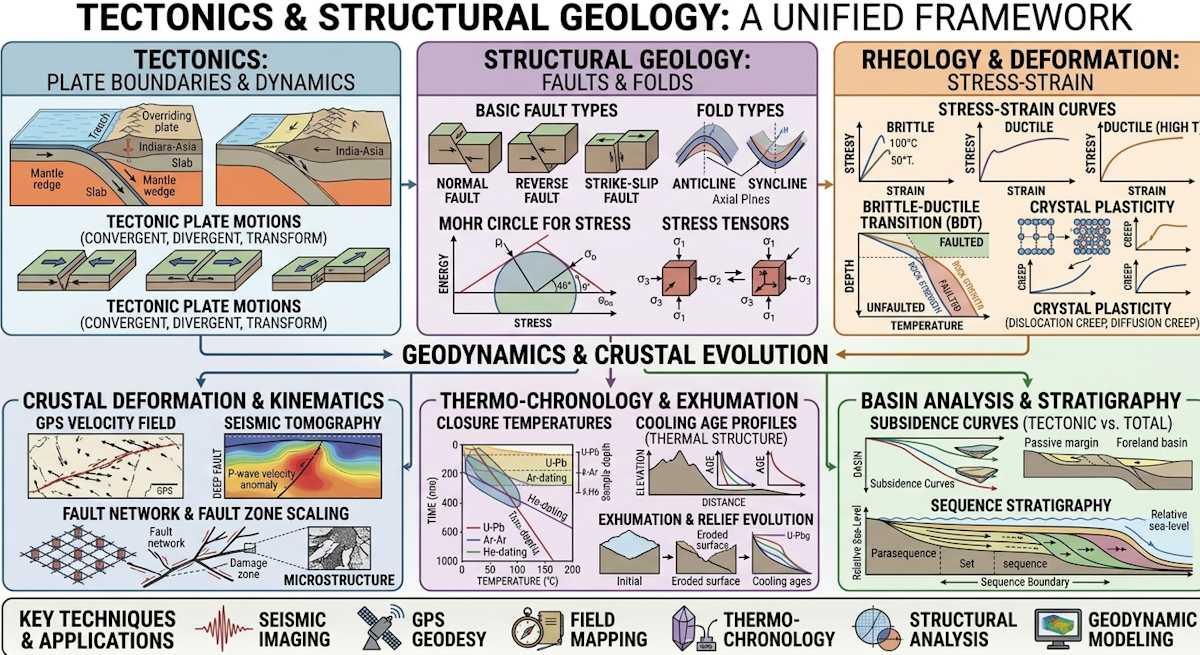
Tectonics & Structural Geology
Contemporary research in petrology and mineralogy integrates cutting-edge micro-analytical tools — such as high-resolution mass spectrometry and synchrotron imaging — to decode the thermal and chemical evolution of Earth's crust and mantle. Recent innovations heavily emphasize sustainable resource exploration, focusing on identifying critical minerals essential for green energy technologies and applying machine learning to advanced mineral identification.
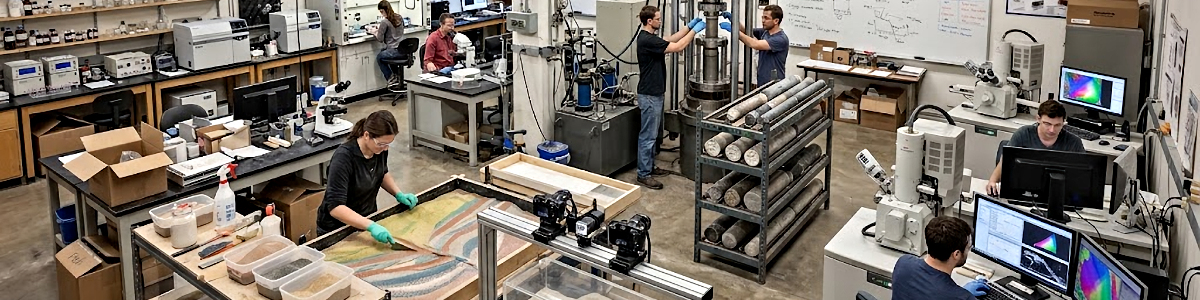
The Cloos Crustal Deformation Laboratory
Honoring Hans Cloos, the structural geologist who mapped granite plutons as slow-flowing bodies and reproduced mountain building in wax and clay — this facility anchors the Analex Laboratories program in tectonics and structural geology. Its work joins field-scale fault and fold analysis with laboratory rock mechanics, aimed at recovering the strain, stress state, and slip timing locked inside deformed rock.
Core Capabilities & Equipment
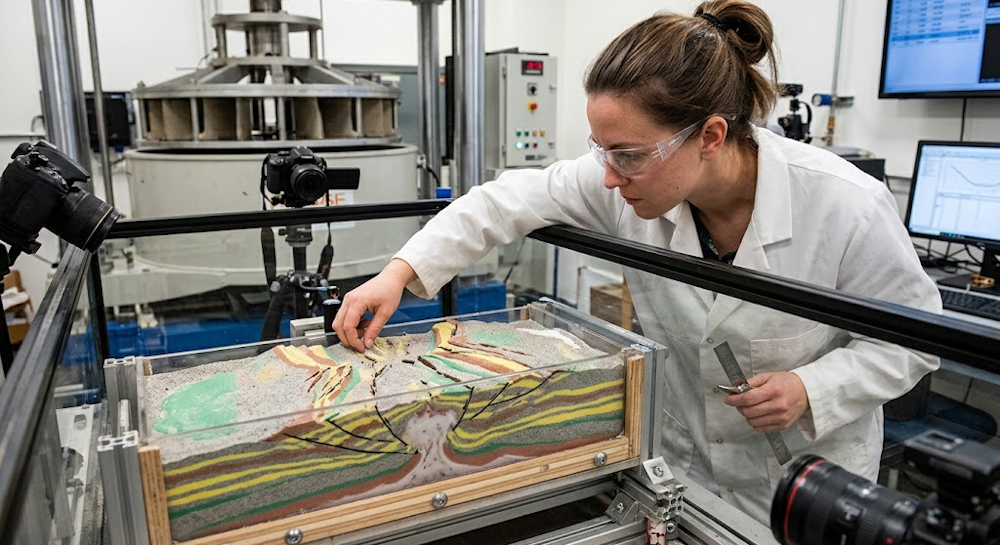
- Tectonic Analog Modelling Bay: Sandbox rigs, layered quartz-sand and silicone packs, and a geotechnical centrifuge grow thrust wedges, rift shoulders, and salt diapirs at scale, letting researchers watch fold-thrust propagation and strain partitioning unfold in real time under controlled boundary conditions.
- Microstructural & EBSD Fabric Laboratory: Electron backscatter diffraction, cathodoluminescence, and optical fabric work quantify crystallographic preferred orientation, subgrain rotation, and dynamic recrystallization in quartz, calcite, and olivine, translating lattice fabrics into shear sense, deformation temperature, and finite strain.
- Rock Mechanics & Triaxial Deformation Cell: Servo-controlled triaxial and direct-shear presses load core to confining pressures near 500 MPa, logging acoustic emission, permeability evolution, and frictional weakening to establish how faults nucleate, slip, heal, and reactivate.
- Low-Temperature Thermochronology Suite: Apatite and zircon (U-Th)/He, fission-track, and argon step-heating methods date cooling through shallow crustal depths, pinning the timing of fault slip, exhumation, and landscape unroofing across orogenic belts.
Tectonics and structural geology have shed their origins as map-and-compass disciplines. Where earlier generations documented folds, faults, and foliations in two dimensions and inferred motion from offset markers, the modern field treats the lithosphere as a deforming continuum governed by measurable rheology, stress state, and strain rate — a physical system to be instrumented rather than sketched. Analex Laboratories, a multinational consortium of structural geologists, geophysicists, geodesists, and rock-mechanics specialists, has positioned itself squarely at the front of that reinvention. The group's guiding premise is that deformation is continuous in time and hierarchical in scale: the same processes that localize slip onto a millimeter-wide shear surface also build mountain belts thousands of kilometers long, and a complete science must connect the two without hand-waving. Analex pursues that connection across field, laboratory, and computational domains under a single research architecture.
The consortium's observational reach is planetary in scope. Dense GNSS arrays track millimeter-per-year surface velocities, interferometric radar resolves coseismic and interseismic strain across entire plate boundaries, and broadband seismic networks image the deep architecture that surface structures root into. At outcrop scale, Analex teams use drone photogrammetry and terrestrial laser scanning to build centimeter-resolution digital models of fault zones, then sample along precisely georeferenced transects. Timing is pinned by a suite of radioisotopic and low-temperature thermochronometers — zircon and apatite fission-track, (U-Th)/He, cosmogenic nuclides — that convert cooling histories into exhumation rates and fault slip chronologies. The result is genuinely four-dimensional: structure, kinematics, and tempo recovered together rather than assumed.
Laboratory deformation work anchors the interpretation of those field datasets. Analex operates triaxial and Paterson-type apparatuses that creep rock at confining pressures and temperatures spanning the brittle-to-ductile transition, with synchrotron X-ray tomography capturing shear localization and pore collapse in real time, and electron backscatter diffraction revealing crystallographic preferred orientation as it develops. Consortium friction experiments have sharpened rate-and-state constitutive laws for faults, clarifying why some patches rupture seismically while neighbors creep, and how fluid pressure, mineralogy, and gouge fabric govern the difference. Related programs interrogate the rheology of quartz, olivine, and feldspar aggregates to constrain dislocation creep versus diffusion creep regimes, giving geodynamicists defensible flow laws instead of free parameters.
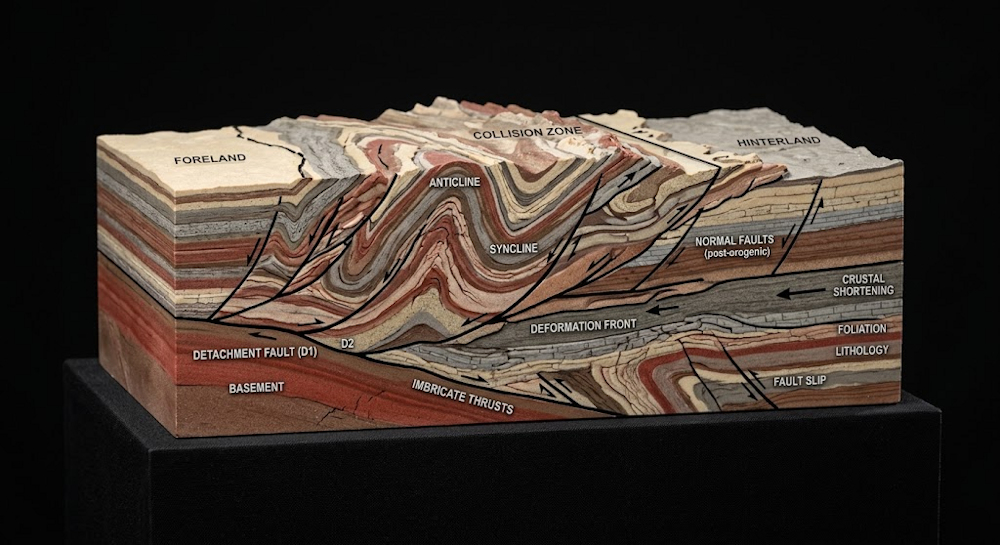
Upward from mechanics, Analex reconstructs plate motion and orogenic evolution. Global circuits of magnetic anomalies, fracture-zone geometry, and seismic tomography feed plate kinematic models that are then stress-tested against the geological record of collision, rifting, transtension, and basin inversion. The consortium places particular emphasis on structural inheritance — how ancient sutures and detachment systems are reactivated again and again, partitioning strain in ways that purely thermal models miss. Its modeling group couples analog sandbox experiments with finite-element and discrete-element codes, benchmarking each against the other and against natural examples, while a subduction-zone program links slab geometry and interface roughness to megathrust segmentation, slow slip, and non-volcanic tremor.
Downstream, the science is inseparable from practical stakes. Analex consults on seismic hazard, subsurface hydrogen and geothermal prospecting, and geologic CO₂ storage, where caprock integrity and fault-seal behavior decide whether a reservoir holds for ten thousand years. Structural corridors also control where critical metals concentrate, making tectonic reconstruction a prospecting tool rather than an academic exercise. Beyond Earth, consortium researchers apply the same toolkit to Venusian fold belts, Martian graben, and the tectonically active icy moons, using planetary deformation as a natural experiment on lithospheric strength under alien thermal regimes. The group's wager is straightforward: as instrumentation, computation, and field observation converge, tectonics will graduate from explaining deformation after the fact to anticipating where the crust will yield next.