Volcanology
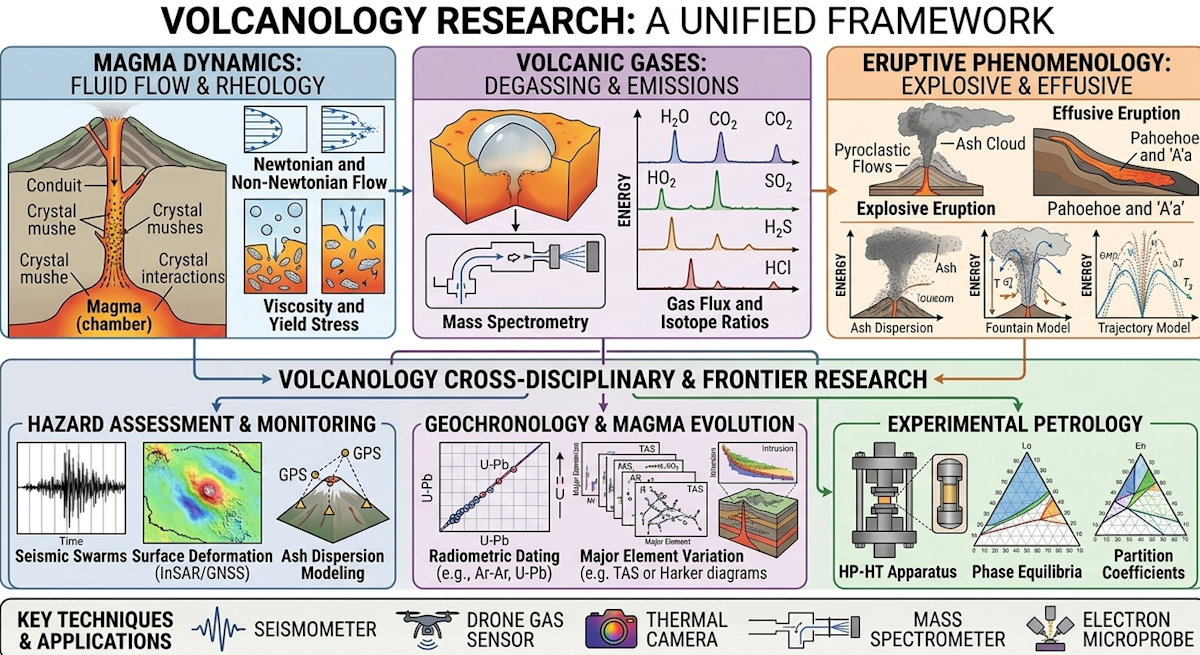
Research, development, and innovation in volcanology heavily leverage cutting-edge technologies like satellite remote sensing, artificial intelligence, and drone-mounted sensors to monitor active systems safely and in real-time. These advancements allow scientists to track subtle ground deformation, seismic shifts, and gas emissions with high precision. Together, these modern tools significantly improve eruption forecasting and early-warning capabilities, ultimately helping protect populations living near hazardous zones.
The Jaggar Volcanic Systems Laboratory
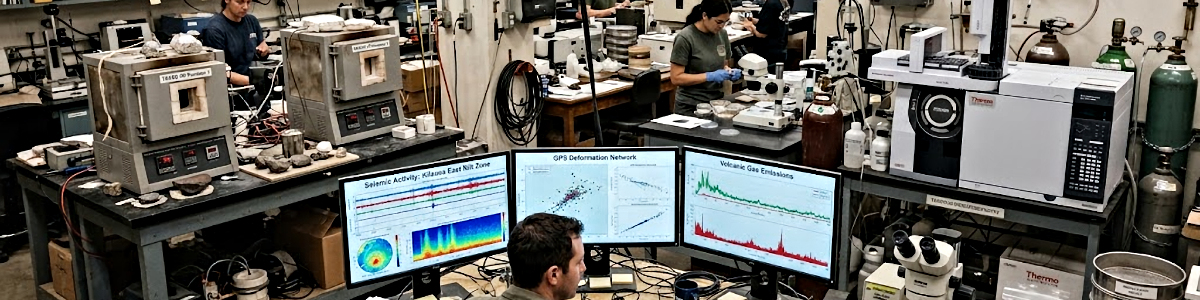
Bearing the name of Thomas A. Jaggar, the geologist who talked the Hawaiian Volcano Observatory into existence and spent his career insisting that eruptions could be watched, measured, and eventually anticipated — this lab carries the Analex Laboratories effort in volcanology. Its remit runs from live multiparameter surveillance to the forensics of ancient eruptions, seeking the signals that separate a restless edifice from a failing one.Core Capabilities & Equipment
- Multiparameter Monitoring Array: A telemetered grid of broadband seismometers, continuous GPS, borehole tiltmeters, infrasound sensors, and thermal cameras streams live data from instrumented volcanoes, training detection algorithms on the tremor, inflation, and degassing that precede an eruption.
- Volcanic Gas & Volatile Laboratory: Field MultiGAS and FTIR campaigns pair with laboratory mass spectrometry of plume and fumarole samples, tracking sulfur dioxide flux, CO₂/SO₂ ratios, and halogen and isotopic signatures that flag fresh magma ascent against a stalled, cooling conduit.
- Tephrostratigraphy & Ash Characterization Suite: Grain-size analysis, componentry counts, and electron-microprobe glass chemistry fingerprint individual ash layers, while dispersion modelling and a regional cryptotephra reference library allow distal fallout to be matched back to its source vent.
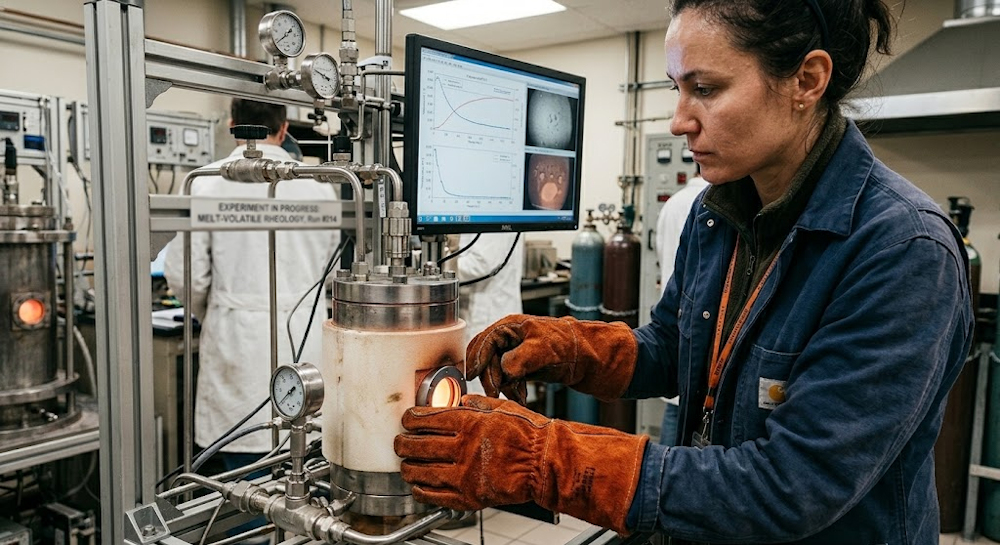
- Experimental Magma & Deformation Furnace Room: Internally heated pressure vessels and viscometry rigs hold silicate melts at magmatic temperatures and controlled volatile loads, measuring crystallization, bubble growth, fragmentation thresholds, and the rheology governing whether a conduit erupts explosively or oozes.
Volcanology has quietly stopped being a science of aftermath. For most of its history the discipline worked backward from deposits — measuring a stratigraphy, dating a flow, estimating a magnitude — and only rarely got to say anything useful before a mountain opened up. Analex Laboratories, a consortium of volcanologists, geophysicists, petrologists, and fluid dynamicists, has built its program around inverting that order. The aim is anticipation: reading the state of a magmatic system in real time and converting that state into a probabilistic forecast of what happens next, on what timescale, and with what intensity. Analex treats a volcano less as a landform than as a plumbing network under load, and every instrument, experiment, and model in its portfolio serves the same goal of resolving that network before it fails.
Surveillance is where the consortium's footprint is largest. Analex designs and deploys multiparametric observatory stacks — broadband and infrasound sensors, tiltmeters and strainmeters, GNSS receivers, UV and FTIR spectrometers measuring sulfur dioxide emission rates, and repeat satellite interferometry for ground inflation. Unoccupied aircraft fly direct sampling missions through plumes, snatching gas and aerosol for isotopic and trace-species analysis at concentrations no ground station can reach, while thermal and radar satellite feeds are fused into automated deformation and thermal-anomaly alerts. The distinguishing feature of the group's monitoring philosophy is calibration: every geophysical signal is paired with a physical explanation from petrology or mechanics, so that a change in seismic character or gas ratio is anchored to a concrete process rather than a statistical pattern.
That anchoring comes from the laboratory and the microscope. Analex's petrology teams reconstruct transcrustal magmatic systems by interrogating the crystal cargo of erupted products — melt inclusions, embayments, and zoning profiles read as records of storage depth, temperature, and volatile content. Diffusion chronometry applied to iron-magnesium and trace-element gradients gives the elapsed time between a recharge event and an eruption, frequently a matter of days to months, which is precisely the window that forecasting needs. Alongside this, the consortium runs high-temperature, high-pressure apparatuses to measure crystallization kinetics, bubble nucleation, and melt viscosity under realistic volatile loads, and couples them to decompression experiments that simulate ascent until fragmentation.
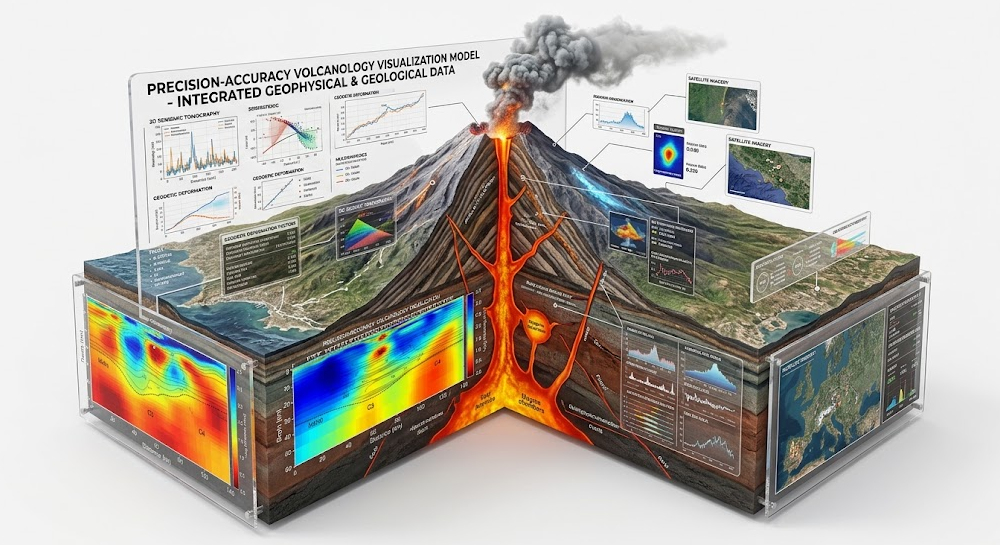
From there, Analex tackles eruption dynamics as a fluids problem. Conduit models resolve the coupled behavior of magma, exsolved gas, and entrained wallrock through the fragmentation front, while plume and umbrella-cloud codes track ash dispersal, particle settling, and atmospheric injection heights. Pyroclastic density current transport, lahar initiation, and lava emplacement are each handled with dedicated numerical and scaled analog experiments, validated against well-documented historical events. A persistent theme is nonlinearity: how small shifts in volatile content or conduit geometry tip a system from effusive to explosive, and where thresholds sit.
The payoff is operational. Analex supplies hazard zonation, evacuation-trigger thresholds, and aviation ash advisories to partner agencies, and its forecasting group has folded machine learning into eruption-onset detection, training classifiers on multiparametric streams from instrumented volcanoes worldwide. The same petrological tools underpin geothermal exploration and the volcanic-hosted ore systems that supply much of the world's copper and gold. Off Earth, consortium scientists interpret Io's sulfur volcanism, Venusian shield fields, Martian outflow and edifice collapse, and the cryovolcanic plumes of Enceladus as tests of how eruption physics behaves under foreign gravity and composition. Analex's bet is that volcanology's next milestone is not a better description of an eruption but a credible countdown to one.